
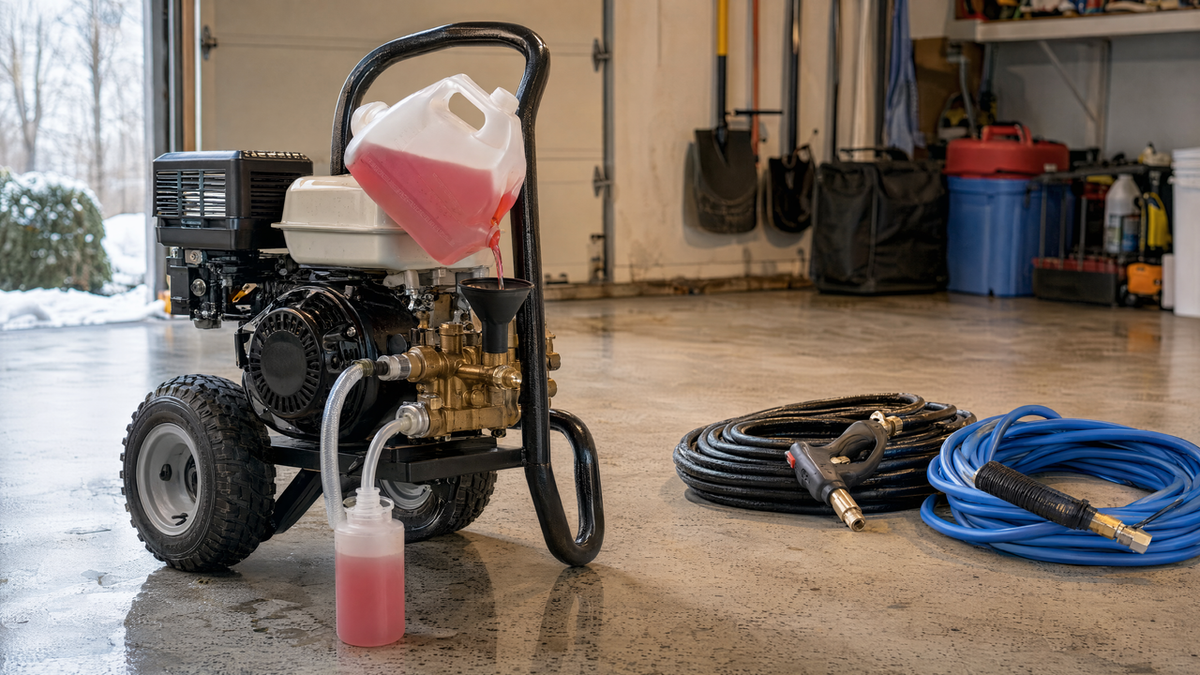
A pressure washer that ran perfectly in October and won't build pressure in April almost always has the same story: a little water was left in the pump, it froze, and the ice cracked the pump housing. It is the most common way these machines die, and it is avoidable in about twenty minutes. Here is how to winterize a pressure washer, gas or electric.
Why Winterizing Matters (Even in a Garage)
Water expands about 9% when it freezes. Inside a pump there is nowhere for that expansion to go, so it pushes against aluminum, brass, and ceramic pistons. One hard freeze is enough, and an unheated garage dips below 32°F on plenty of nights across most of the country.
Cold is not the only issue. Detergent left in the injector dries into a crust, residual water corrodes internal parts, and on gas models untreated fuel starts to varnish the carburetor after about a month. Winterizing handles all of it at once.
When to Do It
Finish before your first hard freeze: late September through October for most of the US, earlier in the upper Midwest and mountain states. If you keep washing into fall, do the full routine after the last job of the season and at least purge the pump after any cold-weather use.
Step 1: Flush the Detergent System
Pull the siphon tube out of the soap bottle and drop it into a bucket of clean water. Attach the black low-pressure soap nozzle, start the washer, and spray for one to two minutes until the water runs clear. This clears the chemical injector so it does not gum up over winter.
Step 2: Shut Down and Release Pressure
Turn off the machine, shut off the water at the spigot, then squeeze the trigger until water stops flowing. Now disconnect the garden hose from the inlet, the high-pressure hose from the outlet, and the gun and wand from the hose.
Step 3: Purge Water From the Pump
This is the step people skip, and the one that matters most.
Gas pressure washers
With the engine switch off and the spark plug wire disconnected, pull the starter cord slowly three to five times. Each pull cycles the pump and pushes water out of the outlet. Keep going until nothing more comes out.
Electric pressure washers
Pumps are not designed to run dry, so keep this brief. With inlet and outlet open, switch the unit on for two to three seconds, then off. Repeat two or three times, tilting the machine toward the outlet between cycles.
Step 4: Add Pump Saver
Purging removes most of the water, not all of it. Pump saver (a small pressurized can from any hardware store) is a lubricating antifreeze made for pressure washer pumps. Screw it onto the garden-hose inlet and press until foam appears at the high-pressure outlet. That tells you it has displaced the last of the water and coated the pistons and seals, which is why many manufacturers recommend it even for storage that never freezes.
No pump saver on hand? Non-toxic pink RV antifreeze works. Pour a few ounces into a short length of garden hose held above the inlet and cycle the pump as in Step 3 until pink comes out the outlet. Do not use automotive antifreeze; it is toxic and hard on seals.
Step 5: Deal With the Fuel (Gas Only)
Either run the tank dry, or add fuel stabilizer at the ratio on the bottle and run the engine two to three minutes so treated fuel reaches the carburetor. If an oil change is due, do it now; used oil holds moisture and acids that sit on internal parts all winter.
Step 6: Drain, Inspect, and Store Hoses and Fittings
Water in a high-pressure hose freezes just like water in the pump, and a hose coiled tight while cold cracks at the bends.
- High-pressure hose: Hold one end up and walk it out to drain, then coil it in loose loops and hang it rather than laying it on concrete. Check the full length for bulges, cuts, or exposed wire braid. If you find any, replace it now rather than discovering the problem at 4,000 PSI in April. A 25-foot steel-braided hose with 3/8" quick connects is a small insurance policy.
- Quick-connect O-rings: Pull back the collar on each coupler and look at the O-ring inside. If it is flattened, cracked, or chipped, swap it. These rings are the usual cause of drips at the connection, and a 40-pack of 1/4" and 3/8" pressure washer O-rings covers every coupler on the machine for years. A dab of silicone grease keeps the new ring pliable through the cold.
- Nozzle tips: Rinse, clear debris with the needle tool, and store them in the onboard holder.
- Gun and wand: Drain and store with the trigger unlocked so the valve spring is not compressed all winter.
Don't forget the garden hose that feeds the washer. Disconnect it from the spigot, drain it completely, and coil it in the garage. If your outdoor faucet is not frost-proof, shut the interior valve and open the spigot to drain it. Our guide to winterizing outdoor faucets and garden hoses covers that in detail, and replacement washers, shut-off valves, and quick connectors are in our garden watering and hose fittings collection.
Step 7: Store It Right
Store the washer upright in a dry spot, ideally above freezing. If an unheated shed is the only option, the pump saver in Step 4 is doing the heavy lifting, so do not skip it. Cover it to keep dust off the pump seals. Electric models belong indoors; the motor and switch do not like months of damp cold, and a tightly coiled cord stiffens and cracks in freezing temperatures.
Spring Restart Checklist
- Reconnect the garden hose, turn on the water, and hold the trigger open with no nozzle installed for 30 to 60 seconds to flush out the pump saver.
- Reattach the high-pressure hose, gun, and wand. Check every coupler for drips and replace any O-rings you missed.
- Gas models: check the oil, confirm fresh or stabilized fuel, reconnect the spark plug wire, and start it.
- Run a low-pressure nozzle for a minute before switching to a higher-pressure tip.
If a connection still drips, our guide to finding and fixing pressure washer leaks walks through the usual culprits.
Mistakes That Undo All Your Work
- Leaving the high-pressure hose attached and pressurized, which stresses seals and traps water in the pump.
- Skipping the detergent flush. Dried soap in the injector is why so many washers "won't pull soap" the next year.
- Using automotive antifreeze instead of pump saver or RV antifreeze.
- Storing a gas washer with untreated fuel for more than 30 days.
- Coiling hoses tightly or leaving them on a cold concrete floor.
Get Ready for Winter in One Trip
Pump saver and fuel stabilizer come from the hardware store, but the wear parts you are likely to find during inspection, from O-rings and quick connectors to adapters and replacement hoses, are all in our Pressure Washer Parts & Accessories collection. Restock now and your washer will be ready the first warm weekend of spring instead of sitting at the repair shop.