
Solar garden lights are simple: a small panel charges a battery all day, and a light sensor turns the LED on at dusk. When they stop working, it's almost always one of a handful of causes, and most can be fixed in five minutes with no tools. Early fall is when a lot of solar lights seem to "die" all at once. Shorter days and lower sun angles cut the charge, and a battery that was borderline in July finally gives up in September. Work through these fixes in order before you spend money on new ones.
1. Check the pull tab or on/off switch
It sounds obvious, but brand-new lights ship with a plastic tab between the battery and the contact, and it's easy to miss. Many lights also have a small on/off switch under the cap that gets bumped during installation. Check both first.
2. Clean the solar panel
A panel covered in pollen, dust, bird droppings, or a film of hard water will charge at a fraction of its rating. Wipe it with a damp cloth and a drop of dish soap, then dry it. If the plastic has gone cloudy or yellow from UV exposure, a thin coat of clear nail polish or a plastic headlight restorer can bring back some transparency.
3. Give it a full-sun reset
If a light has been in the shade for weeks, its battery may be deeply discharged. Switch it off, put it in direct sun for two full days, then switch it on at dusk. This alone revives a surprising number of lights.
4. Replace the rechargeable battery
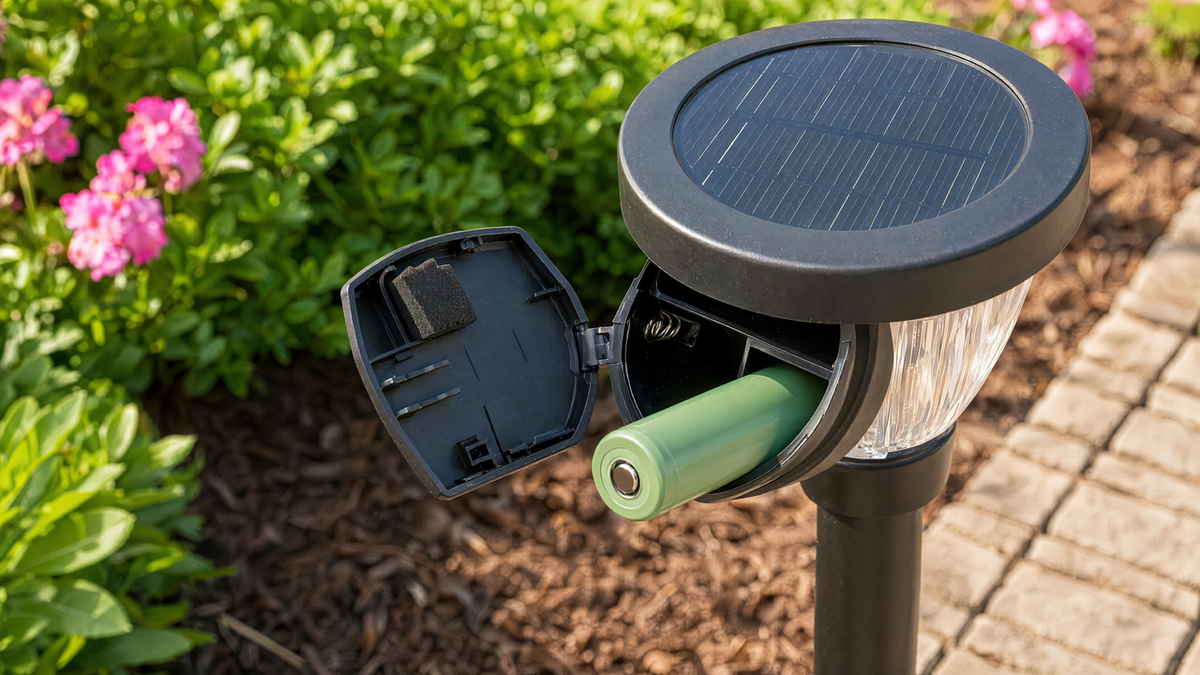
This is the most common real failure. The NiMH or Li-ion cells in solar lights last one to three years, and when they go, the light either won't turn on or only stays on for a few minutes. Open the cap, note the battery type and size (usually AA or AAA NiMH, 600 to 1200 mAh), and replace it with the same type. Don't use a regular alkaline battery; it won't recharge and can leak.
If you have a set of a dozen path lights and a few are dim while others are bright, swap batteries between a working and non-working light. If the problem moves with the battery, you've found it.
5. Move it out of the shade
Solar lights need six or more hours of direct sun to run all night. A spot that was sunny in June can be shaded by September as the sun sits lower and trees fill in. Relocate the light to a south-facing spot, or if the light has a separate panel on a cable, stake the panel in the sun even if the light itself is in shade. Our solar light placement guide covers spacing and sun exposure in more detail.
6. Test the light sensor
The sensor tells the light it's dark. If a nearby porch light, streetlight, or landscape spotlight shines on it, the sensor thinks it's still daytime and the light never comes on. Test by covering the panel completely with your hand at dusk: if the LED turns on, the sensor works and the fix is moving the light away from the other light source.
7. Look for water inside
Condensation or a few drops of water under the lens usually means a failed seal. Open the light, let it dry indoors for a day, and reassemble with a thin bead of clear silicone around the seam. If the circuit board shows green or white corrosion, the light is probably done.
8. Check the wiring on string and lantern sets
On solar string lights and hanging lanterns, the panel and the lights are connected by a cable. Look for a crushed, chewed, or kinked section, especially where the cable enters the panel housing. A single break anywhere kills the whole set.
Why solar lights struggle in fall and winter
Even healthy solar lights run shorter in the cold months. Day length drops, the sun's angle is lower so the panel collects less energy, and cold reduces battery capacity. A light that ran ten hours in July might run four in December. That's normal. If you need reliable all-night light on a walkway through winter, add more units so they overlap, or mix in a low-voltage or plug-in option along with your solar set.
When to replace instead of repair
Replace the light if the panel is cracked, the housing is badly corroded, or a new battery doesn't help. Cheap sets with sealed housings usually aren't worth opening. When you do replace, look for lights with a replaceable battery, a glass or thick polycarbonate panel, and a metal or heavy plastic body that won't yellow. The 34 inch hanging solar lanterns with shepherd hooks are a good example: the panel sits on top where it gets the most sun, and the lantern hangs where the light is useful.
For accent lighting rather than path lighting, solar string lights with a separate staked panel let you put the panel in full sun and run the lights along a fence or through a tree that's in shade.
A quick fall maintenance routine
Once a season, pull each light, wipe the panel, check for water, and confirm the battery is holding a charge. It takes ten minutes for a dozen lights and roughly doubles their useful life. Do it in September before the days get short and again in March.
Need a few replacements?
If some lights are truly past saving, the outdoor and solar lights collection has path lights, lanterns, and solar string lights that all use standard replaceable batteries. Pair them with lights from the string lights collection to fill in shaded spots that solar can't reach.