
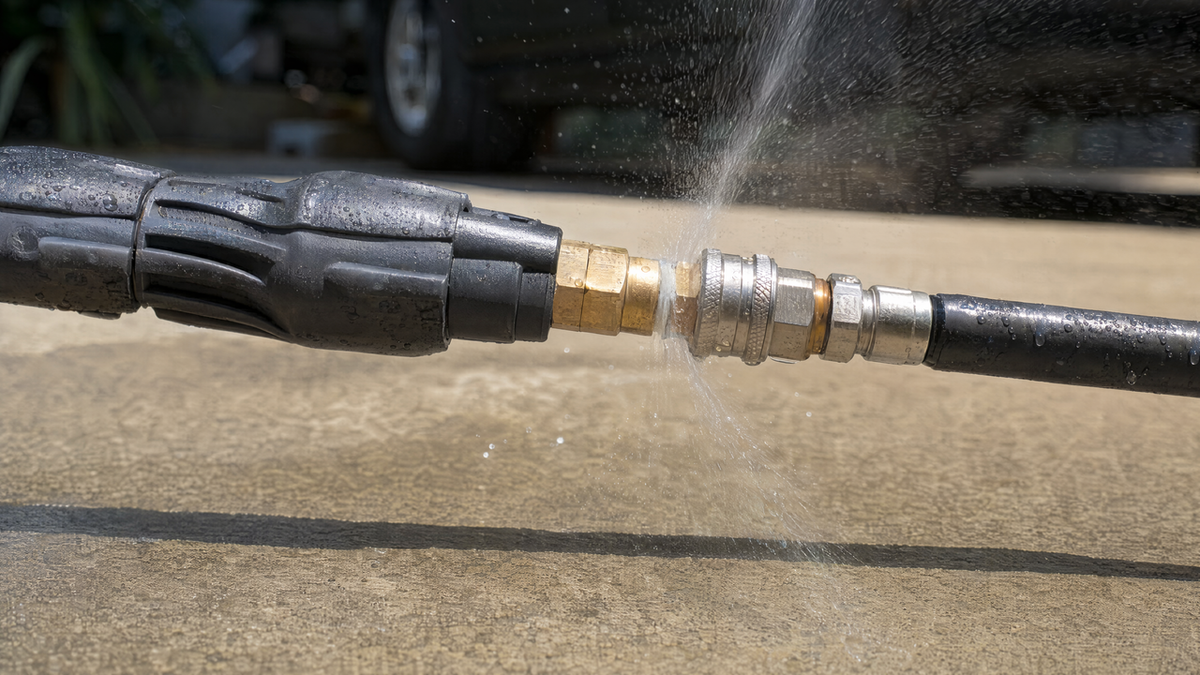
A pressure washer leak rarely announces itself. You notice a fine mist coming off a joint, or a puddle under the machine that wasn't there last time, or that the spray just doesn't have the bite it used to. It's tempting to ignore it — the machine still works.
It's worth ten minutes, though. Every drop escaping at a fitting is pressure not reaching the surface you're cleaning, and a leak at a coupler tends to get worse quickly because the escaping water erodes the sealing surface. The good news is that the overwhelming majority of these leaks come down to parts that cost a few dollars.
First, find out where it's actually leaking
Water travels along hoses and fittings, so the puddle is often nowhere near the source.
- Dry everything. Wipe every connection with a rag until the machine is dry to the touch.
- Run water without the engine or motor. Connect the garden hose, open the tap, and squeeze the trigger to purge air. Watch for drips. This finds low-pressure inlet-side leaks.
- Start the machine and hold the trigger. Look again — now with the system under full pressure. High-pressure leaks show as a fine spray rather than a drip.
- Note whether the leak stops when you release the trigger. If it does, the leak is downstream of the unloader valve. If it continues, it's on the pump or inlet side.
Do this before ordering any parts. It usually takes two minutes and saves you from replacing the wrong thing.
The four leaks you'll almost certainly find
1. A worn O-ring in a quick-connect coupler
This is the most common pressure washer leak by a wide margin. The small rubber O-ring inside each 1/4-inch and 3/8-inch quick connect takes a beating — it's compressed and released every time you swap a nozzle, and it dries out, flattens, or tears.
The symptom: water spraying sideways out of the coupler collar under pressure, or a nozzle that won't hold pressure.
The fix: pull the old O-ring out with a pick or a fingernail, seat a new one, and reconnect. It takes thirty seconds. Because these are consumables, most people keep an assortment pack of quick-connect O-rings in the toolbox rather than ordering one at a time.
While you're there, check the O-ring on the wand end and at the hose-to-gun connection too. They wear at the same rate.
2. A mismatched or worn M22 connection
M22 is the standard thread at the pump outlet and the gun inlet on most consumer machines — but it comes in two sizes. M22-14mm and M22-15mm refer to the inner diameter of the fitting, and they look almost identical. Thread a 15mm hose onto a 14mm outlet and it will start, feel snug, and leak steadily.
The symptom: a persistent drip at the pump outlet that no amount of tightening fixes.
The fix: confirm which size your pump uses, then use the matching fitting. An M22 swivel to 3/8-inch quick connect adapter set solves this permanently by converting both ends of the high-pressure hose to standard quick connects — after which nothing threads and nothing cross-threads. It also means you can swap hoses without a wrench.
3. A pinhole or cracked jacket in the high-pressure hose
Hoses fail from being driven over, kinked at the reel, or dragged around a sharp corner. Once the outer jacket is cut, the steel braid underneath corrodes and the hose is on borrowed time.
The symptom: a needle-thin jet of water from the middle of the hose, or a soft bulge.
The fix: replace it, and don't wait. A hose that's bulging is a burst waiting to happen at 3,000 PSI. Patching high-pressure hose isn't a real option. Pick a replacement rated above your machine's output — a 4000 PSI wire-braided hose gives you margin on a typical 2,000–3,000 PSI unit.
4. A leaking garden hose inlet
The inlet side runs at house pressure, so leaks here drip rather than spray, and they're easy to dismiss. But a loose inlet also draws air, which makes the pump pulse and lose pressure.
The fix: check the rubber washer in the inlet fitting and replace it if it's flattened. Check the inlet screen while you're in there — a clogged screen starves the pump and mimics a pressure loss. Replacement washers, screens and connectors are in Garden Watering & Hose Fittings.
Two habits that prevent most of this
Never store the machine with water in it over winter. Freezing water in the pump cracks housings and destroys seals, and it's the single most expensive pressure washer mistake. Run pump antifreeze through the system, or at minimum disconnect everything, squeeze the trigger to release pressure, and store it somewhere above freezing.
Release pressure before disconnecting anything. Shut the machine off, close the tap, then squeeze the trigger until the flow stops. Pulling a quick connect apart while the line is still charged is how O-rings get torn in the first place.
A ten-minute annual check
- Inspect every O-ring; replace anything flat, cracked or missing.
- Run the hose through your hands looking for cuts, bulges and kinks.
- Clean the inlet screen.
- Check that quick connects click and lock firmly rather than sliding.
- Look for oil under the pump — that one isn't a fitting problem and needs a service.
Fixing your leak
Start with the O-rings — they're the cause far more often than not, and the fix costs less than a coffee. If the leak survives that, work up through the M22 connections and the hose itself. Find replacement O-rings, adapters, couplers and hoses in Pressure Washer Parts & Accessories.