
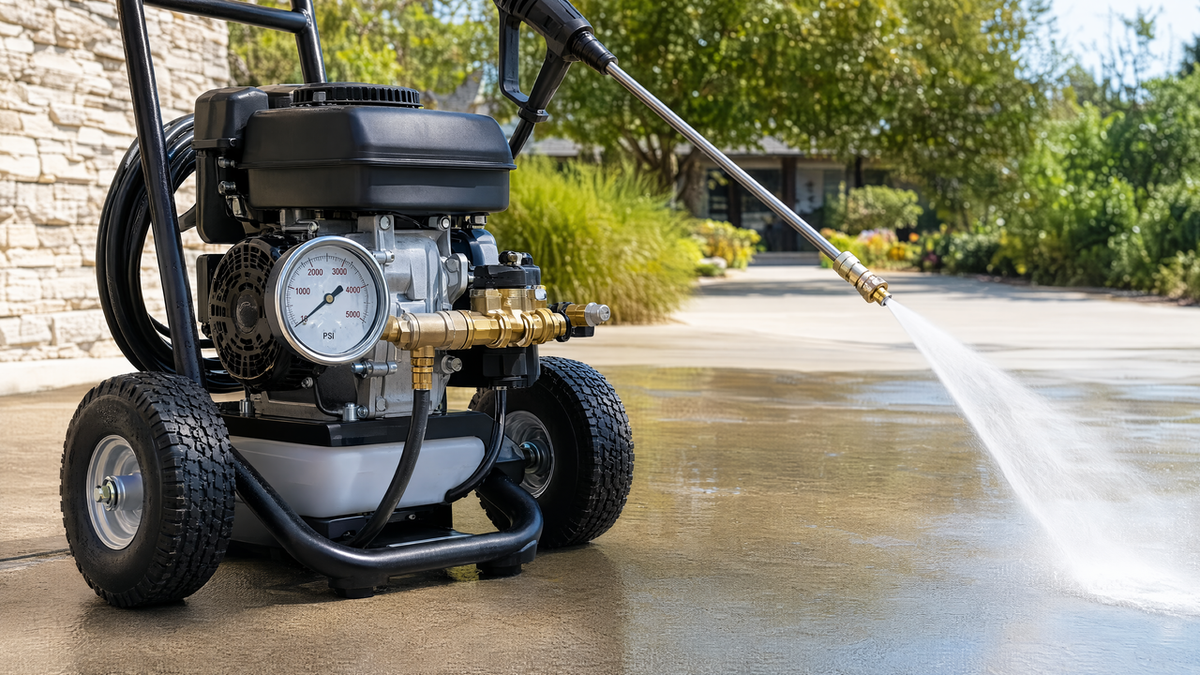
Pressure washer listings lead with one number: PSI. But the right PSI depends entirely on what you're cleaning, and using too much is how people etch concrete, fuzz up a wood deck, or strip paint off a car. This guide gives you a realistic PSI range for each common job, explains why GPM matters as much as PSI, and tells you which nozzle to pair with each setting so you get the result without the damage.
PSI vs. GPM: the two numbers that matter
PSI (pounds per square inch) is how hard the water hits. It's what breaks the bond between grime and the surface.
GPM (gallons per minute) is how much water flows. It's what carries the loosened dirt away. A higher GPM machine cleans faster at the same PSI because it rinses as it goes.
Multiply the two and you get "cleaning units," a rough measure of total cleaning power. A 2000 PSI, 1.4 GPM electric washer (2800 CU) and a 2800 PSI, 2.3 GPM gas washer (6440 CU) can both handle a driveway, but the gas unit will do it in less than half the time.
PSI guide by job
Cars, trucks and boats: 1200 to 1900 PSI
Automotive paint and clear coat are tougher than people think, but the trim, decals, and rubber seals aren't. Stay under 1900 PSI, use the 40 degree (white) nozzle or a foam cannon, and keep the tip at least 18 inches from the surface. Never use the 0 or 15 degree tips on a vehicle.
Patio furniture, grills and outdoor cushions: 1300 to 1800 PSI
Plastic and resin furniture cleans easily at low pressure. Powder-coated metal is fine up to about 1800 PSI. For cushions, use the lowest pressure and the widest tip, and let them dry fully in the sun.
Wood decks and fences: 500 to 1200 PSI
This is the job that gets ruined most often. Softwoods like cedar and pine will fuzz and splinter above about 1200 PSI. Use the 40 degree tip, keep a consistent 12 inches off the surface, and move with the grain in long, overlapping strokes. Composite decking can handle a bit more, but check the manufacturer's guidance first. We covered technique in detail in how to pressure wash a deck before staining.
Vinyl and aluminum siding: 1300 to 1600 PSI
Siding needs moderate pressure and a lot of caution about spray angle. Always spray downward or straight on; spraying upward forces water behind the panels. Use the 25 degree (green) tip for grime and the 40 degree tip for rinsing.
Brick and stucco: 1500 to 2000 PSI
Masonry is tougher, but old mortar and painted stucco can crumble. Test in a hidden spot first. Use the 25 degree tip and work from the bottom up when applying detergent, then rinse from the top down.
Concrete driveways, sidewalks and garage floors: 2500 to 3000 PSI
Concrete is where higher PSI earns its keep. Oil stains, tire marks, and years of embedded dirt need 2500 PSI or more to lift. A surface cleaner attachment makes this dramatically faster and eliminates the stripe marks a wand leaves. Use the 15 degree (yellow) tip for stubborn spots and the 25 degree tip for general cleaning.
Paint stripping and heavy prep: 3000+ PSI
Removing loose paint from concrete or steel takes 3000 PSI and up, usually with a 15 degree tip or a turbo nozzle. This is the one job that needs a gas washer.
Quick reference chart
| Surface | PSI range | Nozzle |
|---|---|---|
| Cars, boats | 1200 to 1900 | 40 degree (white) |
| Patio furniture | 1300 to 1800 | 40 degree (white) |
| Wood deck, fence | 500 to 1200 | 40 degree (white) |
| Vinyl siding | 1300 to 1600 | 25 degree (green) |
| Brick, stucco | 1500 to 2000 | 25 degree (green) |
| Concrete driveway | 2500 to 3000 | 15 or 25 degree |
| Paint stripping | 3000+ | 15 degree or turbo |
The nozzle changes everything
PSI on the box is the maximum with the narrowest tip. Every wider tip reduces effective pressure at the surface. A 3000 PSI machine with a 40 degree tip at 18 inches delivers something closer to 1000 PSI on the surface, which is why the same machine can safely clean a car and a driveway. If your washer came with only one or two tips, a full five-tip pressure washer nozzle set (0, 15, 25, 40 degree plus soap) is the cheapest upgrade you can make. For a full breakdown of what each color does, see our nozzle colors guide.
Do you need a gas or electric washer?
Electric washers run 1300 to 2300 PSI and 1.2 to 1.8 GPM. They handle cars, furniture, decks, siding, and light concrete work, and they're quiet and maintenance-free. For most homeowners, a 2000 PSI electric unit is the sweet spot.
Gas washers run 2500 to 4000+ PSI and 2.3 to 4 GPM. Choose gas if you have a large driveway, heavy oil staining, a lot of concrete, or you're prepping surfaces for paint. Gas units need a hose rated for their output; a 3/8 inch wire-braided hose rated to 4000 PSI is the standard match for a residential gas machine.
Three habits that protect every surface
- Start with the widest tip and farthest distance, then step up only if it isn't cleaning.
- Test in a hidden corner before doing the whole surface.
- Keep the wand moving. Holding it in one spot is what causes gouges and stripes, regardless of PSI.
Get the right parts for your machine
The right nozzle tips, hose, and fittings matter as much as the PSI rating. Everything from replacement O-rings to quick-connect adapters is in the pressure washer parts and accessories collection, and the brass hose connectors that feed your washer are in garden watering and hose fittings.