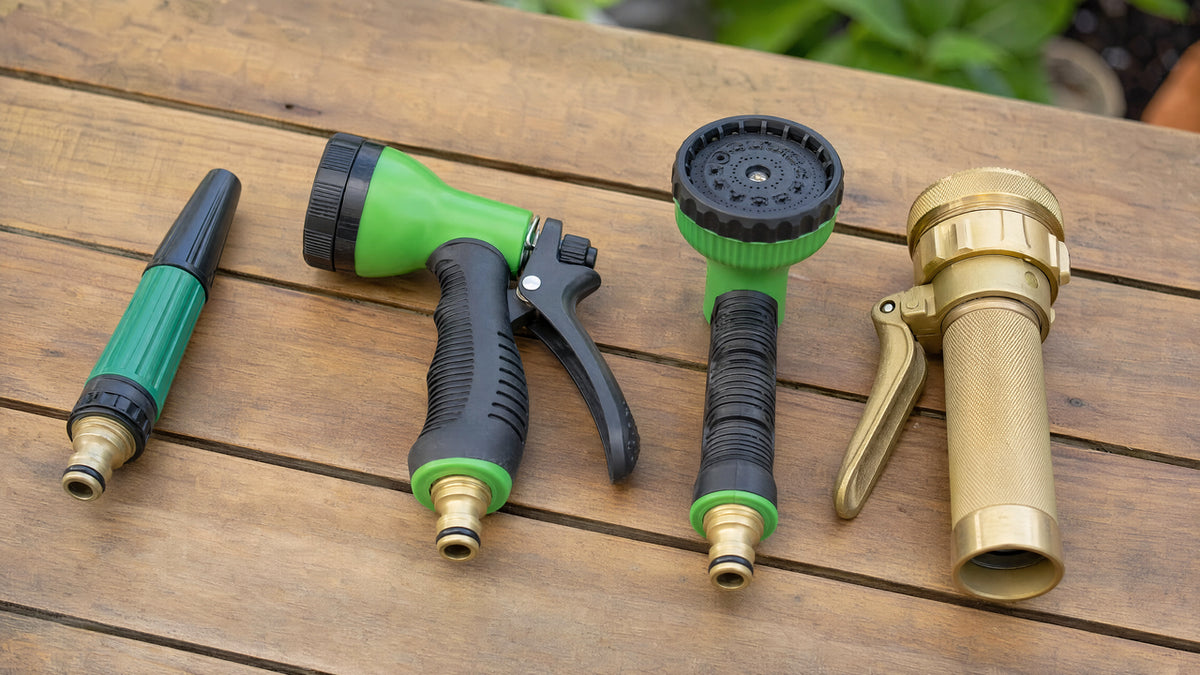
A hose nozzle is the part of your watering setup you touch every single day, yet most people grab whatever is hanging on the hook at the hardware store. The result is usually a plastic pistol grip that leaks at the trigger by August and cracks the first cold night of fall. This guide compares the four main nozzle styles, explains what each does well, and shows you what to look for so the next one you buy lasts for years.
The four nozzle styles
Twist (adjustable jet) nozzles
A twist nozzle is a short brass cylinder you rotate to go from a wide cone to a tight, powerful jet. There is no trigger and nothing to squeeze, which makes it the most durable design and the most comfortable for long watering sessions. Twist it closed and it shuts off completely.
Best for: general garden watering, rinsing patios and driveways, washing cars, and anyone who hates trigger fatigue. A solid brass adjustable twist nozzle is the workhorse option, and a two-pack means one for the front spigot and one for the back.
Pistol grip nozzles
The familiar squeeze-trigger design. Pressure is controlled by how hard you squeeze, so it's convenient for quick on/off tasks like rinsing hands, filling a bucket, or spraying a dog. The trade-off is the trigger mechanism: plastic versions wear out, and even good ones tire your hand after ten minutes.
Best for: short, frequent tasks. Look for a metal body and a trigger lock if you'll use it for longer watering.
Fan (shower/wand) nozzles
Fan nozzles spread water into a wide, gentle sheet or a shower pattern. They're often on the end of a long wand so you can reach hanging baskets and the back of a bed without stepping in the soil.
Best for: seedlings, delicate flowers, hanging planters, and raised beds. Not useful for cleaning.
Fireman (dial) nozzles
A fireman nozzle has a lever or dial that opens a full-flow stream. It moves a lot of water fast, which is great for filling a pool, washing off a boat, or blasting mud off equipment, but it's too much force for plants.
Best for: high-volume jobs where flow matters more than control.
Material: why brass wins
Nozzle bodies come in plastic, aluminum, zinc alloy, and solid brass.
- Plastic is cheap and light, but UV exposure makes it brittle and the threads strip easily. Expect one or two seasons.
- Aluminum is light and doesn't rust, but the threads gall (seize) against brass hose fittings and it dents.
- Zinc alloy looks like brass and is often labeled "metal," but it's softer and can corrode from the inside out.
- Solid brass doesn't rust, doesn't get brittle in the sun, and its threads survive being cross-threaded and overtightened. A brass nozzle from a decade ago usually still works.
If a listing says "metal" without saying "brass," assume it's zinc. We compared materials in depth in brass vs. plastic garden hose fittings.
Features worth paying for
Built-in shut-off valve
A nozzle with its own shut-off lets you stop the water at the hose end instead of walking back to the spigot. On a twist nozzle, this is usually a small ball valve behind the tip. The brass twist nozzle with on/off valve combines both, so you can set the spray pattern once and just flip the lever to stop.
O-ring seals front and back
Leaks at the hose connection are almost always a missing or flattened washer. Good nozzles ship with a rubber washer and have an O-ring inside the twist mechanism. Keep a few spare 3/4 inch hose washers on hand; they cost almost nothing and fix most drips.
Standard 3/4 inch GHT threads
Every garden hose in the US uses 3/4 inch Garden Hose Thread. Make sure the nozzle says GHT or 3/4 inch; some imported nozzles use metric threads that seem to fit but leak.
Quick connect compatibility
If you swap between a nozzle, a sprinkler, and a wand, a quick-connect set on the hose end lets you change attachments in a second. Nozzles with standard GHT threads work with any quick-connect system.
Matching the nozzle to your water pressure
Nozzles don't create pressure; they shape whatever your spigot delivers. If your spray feels weak, the nozzle is rarely the cause. A kinked hose, a half-open spigot, a clogged inline filter, or a long, narrow hose are the usual suspects. Our guide to low water pressure from a garden hose walks through each one.
Simple maintenance
- Rinse the tip after use if you water with fertilizer or from a pond.
- Replace the washer once a season.
- Bring brass nozzles inside for winter. They won't crack like plastic, but trapped water can freeze and push out the O-rings.
- If the twist action gets stiff, a drop of silicone grease on the threads fixes it.
Our recommendation
For most homeowners, a solid brass twist nozzle with a shut-off valve covers watering, rinsing, and washing without any moving parts to fail. Add a fan wand if you grow seedlings or hanging baskets. Skip plastic entirely.
Find a nozzle that lasts
Every nozzle, splitter, and connector in our garden watering and hose fittings collection is solid brass with standard 3/4 inch threads, and the most popular ones are in best sellers.