
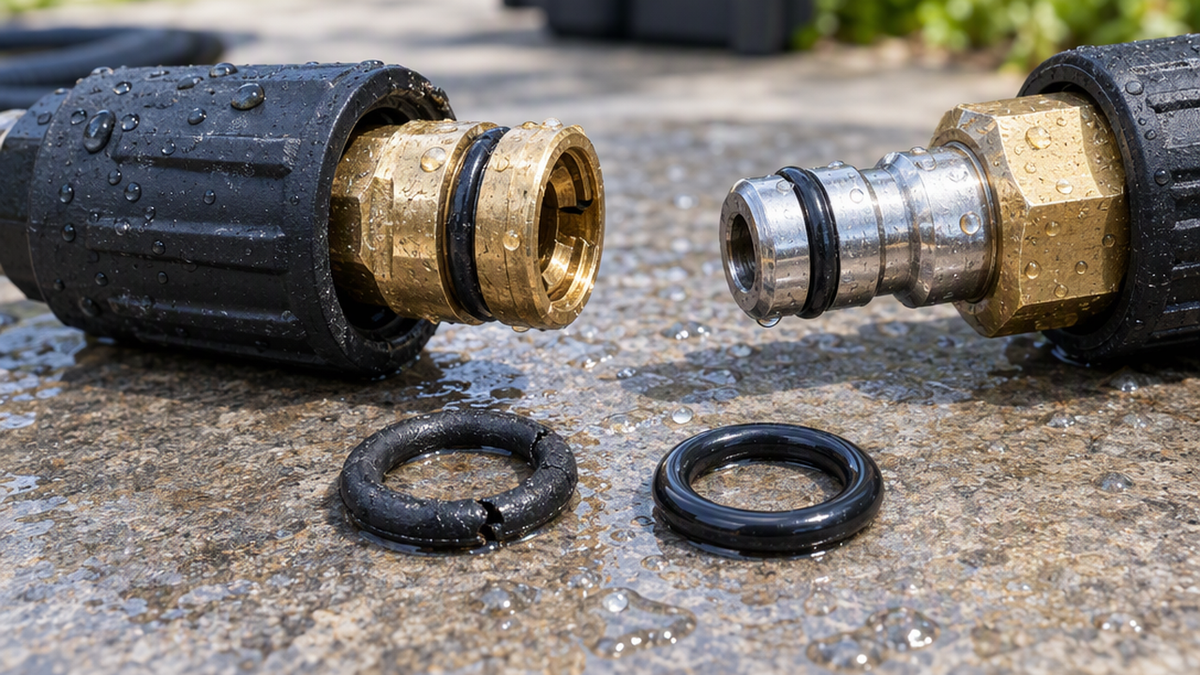
A thin spray of water from the connection between your pressure washer hose and wand is one of the most common annoyances in pressure washing. It wastes water, soaks your shoes and, worse, can reduce the pressure that reaches the surface. The good news is that the culprit is almost always a small rubber ring that costs a few dollars.
This guide shows you how to find the leak, replace the O-ring and keep quick connect fittings sealed for the long term.
How Quick Connect Couplers Work
Most pressure washers use quick connect couplers: a female socket on one part and a male plug on the other. When you push the plug into the socket, a spring-loaded collar locks it in place. Inside the connection, a small rubber O-ring forms the seal that keeps high-pressure water from escaping.
Over time that O-ring takes a lot of abuse. It is squeezed, stretched and exposed to pressure, sun and cleaning chemicals. Eventually it flattens, cracks or goes brittle, and water finds a way around it.
Signs the O-Ring Is the Problem
- Water drips or sprays from where two fittings join.
- The leak gets worse when you squeeze the trigger and pressure builds.
- The coupler seems loose or wobbles.
- You can see cracks, flat spots or missing pieces on the ring when you pull the fitting apart.
If your machine also seems weak, not just leaky, take a look at our guide to fixing a pressure washer that is losing pressure.
What You Need
- A replacement O-ring set in the right size. Our pressure washer O-rings 40 pack includes 20 pieces for 1/4 inch quick connect couplers and 20 pieces for 3/8 inch quick connect fittings.
- A small flat screwdriver or O-ring pick
- A clean cloth
- A little silicone or O-ring grease, if you have it
Step-by-Step: Replacing a Quick Connect O-Ring
- Turn everything off. Switch off the pressure washer, turn off the water supply and squeeze the trigger to release stored pressure.
- Disconnect the fitting. Pull back the collar on the coupler and separate the parts.
- Inspect the old ring. Look at the O-ring on the male plug, and check inside the female socket. Note whether it is cracked, flat or stretched.
- Remove the O-ring. Gently lift it out with a pick or small screwdriver. Be careful not to scratch the metal groove, because scratches can cause new leaks.
- Clean the groove. Wipe out grit or debris with a clean cloth.
- Match the size. Compare the new ring with the old one. A ring that is too big will bulge, and one that is too small will not seal.
- Lubricate lightly. A thin film of silicone grease helps the ring seat smoothly and last longer.
- Install the new ring. Roll it into the groove without twisting it.
- Reconnect and test. Push the fitting together, turn on the water first, then the machine, and check for drips.
When the Fitting Itself Is Worn
A new O-ring will not fix a coupler that is bent, corroded or has a damaged collar. If the leak persists after replacing the ring, or if the fitting is stiff or fails to lock, replace the coupler. A full set of adapters can also be handy if you are mixing hoses and accessories with different thread types. Our pressure washer adapter set includes M22 14mm quick connect swivels, 3/8 inch quick connect fittings and 3/4 inch female to 1/2 inch quick release pieces, so you can match the connections on your machine.
Browse our full range in the pressure washer parts and accessories collection.
Preventing Future Leaks
- Keep fittings clean. Dirt and sand grind away at O-rings. Rinse couplers after use.
- Do not twist the hose under pressure. Use swivel fittings to reduce stress at the connection.
- Store out of the sun. UV light makes rubber brittle.
- Relieve pressure before disconnecting. Disconnecting under pressure is hard on seals and can be unsafe.
- Keep spares. A bag of O-rings in the toolbox saves a trip to the store mid-project.
- Check chemicals. Some cleaners can degrade rubber. Rinse with clean water after using detergent.
Safety Reminders
Pressure washers generate enough force to injure skin, so never test a leak with your hand and never point the wand at yourself or others. Always release the pressure before touching fittings. Wear closed shoes and eye protection when working around the machine.
Related Reading
If you are setting up for a big cleaning day, our guide to pressure washer nozzle colors will help you pick the right tip, and our walkthrough on pressure washing a concrete driveway shows how to put it all into practice.
Final Thoughts
Before you assume a leaking pressure washer is beyond saving, check the humble O-ring. A few minutes and a few cents of rubber can bring a dripping connection back to a tight, reliable seal and protect the pressure you paid for.
Need parts for your pressure washer? Shop our Pressure Washer Parts & Accessories and get back to work.