
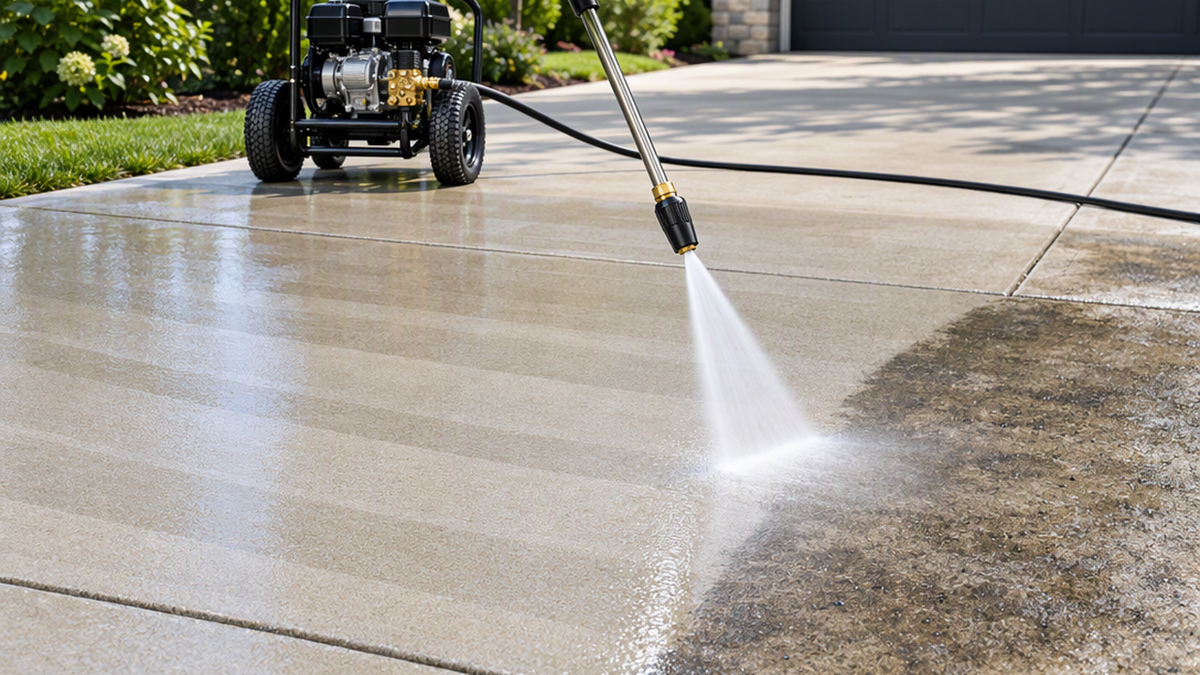
A concrete driveway is one of the most satisfying things to pressure wash — right up until you step back and notice a faint pattern of lighter and darker stripes across it. That "zebra stripe" effect isn't a sign you need a stronger machine; it's almost always a technique problem, and it's one of the easiest pressure washing mistakes to fix once you know what's causing it.
Why Driveways Streak
Concrete is porous, and pressure washing lifts dirt unevenly if your passes don't overlap consistently or if you linger too long in one spot. The result is stripes: a clean band where the spray dwelled longest next to a duller band where it moved past too quickly. Inconsistent nozzle angle and distance from the surface make it worse, since even small changes shift how much cleaning power actually reaches the concrete.
What You'll Need
A pressure washer with enough hose to cover the full driveway without repositioning constantly, a nozzle tip suited to concrete, and a driveway-safe detergent for any oil or tire marks. A 25ft pressure washer hose gives you enough reach to work a two-car driveway from one or two outlet positions instead of dragging the whole unit around.
Step-by-Step: Pressure Washing a Concrete Driveway
1. Clear and pre-treat the surface
Sweep off loose debris, leaves, and gravel first — pressure washing over debris just sends it flying and can pit the concrete. If you have visible oil spots or tire marks, apply a concrete degreaser and let it sit for the time on the label (usually 10 to 15 minutes) before you start washing, so the pressure washer is lifting already-loosened residue rather than fighting a fresh stain from scratch.
2. Choose the right nozzle for concrete
A 15-degree (yellow) or 25-degree (green) tip is the sweet spot for driveways — narrow enough to actually clean, wide enough not to etch or gouge the surface. Save the 0-degree (red) pinpoint tip for stubborn individual stains only, and never hold it in one place for more than a second or two. A full set of nozzle tips at different angles makes it easy to switch between broad cleaning and spot-treating a stain without swapping equipment.
3. Work in slow, overlapping passes
This is the single biggest fix for the striping problem. Move in straight, slightly overlapping passes — each pass covering roughly a third of the previous one — at a steady walking pace. Resist the urge to speed up on the "easy" stretches and slow down on stains; consistent speed is what keeps the finish even across the whole surface.
4. Keep distance and angle consistent
Hold the wand at roughly the same distance from the concrete (about 8 to 12 inches for most nozzle tips) and the same angle throughout. Letting the tip drift closer in some spots and farther in others changes the cleaning intensity pass to pass, which is exactly what creates uneven bands even when your overlap technique is otherwise solid.
5. Rinse and let it dry fully
Finish with a final rinse pass over the whole area to clear any loosened dirt or detergent residue, then let the driveway air dry completely before parking on it or judging the result — concrete often looks patchy while wet and evens out considerably once fully dry.
Dealing with Oil Stains and Tire Marks
Fresh oil spots respond well to degreaser and a 0-degree tip used briefly and carefully, moving constantly rather than holding still. Older, set-in stains may need a second treatment round or a dedicated concrete stain remover — pressure alone won't fully lift oil that's soaked deep into porous concrete over months or years, and forcing it with a narrow tip risks damaging the surface instead.
Common Mistakes to Avoid
Uneven pass speed is the top cause of streaking, followed closely by an inconsistent stand-off distance. Using too narrow a nozzle tip for general cleaning is another common one — it feels more powerful, but it's what actually etches visible lines into the concrete rather than cleaning it evenly. And skipping the pre-treatment step on oil stains just means running the same spot over and over at full pressure, which is harder on both the surface and your equipment than letting a degreaser do the first pass of the work.
Picking the Right Day to Wash
Overcast, mild days are actually better than hot, sunny ones — direct sun can dry degreaser or soap onto the surface before you've rinsed it off, leaving faint residue marks that are their own kind of streak. If rain is forecast within a few hours, it's usually fine to wait, since a damp driveway won't hold a fresh coat of dirt as easily as a bone-dry one anyway. Early fall, before leaves and debris pile up and before the first frost, is a good window to get a driveway properly clean and check hoses and fittings for wear before winter storage.
Get the Right Gear for the Job
The right hose length and nozzle set take the guesswork out of getting an even, streak-free finish. Browse our full range of pressure washer hoses, nozzles, and fittings to get set up before your next driveway cleaning day.