
You turn on the spigot expecting a strong spray and get a sad dribble instead. It's a frustrating problem partly because there are so many possible causes between the water main and the nozzle in your hand - and most people start replacing things at random.
A better approach is to isolate the system section by section. Each test takes a minute, and by the end you'll know exactly which component is stealing your pressure.
Understand what you're actually measuring
Two different things get called "pressure," and confusing them sends people down the wrong path.
Pressure (measured in PSI) is the force pushing the water. Most homes sit somewhere between 40 and 80 PSI. Flow (measured in gallons per minute) is how much water actually moves. A long, narrow, or partially blocked hose barely affects pressure at the spigot but strangles flow at the far end - and what you experience as "weak" is usually a flow problem.
That distinction matters because it means the fix is almost always about clearing a restriction, not about somehow adding force.
Test 1: Start at the spigot
Disconnect the hose entirely and turn the spigot wide open. Does it gush?
If yes, your supply is fine and the problem lives somewhere downstream. Skip to the next test.
If the spigot itself is weak, the issue is in the house. Check whether other fixtures are also weak - if the whole house is affected, look at your main shutoff valve (sometimes not fully open after plumbing work) and your pressure regulator, which typically lasts 10 to 15 years. If only the outdoor spigot is weak, the spigot's own washer or valve seat may be failing, or there's a partially closed shutoff on the supply line inside.
Test 2: The hose with nothing attached
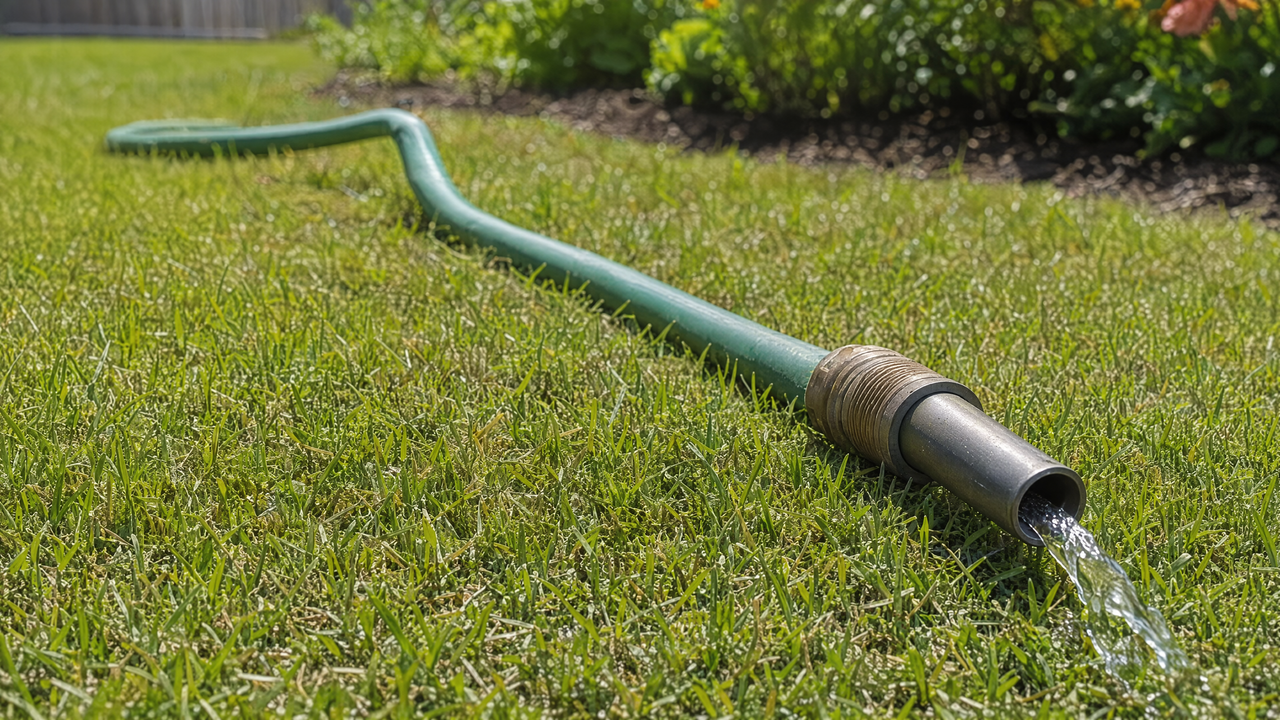
Reconnect the hose, leave the nozzle off, and turn it on full.
Weak flow here points at the hose itself:
- Kinks. Walk the full length. A single sharp kink behind a planter cuts flow dramatically. Older vinyl hoses develop permanent kink memory at the folds.
- Length and diameter. Every additional 50 feet costs you flow. A 5/8-inch hose delivers meaningfully more than a 1/2-inch one, and a 3/4-inch more still. If you're running 150 feet of half-inch hose, the hose is your bottleneck.
- Internal collapse. Cheap hoses can delaminate and collapse internally. You'll feel a soft spot that flattens under suction.
- Slope. Running uphill costs roughly half a PSI per foot of rise. It adds up on a hillside lot.
Test 3: Check the screens and washers
This is where most mystery pressure problems are actually hiding.
Unscrew the hose from the spigot and look inside the female coupling. There's a rubber washer in there, and often a small mesh screen. Sediment, rust flakes, and mineral scale collect on that screen until barely anything gets through. Pull it out, rinse it, and soak it in white vinegar if it's crusted with mineral deposits.
Check the washer too. A flattened, cracked, or missing washer causes leaks at the connection, and water spraying sideways at the spigot is water not reaching your nozzle. Washers cost pennies. Replace them on sight rather than trying to judge whether they're still good.
If you have an inline filter or a quick-connect set in the line, check those screens as well - and if you're still using threaded couplings that you have to spin on and off, a set like our 3/4-inch quick connector set with spare washers makes these checks fast enough that you'll actually do them.
Test 4: Check the splitter
If your spigot feeds a Y-splitter or a multi-way manifold, test with the splitter removed. Cheap plastic splitters have narrow internal passages that throttle flow noticeably, and their valves can partly close over time from vibration.
Also make sure you're not fighting yourself: running a sprinkler on one outlet while trying to use a nozzle on another splits the available flow between them. Brass splitters with full-bore valves, like our 4-way heavy duty brass hose splitter, restrict far less than thin-walled plastic ones and let you shut off unused lines properly.
Test 5: The nozzle
If everything upstream flows well and the spray is still weak, the nozzle is the problem. Mineral buildup clogs the orifices on adjustable nozzles, and worn internal seals let water bypass instead of accelerating through the tip.
Soak the nozzle in white vinegar overnight and clear the openings with a pin. If that doesn't restore it, replace it - and note that a brass nozzle with a solid-machined tip will hold up far better against hard water than a plastic one. Solid brass options are worth the small premium in the garden watering and hose fittings collection.
One honest caveat: no nozzle creates pressure. A nozzle concentrates the flow you already have into a narrower, faster stream. If your flow is genuinely low, a better nozzle will help the spray feel stronger, but it won't fill a bucket any faster.
When you actually need a pressure washer
If your goal is stripping algae off siding or grime out of concrete, a hose will never get there no matter how well it's tuned. Household hose pressure tops out around 80 PSI; a consumer pressure washer runs 1,500 to 3,000. That's a different tool for a different job - our pressure washer parts and accessories cover hoses, nozzles, and adapters if that's the direction you're heading.
Quick reference
- Weak at the spigot with no hose attached, plumbing issue
- Fine at the spigot, weak at the hose end, kink, length, or diameter
- Leaking at the connection, worn washer
- Gradual decline over months, clogged screen or scaled nozzle
- Sudden drop after adding a splitter, restrictive splitter
Most of these come down to a few dollars of brass and rubber. Browse the Garden Watering & Hose Fittings collection for washers, quick connects, splitters, and nozzles that will keep your water where it belongs.