
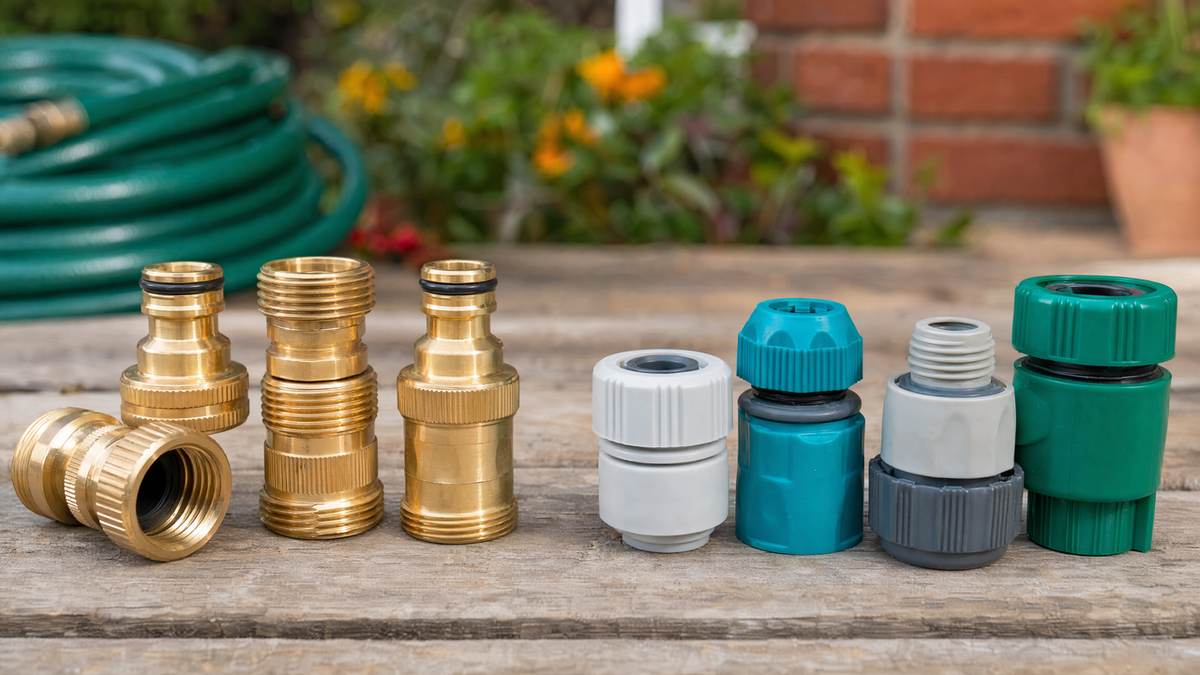
Stand in the watering aisle and the choice looks obvious in whichever direction you're already leaning. Plastic quick-connects cost a few dollars and weigh nothing. Brass costs three times as much and feels like it came off a fire truck. Both claim to be leak-free.
After a couple of seasons the difference becomes clearer, but not in the simple way people expect. Brass isn't automatically better everywhere, and plastic isn't automatically junk. What matters is which connection you're making and what happens to it over a year.
How each material actually fails
Understanding the failure mode is more useful than reading spec sheets.
Plastic fittings
Glass-filled nylon and ABS fittings fail from UV exposure and repeated stress. Sunlight makes the polymer brittle over one to three seasons outdoors. The fitting looks fine, then one day you overtighten it slightly and the collar cracks. Threads are the second weak point — plastic threads deform under a wrench and cross-thread easily against a brass spigot.
What plastic does well: it doesn't corrode, it doesn't seize onto other fittings, and it's light enough that a connector hanging off a nozzle doesn't drag on the hose.
Brass fittings
Brass fails from dezincification and mineral scale, not from breaking. In hard water, calcium builds up in the threads and around O-rings until a swivel that used to turn by hand needs pliers. In water with aggressive chemistry, cheaper high-zinc brass slowly loses zinc and develops a pinkish, crumbly surface.
What brass does well: it holds its shape under a wrench, tolerates being frozen with a little water inside far better than plastic, and threads mate properly with the brass spigot on your house.
The comparison in plain terms
- Lifespan outdoors: plastic 1–3 seasons; brass 5–15 years, sometimes longer.
- Freeze tolerance: brass is much more forgiving. Plastic connectors left on a spigot over winter are the single most common springtime leak.
- Repairability: brass, easily — usually a $0.20 washer. Cracked plastic gets thrown away.
- Weight: plastic wins, and it matters on a handheld nozzle used for an hour.
- Cost per use: brass wins on anything you touch daily; plastic wins on anything you install once and forget.
Which connections are worth upgrading
You don't need to replace everything. Spend on the connections that move, take load, or stay outdoors year-round.
Worth brass
- The spigot connection. It's the highest-pressure point in the system and it's threaded into brass already. A plastic fitting here is the mismatch most likely to leak.
- Shut-off valves. These get operated constantly, and a plastic valve handle is a predictable break point. A solid brass shut-off valve at the hose end saves walking back to the tap and survives being stepped on.
- Splitters and manifolds. A splitter carries the weight of two or three hoses pulling in different directions. That's a bending load, and it's where plastic bodies crack first.
- Anything left outside through winter.
Plastic is fine
- Sprinkler and drip-line couplings that sit in one place all season.
- Hose menders on a hose you already consider disposable.
- Anything stored indoors between uses.
Why brass fittings still leak (and it's usually not the brass)
People upgrade to brass, get a drip, and conclude they wasted their money. Nearly always the culprit is one of these:
- A missing or flattened rubber washer. The washer makes the seal — the metal just holds it in place. Washers compress permanently over a season or two. Replace them before replacing anything else.
- Overtightening. Cranking a brass fitting down with pliers deforms the washer seat. Hand-tight plus a small nudge is correct.
- Grit in the seat. A grain of sand holds the faces apart. Rinse both halves and look before you reconnect.
- Mixed thread standards. US garden hose thread (GHT, 3/4-11.5) does not match European or BSP fittings, and forcing them together damages both.
Quick connects: the honest verdict
Quick-connect couplers are the accessory most worth owning and the one where material choice matters most. You'll operate them hundreds of times a season, and the locking collar is exactly the part that plastic gives up on first.
A brass quick connector set with spare washers costs a little more up front and is still working in five years. Keep a male end on each attachment — nozzle, sprinkler, wand — and one female on the hose, and swapping tools becomes a one-second job. Full range in Garden Watering & Hose Fittings.
Before the first freeze
Whatever material you've chosen, late fall is when the difference shows up. Water trapped in a fitting expands as it freezes, and plastic splits where brass tends to survive.
Disconnect every hose from the spigot, drain fittings by holding them vertically for a few seconds, and store quick-connects and valves indoors. Two minutes of work now saves a spring spent chasing drips.
Upgrading a few connections?
Start with the spigot, the shut-off, and the quick connects — those three carry most of the wear in a watering setup. Browse brass valves, splitters and connectors in Garden Watering & Hose Fittings.