
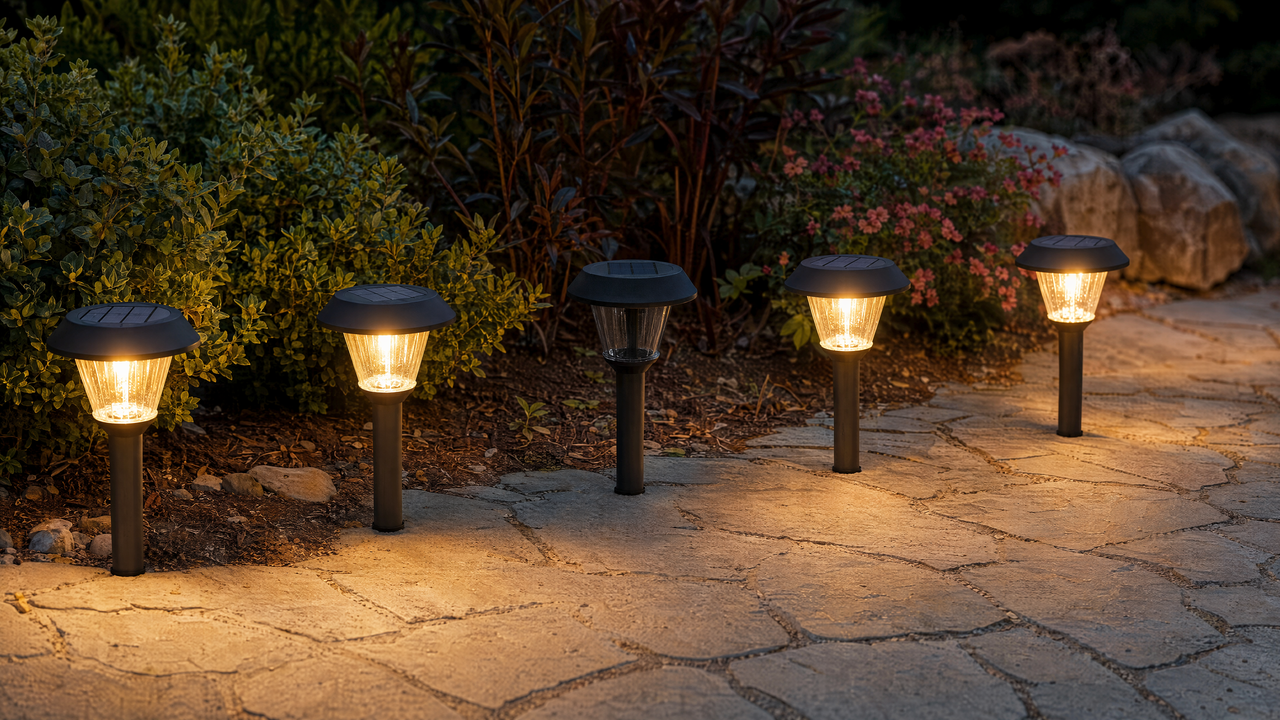
Few things are more satisfying than a garden that lights itself up at dusk — and few things are more annoying than walking outside to find half your solar lights dark, dim, or blinking like they've given up. Before you toss them in the bin and order replacements, take ten minutes to run through this checklist. In most cases, a "dead" solar light is just a dirty, shaded, or tired one, and the fix costs nothing.
How Solar Lights Actually Work (in 30 Seconds)
Every solar light has four parts: a small photovoltaic panel, a rechargeable battery, an LED, and a light sensor. The panel charges the battery during the day; the sensor switches the LED on when it gets dark. If any one of those four links breaks down — dirty panel, worn battery, confused sensor — the whole light fails. That's good news: it means the fixes are simple and mostly free.
Fix 1: Check for a Pull Tab or Off Switch
It sounds obvious, but it's the number one cause of "brand new lights that don't work." Many solar lights ship with a plastic pull tab insulating the battery, and nearly all have a small ON/OFF switch hidden under the cap. Make sure the tab is removed and the switch is actually on. If you just bought a multi-pack and only some work, this is almost certainly why.
Fix 2: Clean the Solar Panel
A layer of dust, pollen, or bird droppings can cut a small panel's charging power dramatically — and August is prime season for baked-on grime. Wipe the panel with a damp cloth and a drop of dish soap, then dry it. If the panel looks cloudy or chalky after cleaning, the plastic has oxidized: rub it gently with a tiny amount of toothpaste or a plastic polish, then wipe clean. You'll be surprised how often this alone restores full brightness.
Fix 3: Give Them Real Sunlight
Solar lights need 6–8 hours of direct sun for a full charge. A spot that was sunny in June may be shaded by grown foliage in August. Walk your yard mid-afternoon and check: is the panel under a tree canopy, an eave, or the shadow of a fence? Even partial shade for a few hours can leave a battery too weak to run all night. Relocate the light — or trim the branch — and give it two full sunny days before judging the result.
Fix 4: Do a Deep-Charge Reset
Rechargeable batteries develop a shallow-charge pattern when they never fill completely. To reset: switch the light OFF, leave it in direct sun for 48–72 hours so the panel charges the battery without draining it each night, then switch it back on. This "deep charge" often revives lights that have been getting dimmer week after week.
Fix 5: Replace the Rechargeable Battery
Solar light batteries (usually AA or AAA NiMH cells) last one to two years — they're the part that wears out first. If a light is two seasons old and the deep-charge reset didn't help, unscrew the cap and swap in a fresh NiMH rechargeable of the same size and voltage. Never use regular alkaline batteries; they aren't designed for daily recharging and can leak. A $10 pack of NiMH cells can bring a whole set of pathway lights back to life.
Fix 6: Check the Sensor at Night
If your lights stay off even after dark, the sensor may be fooled by nearby light — a porch lamp, a street light, even a bright window. Test by covering the panel with your hand or a cloth: if the LED comes on, the sensor works and something nearby is keeping it "awake." Move the light farther from the light source, or angle the sensor away from it.
Fix 7: Look for Water Inside
After summer thunderstorms, condensation can fog the panel or corrode the battery contacts. Open the housing, let everything air-dry for a day, and clean any white or green crust off the contacts with fine sandpaper or a pencil eraser. Re-seat the seals when you reassemble — most "waterproof" failures are just a gasket that shifted.
When It's Time to Replace
If you've cleaned the panel, swapped the battery, and given the light two sunny days and it's still dead, the LED or circuit board has likely failed — and at that point replacement makes more sense than repair. Modern sets are brighter and run longer than lights from even a few years ago. For a warm, hands-free glow along walkways and flower beds, a set like the 12-pack solar pathway lights for patios, yards, and driveways covers a full walkway in one go. Prefer something more decorative? The 34-inch hanging solar lanterns with shepherd hooks add height and a classic coach-light look beside doorways and garden beds — no wiring, no timer, no fuss.
You can compare all of our panel styles, lanterns, and pathway sets in the outdoor and solar lights collection.
Keep Them Bright All Season
A little routine goes a long way: wipe panels once a month, check for new shade as plants grow, deep-charge twice a season, and swap batteries every couple of years. Do that, and a good set of solar lights will glow reliably from spring through the first snow.
Ready for an upgrade? Explore the full Outdoor & Solar Lights collection — pathway sets, hanging lanterns, and solar string lights for every corner of your yard.