
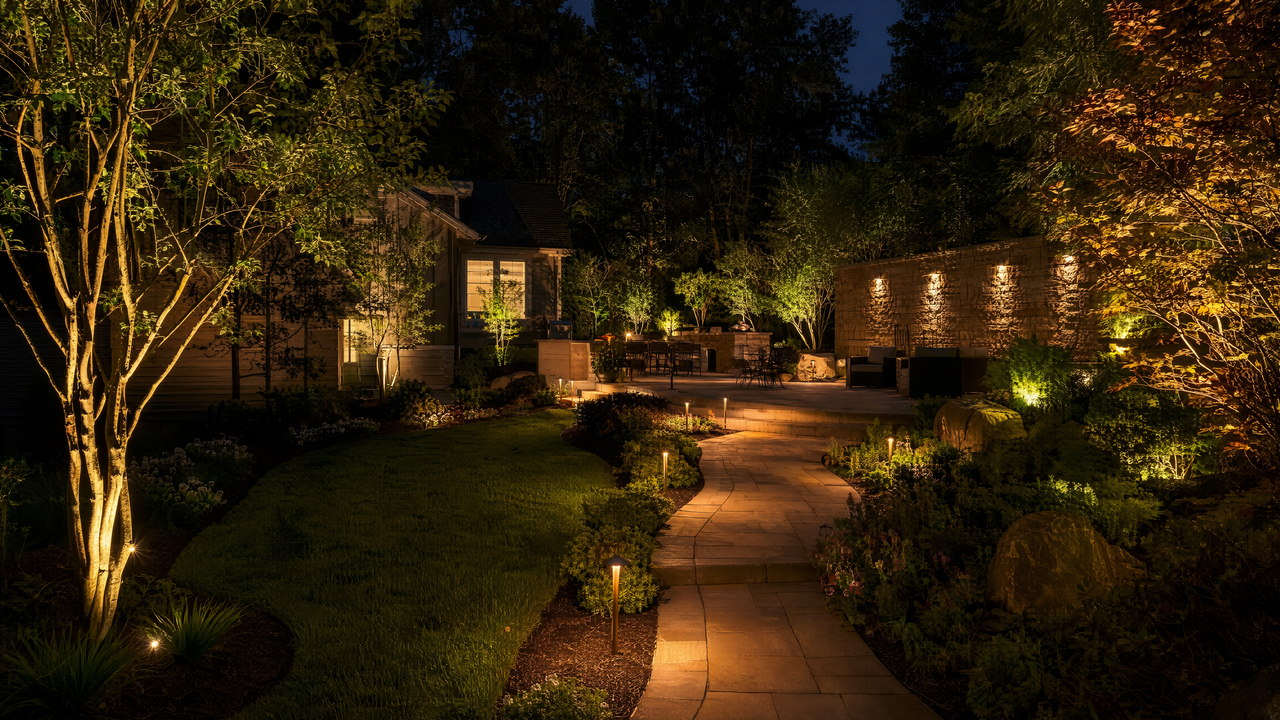
Landscape Lighting 101: How to Layer Lights for a Stunning Backyard
Standing in your backyard at dusk, you watch the last light fade. The trees disappear. The garden path becomes invisible. The patio feels closed-in rather than inviting. You know outdoor lighting could change everything, but a single fixture won't do the job. The secret that professional landscape designers use is layering — combining ambient, task, and accent lighting to create depth, function, and mood. Here is how to master it.
Key Takeaways
- Layered lighting — ambient, task, and accent — can increase perceived outdoor living space by up to 30% (American Society of Landscape Architects, 2023).
- Well-designed landscape lighting boosts home curb appeal and can add 5% to 10% to property value (NAR 2024 Remodeling Impact Report).
- LED landscape lights use 75% less energy than halogen and last 15 to 25 times longer, making them the clear choice for any outdoor scheme.
- Pathway lights, spotlights, and string lights each serve a different layer — mixing them properly avoids the "airport runway" look.
What Is Layered Outdoor Lighting and Why Does It Matter?
In 2023, the American Society of Landscape Architects reported that outdoor lighting systems rated as one of the top three most-wanted outdoor features among homeowners, with 78% ranking it as "essential" or "highly desirable." Layered lighting is the practice of using multiple light sources at different heights and intensities to create a balanced, functional nighttime landscape. Instead of one bright floodlight, you use a combination of soft ambient glow, targeted task light, and dramatic accent illumination.
This approach matters because a single light source creates harsh shadows and flat scenes. By layering, you add depth, guide the eye, and make your yard usable after dark. A 2024 study by the National Association of Realtors found that outdoor lighting improvements ranked among the top five exterior projects with the highest return on investment, recouping up to 67% of project cost at resale.

What Are the Three Layers of Outdoor Lighting?
Professional landscape lighting breaks down into three distinct layers. Each serves a specific purpose, and all three work together to create a cohesive nighttime environment. According to the Illuminating Engineering Society (IES) RP-33-22 standard for outdoor lighting, a well-designed residential landscape should incorporate at least two of these three layers for adequate visual interest and safety.
Ambient Lighting — The Foundation Layer
Ambient light provides the base illumination for your outdoor space. It softens shadows, defines the overall area, and creates a sense of safety. Think of it as the moonlight equivalent — general, even light that lets you move around comfortably. In 2022, a University of California Berkeley study on nighttime outdoor usability found that ambient light levels of 5 to 10 lux at ground level were sufficient for safe navigation while maintaining a natural nighttime atmosphere.
Common ambient light sources include string lights draped across a patio, post lights along a fence line, and recessed deck lights. The goal is even coverage without glare. Place ambient fixtures 8 to 12 feet apart for consistent illumination.
Task Lighting — The Functional Layer
Task lighting focuses on specific activity zones. It is brighter and more directional than ambient light. Your grill area, outdoor dining table, kitchen prep counter, and reading nook all need task lighting. The IES recommends 20 to 50 lux for outdoor cooking and dining surfaces — roughly two to three times the level of ambient light.
Pendant lights over a dining table, under-cabinet LED strips on an outdoor kitchen, and adjustable wall sconces near seating areas all qualify as task lighting. Dimmers are especially useful here, allowing you to adjust brightness from meal-prep mode to dinner ambiance.
Accent Lighting — The Drama Layer
Accent lighting draws attention to specific features: a specimen tree, a water fountain, a stone wall, or a sculpture. It creates contrast and visual interest. The rule of thumb is a 3:1 or 5:1 ratio between the accent light and the surrounding ambient level — enough to highlight without washing out. A 2023 survey by the Association of Outdoor Lighting Professionals found that uplighting trees was the single most requested accent technique among homeowners, with 64% choosing it as their top landscape lighting priority.
Use spotlights, well lights, and directional path lights to achieve accent effects. Angle them at 30 to 45 degrees to reduce glare and create natural-looking shadows.

How Do You Choose the Right Light Fixtures for Each Layer?
Choosing fixtures is not about buying the brightest option — it is about matching beam angle, color temperature, and placement to the layer's purpose. In 2026, the outdoor lighting fixture market is projected to reach $18.2 billion globally (Grand View Research, 2024), with LED fixtures accounting for over 70% of new installations. The right selection starts with three specs: beam angle, lumens, and color temperature.
Ambient fixtures: Wide beam angle (120° or more), 300 to 600 lumens, warm white (2700K to 3000K). String lights, post lights, and lanterns work best. Mount at 7 to 10 feet for optimal spread.
Task fixtures: Medium beam angle (60° to 90°), 500 to 1000 lumens, neutral white (3000K to 4000K). Pendants, sconces, and under-counter strips. Position 28 to 36 inches above the task surface.
Accent fixtures: Narrow beam angle (15° to 40°), 150 to 300 lumens, warm white (2700K to 3000K). Spotlights, well lights, and directional path lights. Place at ground level or in tree canopies pointed downward.
Color temperature consistency matters. Mixing 2700K warm lights with 4000K cool lights in the same view creates visual discord. A 2025 study by the Lighting Research Center at Rensselaer Polytechnic Institute found that outdoor spaces with coordinated color temperatures (within 300K of each other) were rated 41% more "harmonious" by test subjects compared to mixed-temperature schemes.
How Do You Plan a Layered Lighting Layout for Your Yard?
Mapping your lighting layout starts with a simple sketch of your property. Mark every zone you use at night — driveway, entry path, patio, grill area, dining spot, garden beds, and trees you want to highlight. Then assign each zone to one or more lighting layers.
According to the Outdoor Lighting Association (OLA), a typical 0.25-acre suburban lot needs 10 to 15 light fixtures for complete layered coverage. Over-lighting is a common mistake — more fixtures do not mean better results. The goal is purposeful placement, not maximum brightness.
Start with the safety layer: illuminate steps, changes in elevation, and the main walkway. Then add ambient light for the patio or deck. Layer in task lighting for cooking and dining zones. Finally, add accent lights on the three to five most interesting features — a mature tree, a water feature, or an architectural detail.
A 2024 survey by Fixr.com found that 56% of homeowners who installed landscape lighting did so themselves, with an average material cost of 380 dollars for a basic system. Professional installation averages 2,000 to 4,500 dollars for a typical single-family lot, depending on fixture count and complexity.

What Are the Most Common Landscape Lighting Mistakes to Avoid?
Even with good intentions, many homeowners make the same errors. The most common is the "airport runway" effect — placing path lights in a straight line at equal spacing, creating a harsh corridor of light. Instead, stagger path lights on alternating sides of the walkway and use lower-wattage bulbs to soften the glow.
Another frequent mistake is aiming lights directly at the house. In 2025, the Dark Sky Association reported that 83% of residential light trespass complaints came from improperly aimed outdoor fixtures. Use shields and aim lights downward or at specific landscape features. This not only prevents neighbor complaints but also reduces light pollution — an increasingly important consideration as more cities adopt outdoor lighting ordinances.
Glare is the third major issue. When the light source is visible to the eye, it causes discomfort and reduces visibility. The IES recommends using fixtures with a "cutoff" rating of 90 degrees or less — meaning no light is emitted above 90 degrees from vertical. Dark-sky-compliant fixtures are now widely available and are required by code in 12 U.S. states as of 2026.
Finally, do not forget about seasonal changes. A lighting plan that works in summer when trees are full may look different in winter when branches are bare. Use adjustable fixtures that can be re-angled as the landscape changes through the year.
How Much Does a Layered Landscape Lighting System Cost?
Costs vary widely based on fixture count, quality, and whether you install yourself. According to HomeAdvisor's 2025 Landscape Lighting Report, the national average for a professionally installed system is 3,200 dollars, with most homeowners spending between 2,000 and 4,500 dollars.
Here is a breakdown by layer:
- Ambient lighting (string lights, post lights, deck lights): 80 to 300 dollars per fixture installed, or 20 to 80 dollars for DIY string light kits.
- Task lighting (pendants, sconces, under-counter strips): 150 to 400 dollars per fixture installed.
- Accent lighting (spotlights, well lights, path lights): 100 to 250 dollars per fixture installed.
- Low-voltage transformer and wiring: 100 to 300 dollars for a quality system that supports 10 to 15 fixtures.
LED fixtures cost more upfront but save an estimated 47 dollars per year in electricity per fixture compared to halogen equivalents (Energy.gov, 2024). Over a 10-year lifespan, the savings more than offset the initial investment.
A typical 0.25-acre property needs 10 to 15 fixtures: 4 to 6 ambient, 2 to 3 task, and 4 to 6 accent lights. The exact number depends on your yard's layout and how many features you want to highlight.
Warm white (2700K to 3000K) is the standard for residential landscape lighting. It complements greenery and warm-toned hardscaping. Use 3000K to 4000K for task areas where visibility is more important than ambiance.
Yes. Low-voltage lighting systems are designed for DIY installation. The key steps are laying cable, connecting fixtures with waterproof connectors, and mounting a transformer. Over 80% of low-voltage landscape lights are installed by homeowners (Fixr.com, 2025).
Use full-cutoff fixtures that direct light downward. Aim all lights at your own property features, not at property lines. The Dark Sky Association recommends choosing fixtures with a "Dark Sky Approved" label.
Most landscape lighting systems use photocells or timers to turn on at dusk and off by midnight. Motion sensors for task areas add convenience. Running lights 5 to 6 hours per night is typical for residential use.
Conclusion
Layered landscape lighting transforms your backyard from a dark void into an extension of your home. The key is understanding the three layers — ambient, task, and accent — and choosing the right fixtures for each. Start with a plan, invest in quality LED fixtures, and avoid common mistakes like glare and over-lighting. Whether you install yourself or hire a professional, the result is a yard that feels larger, safer, and more welcoming after dark.
Your outdoor space deserves to be enjoyed at all hours, not just during daylight. With the right lighting layers, you can extend your living area into the evening and create a backyard that shines — literally.
References
- American Society of Landscape Architects — "2023 Residential Landscape Architecture Trends", retrieved 2026-08-10.
- National Association of Realtors — "2024 Remodeling Impact Report: Outdoor Features", retrieved 2026-08-10.
- Illuminating Engineering Society — "RP-33-22: Lighting for Exterior Environments", retrieved 2026-08-10.
- Grand View Research — "Outdoor Lighting Fixtures Market Size Report, 2024-2030", retrieved 2026-08-10.
- Lighting Research Center, Rensselaer Polytechnic Institute — "Color Temperature Perception in Outdoor Spaces", 2025, retrieved 2026-08-10.
- Fixr.com — "Landscape Lighting Cost Guide 2025", retrieved 2026-08-10.
- HomeAdvisor — "2025 Landscape Lighting Installation Report", retrieved 2026-08-10.
- Energy.gov — "LED Lighting: Energy Savings Forecast", 2024, retrieved 2026-08-10.
- Dark Sky Association — "2025 Residential Light Trespass Survey", retrieved 2026-08-10.
- Outdoor Lighting Association — "Residential Lighting Best Practices Guide", retrieved 2026-08-10.