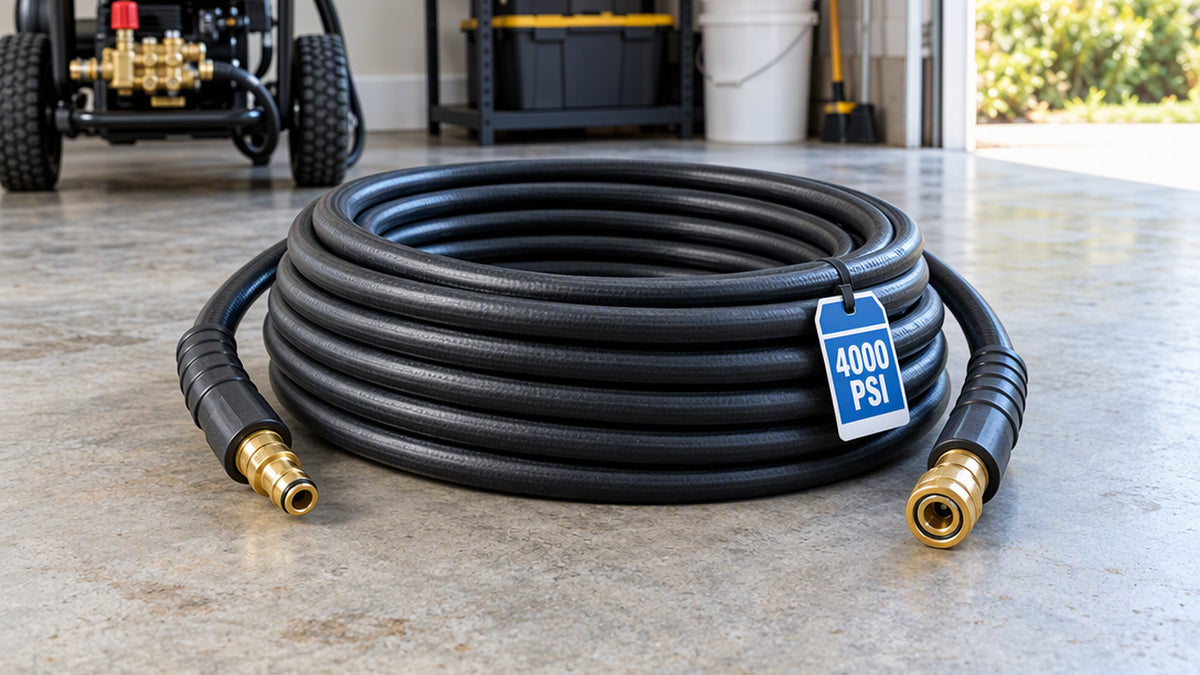
The hose is the lifeline of your pressure washer. It carries high-pressure water from the pump to the gun, and it takes a lot of abuse along the way: dragging across concrete, kinking around corners and flexing every time you move. When a hose wears out or you need more reach, picking the right replacement matters. The wrong one can leak, burst or simply refuse to connect. This guide covers the three things that matter most: length, pressure rating and connector type.
Why the right hose matters
Pressure washers operate at thousands of PSI. A hose that is under-rated or damaged can fail suddenly, so choosing the correct hose is a safety issue, not just a convenience. A good hose also delivers consistent flow, resists kinks and holds up after repeated use.
Step 1: Check the pressure rating
Every pressure washer hose has a maximum working pressure printed on it, measured in PSI. Your replacement should have a rating at least as high as your machine's maximum PSI. If your washer runs at 3,000 PSI, a hose rated for 2,000 PSI is not safe. When in doubt, choose a hose with some margin above your washer's output.
For example, the 25ft pressure washer hose with 3/8-inch quick connect is rated for 4000 PSI and is made of rubber with a steel-wire braid, which supports high working pressure. Always compare the rating to the specifications for your own machine before purchasing.
Step 2: Decide on length
Longer hoses give you more reach, but length has trade-offs.
- Short hoses (under 25 ft) are easy to manage and store, suitable for small patios and cars.
- Medium hoses (25 to 50 ft) are the most popular for general home use, reaching around a house without moving the machine often.
- Long hoses (50 ft and up) reduce the need to relocate the washer, but they are heavier and harder to coil. They can also cause a small drop in pressure, especially on lower-powered machines.
A good approach is to measure the farthest area you plan to clean from where the machine will sit, add a few extra feet for slack, and choose the closest standard length.
Step 3: Match the connector type
This is where many people run into trouble. Pressure washer hoses connect to the machine and to the gun with several different standards. Common ones include:
- M22 fittings (14 mm or 15 mm), found on many machines.
- 3/8-inch quick connect, which lets you click the hose on and off.
- 1/4-inch quick connect, usually seen on smaller guns and wands.
- Threaded connections of various sizes.
If your hose and machine do not match, you can often bridge them with the right adapter. We explain the differences in detail in our guide to pressure washer adapters, M22 fittings and quick connects.
The M22 swivel to 3/8-inch quick connect adapter set is a useful kit for this job, with quick connect swivels, 3/8-inch quick disconnect and M22 male fittings, plus 3/4-inch female to 1/2-inch quick connect pieces. A swivel connection also helps stop the hose from twisting as you work.
Step 4: Look at construction
A durable hose has reinforced layers. Steel-wire braiding adds strength and helps the hose handle pressure without ballooning or bursting. Look for a flexible outer cover that resists abrasion and does not become stiff in cool weather, since a stiff hose kinks and wears faster.
Step 5: Inspect and install carefully
- Turn off the machine and release pressure by squeezing the trigger.
- Disconnect the old hose from the pump and gun.
- Inspect the connection points on the machine. Replace worn O-rings, which are a frequent cause of leaks.
- Attach the new hose and push quick connectors firmly until they click.
- Turn on the water supply, squeeze the trigger to purge air, then start the machine.
- Check for leaks at both ends before starting to clean.
If a quick connect drips, our guide to replacing O-rings on a leaking quick connect walks through the fix step by step.
How to make your hose last longer
- Avoid sharp bends. Kinks weaken the hose and restrict flow.
- Do not drive over it. Vehicles and heavy items can crush the internal layers.
- Relieve pressure before disconnecting. Always release it first.
- Coil loosely. Use a hose reel or loose loops rather than tight coils.
- Drain before freezing weather. Water trapped in the hose can freeze and cause damage.
- Store out of direct sunlight. Heat and UV can age the cover.
When to replace your hose
Replace a hose if you see bulges, cracks, exposed braiding, persistent leaks at the crimped ends or a stiff, damaged cover. Do not tape or patch a high-pressure hose; those repairs are unsafe at working pressure.
Check your accessories at the same time
While you are replacing a hose, it is a good moment to check other parts of your setup, such as O-rings, nozzle tips and the spray gun. Our pressure washer parts and accessories collection includes hoses, adapters and small replacement parts in one place. If your washer connects to a standard garden hose for its water supply, you may also find useful connectors in our garden watering and hose fittings collection.
Quick checklist before you buy
- Find your washer's maximum PSI and choose a hose rated at or above it.
- Measure the distance you need to reach.
- Identify the connector type on your machine and gun.
- Order an adapter if the connectors do not match.
- Buy spare O-rings so you are ready for small leaks.
Need a hose or adapter? Shop the Pressure Washer Parts & Accessories collection and get your washer back to work.