
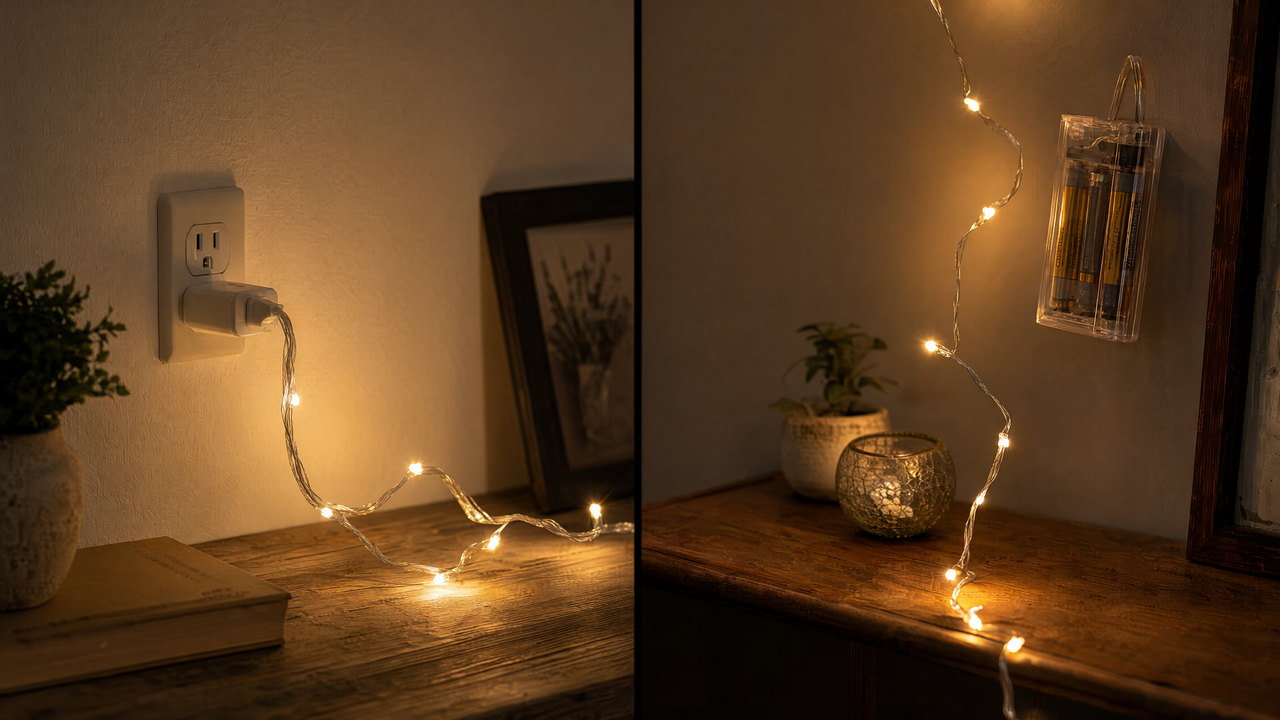
You've found the perfect spot for fairy lights — above the bed, along a bookshelf, wrapped around a porch railing. Then you hit the one question every product page dodges: plug-in or battery-operated?
It's not a trick question, and neither answer is wrong. But picking the wrong one is how you end up with a gorgeous display that dies every four days, or a beautiful mantel with an extension cord running across the living room floor. Here's how to decide before you buy.
The short answer
Choose plug-in when the spot has an outlet within reach and the lights will be on for hours at a time — bedrooms, patios, Christmas trees, permanent porch displays.
Choose battery-operated when there's no outlet, when you need to hide the power source, or when the lights are decorative rather than functional — centerpieces, wreaths, mason jars, mantels, anywhere a visible cord would ruin the look.
Most homes end up using both. Now for the details that actually matter.
Brightness and length
Plug-in sets win here, and it isn't close. A wall adapter delivers steady voltage for as long as you want it, so manufacturers can run longer strands with brighter LEDs without worrying about draining anything. That's why you'll find plug-in sets at 33, 49 and 100 feet while most battery sets top out shorter.
Battery sets have gotten much better, though. Modern copper-wire fairy lights sip so little power that a set like our 99-foot 300-LED copper wire string lights can cover a whole room on six AA batteries. The trade-off is that the individual LEDs are smaller and softer — lovely for ambience, not enough to light a path.
Rule of thumb
- Task or accent lighting you'll rely on: plug-in
- Atmosphere and sparkle: either works
- Runs longer than about 50 feet: plug-in is usually simpler
Runtime and the battery math
This is where people get surprised. A typical battery fairy light set runs 18 to 24 hours of continuous use on a fresh set of AAs. Sounds fine — until you realize that's about six evenings if you leave them on from dinner to bedtime.
Two things fix this. The first is a built-in timer, which most decent battery sets now include: it runs the lights six hours, then shuts off for eighteen, and repeats on the same schedule every day. That single feature roughly triples how long a set of batteries lasts, because the lights are no longer burning through the night while everyone's asleep.
The second is rechargeable AAs. If you're running battery lights year-round, a pack of rechargeables pays for itself in about two months and saves you the alkaline-battery guilt.
Plug-in sets, of course, have no runtime limit at all. Add a cheap outlet timer and you get the same automatic on/off behavior for a couple of dollars.
Where the cord goes
The honest downside of plug-in lights is the lead wire — the section between the wall plug and the first bulb. It's usually 3 to 6 feet, and it has to go somewhere. Before you buy, look at your spot and ask where the nearest outlet is and whether you can hide that run behind furniture, along a baseboard, or up a curtain edge.
Battery sets solve this completely. The battery box is small enough to tuck behind a plant pot, inside a vase, or under a cushion. That's why they dominate for table centerpieces, garland on a banister, and anything on a shelf far from the wall.
Star-shaped plug-in sets like these 33-foot 100-LED star string lights are a nice middle ground for windows — the outlet is usually close by, and the extra brightness reads well from the street.
Indoors vs. outdoors
Outdoors, check the weather rating on both types. Plug-in outdoor sets are built for it, but the adapter still needs to stay dry or live in a covered outdoor outlet. Battery sets often have a waterproof battery box, which makes them genuinely handy for wreaths, mailboxes and trees far from the house — just remember you'll be trekking out there to swap batteries in the cold.
For anything permanent outdoors — pergolas, patio perimeters, railings — plug-in is the lower-maintenance choice. Browse the full range of string lights and fairy lights to compare lengths and bulb styles side by side.
Cost over a year
Sticker prices are similar; running costs aren't. LED fairy lights use so little electricity that a plug-in set costs pennies per month. Battery sets cost whatever you spend on AAs — which, at six batteries per set replaced every couple of months across several sets, adds up faster than people expect.
None of this makes battery lights a bad deal. It just means you should reach for them where their flexibility earns its keep, rather than using them everywhere by default.
A quick buying checklist
- Where's the nearest outlet? Within 6 feet and hideable — go plug-in.
- Will the power source be visible? If yes and that bothers you, go battery and hide the box.
- How many hours a day? Over 6 hours daily — plug-in, or battery with a timer.
- Indoor or exposed? Check the rating either way; outdoor sets are marked.
- Do you want a remote? More common on battery sets, and genuinely useful when the box is buried behind a couch.
Still not sure?
Buy one of each. Put the plug-in set where you'll use it every evening and the battery set where the cord would be a problem. After a month you'll know exactly which one you want more of — and you'll have solved two spots instead of one.
Ready to pick? Browse our full collection of string lights and fairy lights in both plug-in and battery styles, with warm white, multicolor and star-shaped options for every room.