
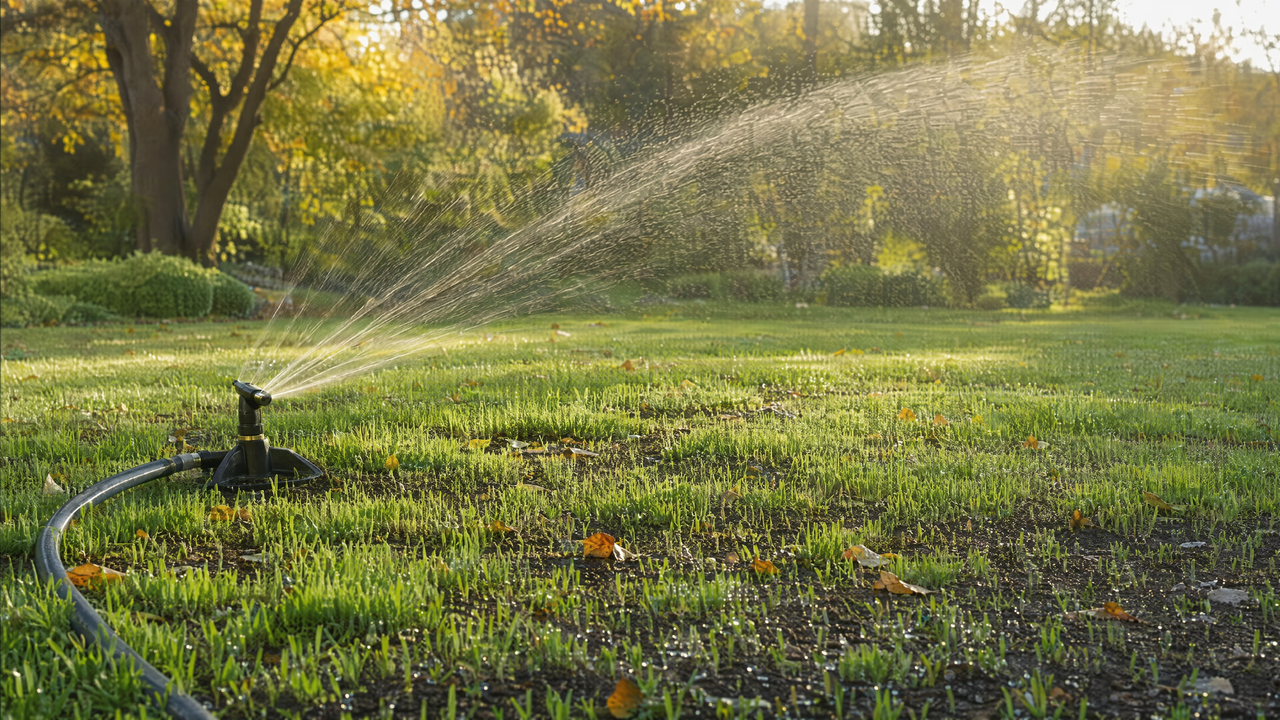
If you're seeding a cool-season lawn, the next few weeks are the best window you'll get all year. Soil is still warm from summer, nights are cooling off, and the weeds that would normally crowd out young grass are winding down. Seed put in the ground in late August or September usually establishes faster than anything planted in spring.
But there's a catch. Almost every failed overseeding job comes down to the same thing: watering. Not the amount of seed, not the fertilizer, not the soil test. Just water — too much of it, too little of it, or delivered with so much force it washes half the seed into the driveway.
Here's what a new seedbed actually needs, week by week, and the hose setup that makes it easy to hit those targets without standing outside for an hour a day.
The one rule that matters: keep the top inch damp
A grass seed doesn't have roots yet. It has a tiny amount of stored energy and a thin film of moisture around it, and that's it. If that film dries out — even for a few hours on a hot afternoon — the seed dies. It doesn't pause and resume. It dies.
So the goal isn't "deep watering" the way it is for an established lawn. It's the opposite. You want the top inch of soil consistently damp, like a wrung-out sponge, from the day you seed until the new grass is a couple of inches tall. Short and frequent beats long and occasional, every time.
A quick field test: press your finger into the soil. If it comes back with dark, cool soil clinging to it, you're fine. If it's dusty or the surface has gone pale, you waited too long.
The watering schedule, stage by stage
Days 1 to 10 (before germination)
Water two to three times a day for about 5 to 10 minutes per zone. In hot, windy weather, make it three or four. You're not trying to soak the ground — you're topping off the moisture that evaporated since the last pass.
Good timing: early morning, midday, and late afternoon. Skip evening watering if you can, since overnight moisture on cool nights invites fungus.
If you're watering by hand, this is where a nozzle with a genuinely gentle setting earns its keep. A hard jet will carve channels through your seedbed and float the seed into low spots, which is why so many overseeded lawns come in patchy. The brass adjustable twist nozzle lets you dial from a fine mist for fresh seed all the way to a full stream later on, and the solid brass body holds its setting instead of drifting mid-pass the way cheap plastic nozzles do.
Days 10 to 21 (seedlings emerging)
Once you see green fuzz, back off slightly: two waterings a day, 10 to 15 minutes each. The seedlings now have thread-thin roots reaching down, and you want to encourage them to keep going. Still don't let the surface dry out completely.
Different grasses germinate on different clocks, so don't panic at uneven emergence. Perennial ryegrass shows up in 5 to 7 days, tall fescue around 7 to 12, and Kentucky bluegrass can take 14 to 21 days. If you used a blend, expect the lawn to fill in over several weeks.
Weeks 4 to 6 (transitioning to a normal lawn)
Now you flip the strategy. Cut back to every other day, then to two or three times a week, and water longer each time — 20 to 30 minutes. Deeper, less frequent watering pulls roots downward and builds a lawn that can handle next summer.
You can usually mow once the new grass hits about 3 inches. Use a sharp blade and take off no more than a third of the height.
How much water is that, actually?
New seed wants roughly a quarter inch of water per day spread across those short sessions. Established lawn wants about an inch per week total.
You don't need a fancy gauge to measure this. Set a few empty tuna cans or shallow containers around the area, run your sprinkler, and time how long it takes to collect a quarter inch. Now you know your numbers, and you can stop guessing.
The hose setup that makes this sustainable
Watering three times a day for two weeks sounds miserable, and it is — if your setup fights you. A few small changes make it a two-minute job instead:
- Add a splitter at the spigot. One outlet feeds the sprinkler for the seeded area, the other stays open for a hand-watering hose. No unscrewing fittings in the dark.
- Use quick connectors. Swapping between a nozzle and a sprinkler head takes a second instead of thirty. A set of 3/4-inch quick connectors on every hose end and accessory is the single cheapest upgrade to a watering routine.
- Put a shut-off valve at the hose end. Lets you stop the flow while you reposition, instead of walking back to the spigot every time.
- Fix leaks before you start. A dripping connection at the spigot wastes water and drops your pressure at the nozzle. Usually it's a worn rubber washer, not the fitting.
Most of this is inexpensive brass hardware you'll reuse for years. Our full range of garden watering and hose fittings covers the splitters, connectors, valves, and nozzles that make up a setup like this.
Four mistakes that kill new seed
Watering too hard. The most common one. If you see seed pooled in one corner or bare stripes where water ran, your spray was too aggressive. Back it off to a mist.
Watering deeply but rarely. One long soak every three days is the right approach for a mature lawn and exactly wrong for seed. The surface dries between sessions and the seed never gets a chance.
Letting leaves pile up. Fall seeding and falling leaves overlap. A mat of wet leaves blocks light and traps moisture against the seedlings. Blow or rake gently every few days — don't rake hard enough to disturb the seedbed.
Walking on it. Foot traffic on saturated soil compacts it and crushes seedlings. Keep kids, dogs, and yourself off the area for the first month if you can.
Don't forget to winterize
Once the new lawn is established and the first hard freeze is on the way, drain and disconnect your hoses. Water left inside a hose or a brass fitting expands when it freezes and cracks things that were perfectly fine in October. Store hoses coiled loosely somewhere above freezing, and your fittings will be ready to go in spring.
Getting started
Seeding a lawn is genuinely one of the higher-return weekend projects there is — but the first three weeks of watering decide whether it works. Keep the top inch damp, water lightly and often, and ease into a deeper schedule as the roots come in.
If your current hose setup makes that a chore, it's worth fixing before you spread a single seed. Browse our watering and hose fitting collection for nozzles, splitters, connectors, and shut-off valves, or check the best sellers to see what other gardeners reach for most.