
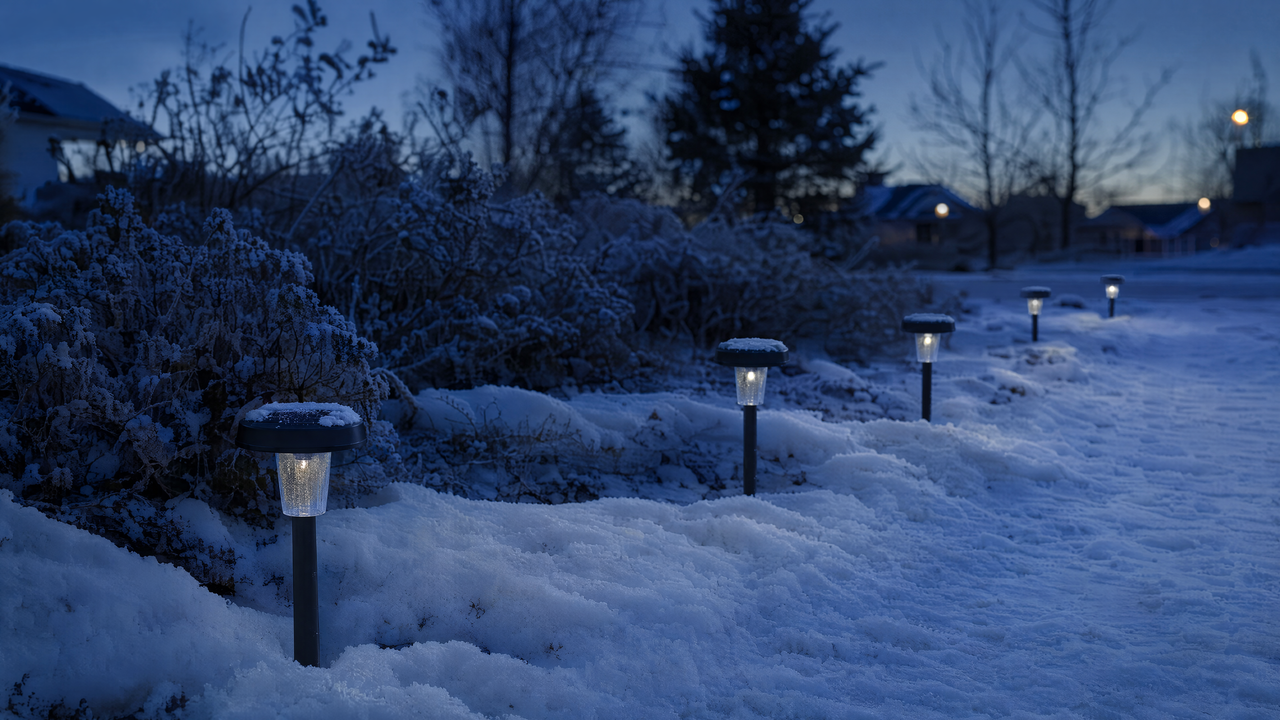
Every year around late October, the same thing happens: the solar lights that ran beautifully all summer start fading out by 9 p.m. By December they're barely making it past dinner. So do solar lights actually work in winter, or are they a warm-weather-only purchase?
They work. They just work less. Understanding exactly why turns a frustrating problem into a manageable one — and most of the fixes take about ten minutes.
Why winter performance drops
Three separate things are working against your solar lights once the season turns, and they compound.
1. There's simply less daylight
This is the big one. In the northern half of the US, the sun is up for roughly 15 hours in late June and about 9 hours around the winter solstice. Your panel has 40% less time to collect a charge — and it's charging for a night that's several hours longer. That squeeze alone explains most of what you're seeing.
2. The sun sits lower and weaker
Winter sunlight arrives at a shallower angle and travels through more atmosphere, so it carries less energy per square inch. A panel lying flat, which is how most stake lights are built, is optimized for high summer sun. In January that same flat panel is catching light at a glancing angle and losing a lot of it.
3. Cold slows the battery
The rechargeable cells inside solar lights hold less usable charge in the cold. Below freezing, expect noticeably shorter runtimes even from a fully charged battery. This part is physics, not a defect — the capacity comes back when it warms up.
What's realistic to expect
A solar light that ran 8 to 10 hours in July will often run 3 to 5 hours on a clear winter day, and less after an overcast stretch. That's normal. If yours are running 30 minutes or dying entirely, something else is wrong — and that's usually fixable.
Five fixes that actually help
Clean the panels — seriously
A film of dust, pollen, hard-water spots or fallen-leaf residue can cut charging dramatically, and it builds up invisibly over a season. Wipe each panel with a damp cloth and a drop of dish soap, then dry it. Do this at the start of winter and again mid-season. It's the single highest-return five minutes you'll spend.
Move them into the winter sun
The sun's path shifts south and lower in winter, which means the shade map of your yard changes completely. A spot that baked all summer may sit in the shadow of your house or fence from November onward. Walk the yard around noon on a sunny day in December and note where the light actually falls — then move your lights there.
Tilt the panel if you can
Any light with an adjustable head or panel should be angled toward the southern sky rather than left flat. Even a 30- to 45-degree tilt makes a measurable difference, and it has the side benefit of shedding snow instead of collecting it.
Brush off snow the same day
An inch of snow on a solar panel means essentially zero charging. The light will run flat that night and start the next day empty. A quick pass with a broom after each snowfall keeps the whole system from falling behind.
Consider hanging instead of staking
Ground-level stake lights get buried, splashed with slush, and shaded by drifts. Hanging fixtures sit above all of that. A pair of 34-inch hanging solar lanterns with shepherd hooks keeps the panel up where it can see the sky, and the lantern shape reads well against bare winter branches.
When solar isn't the right tool
Be honest about a few situations where solar will disappoint you no matter what you do:
- Deep shade all winter — a north-facing side yard with tall evergreens isn't going to charge anything.
- Security lighting — if you need it bright and reliable at 3 a.m. in February, run a wire.
- Holiday displays on a schedule — if the lights must be on from 5 to 11 p.m. every night in December, plug-in is the stress-free choice.
For those spots, a plug-in set does the job without any of the guesswork. Our string lights and fairy lights collection covers the runs where reliability matters more than wire-free convenience.
Storing them instead
If you'd rather pull your solar lights for the season, don't just toss them in the garage switched on. Turn each unit off, wipe the panel, and store them somewhere that doesn't drop far below freezing — a basement or insulated shed beats an unheated detached garage. Give them a few hours of sun before storing so the battery isn't sitting at empty for months, which is what kills solar batteries permanently.
Pull them out in early spring, clean the panels again, and give them two full sunny days before you judge whether they survived.
The bottom line
Solar lights in winter are a reasonable expectation with adjusted goals. Think of them as four hours of evening ambience rather than dusk-to-dawn coverage, keep the panels clean and clear, and put them where the low winter sun actually reaches. Do that and they'll carry you through to spring.
Getting your yard ready for the cold months? Browse our outdoor and solar lights collection for hanging lanterns, pathway stakes and weather-rated fixtures built to handle the season.