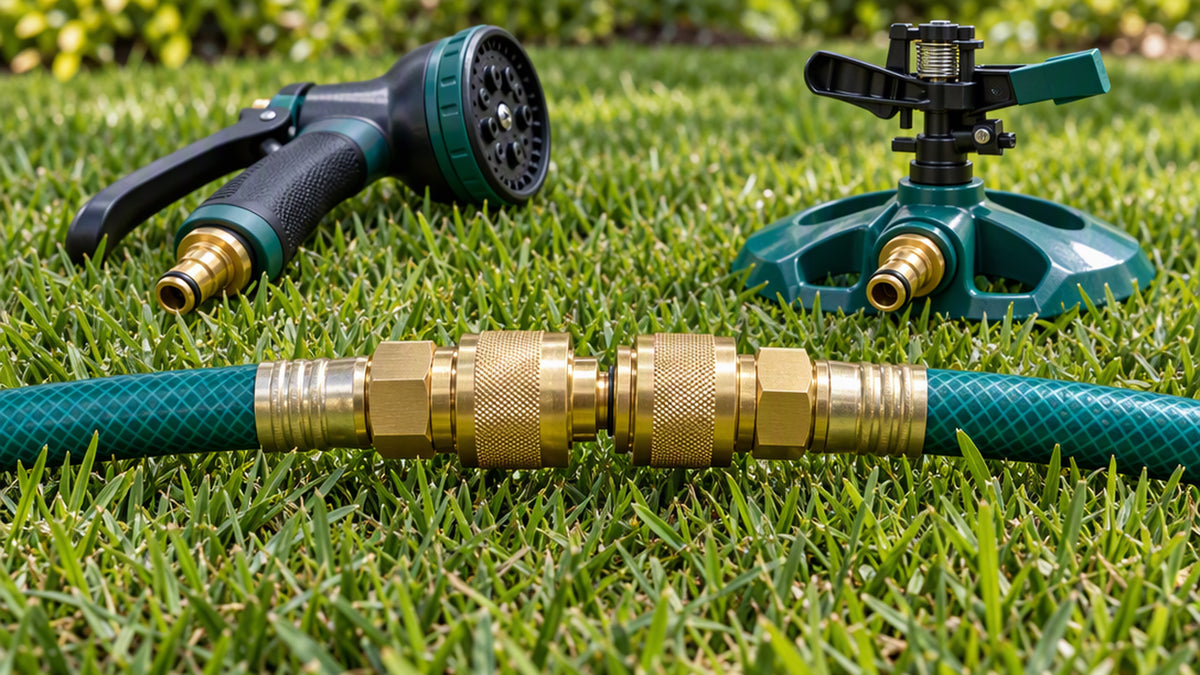
If you have ever unscrewed a garden hose nozzle with wet, cold hands just to switch to a sprinkler, you already understand the appeal of quick connectors. A good set lets you click a nozzle, wand or sprinkler on and off in a second, and it keeps the water where it belongs. A bad set drips at the tap and gets blamed on the hose. This guide explains how to choose the right connectors and how to fix the leaks that most people run into.
What a Garden Hose Quick Connector Actually Does
A quick connector is a two-part fitting. The male end screws onto the tap, nozzle or accessory, and the female end screws onto the hose. Once both are installed, you push the pieces together and they lock. Pressing a release collar or sleeve lets you pull them apart again. The result is tool-free switching between attachments without twisting threads every time.
Step 1: Confirm Your Thread Size
Most residential hoses and spigots in the United States use 3/4 inch garden hose thread, often written as GHT. That is the size you will find on the majority of nozzles, sprinklers and splitters, so a 3/4 inch connector set is the safe default. Hold your existing fitting up to the spigot: if it threads on smoothly by hand, you have the right size. Pressure washer hoses and small drip-irrigation lines use different threads, so do not assume a garden hose set will fit them.
Step 2: Pick the Right Material
Solid brass
Brass resists corrosion and handles repeated connecting and disconnecting well. It costs a little more, but it tends to last across many seasons outdoors.
Plastic and mixed materials
Plastic connectors are light and inexpensive, and they can work fine for occasional use. They are more likely to crack if they are stepped on, left in direct sun for years or hit by a freeze.
Step 3: Decide How Many Sets You Need
Think about where water needs to change direction. A typical yard might have a front hose, a back hose, a sprinkler line and a wand for washing the car. One male and female pair per attachment lets you swap between all of them. Multi-packs also give you spares for a hose that eventually gets damaged near the end. Our 3/4 inch garden hose quick connector set, 4 pack includes four male and four female connectors plus extra rubber washers, which suits a multi-hose setup. If you only need a couple of swap points, the 2 set version costs less.
Step 4: Install Them Without Leaks
- Cut the hose end cleanly. If the old coupling is damaged, cut a few inches off so you start with a clean, round end.
- Check for a rubber washer. Every female connector needs a flat washer inside. Without it, water will seep at the threads.
- Thread by hand first. Start the threads slowly so they do not cross, then turn until snug.
- Tighten a little more, not with a wrench. Hand tight plus a slight extra turn is usually enough. Over-tightening can crush the washer or crack plastic.
- Test under full pressure. Turn the tap on slowly and look for drips at each joint.
Fixing the Most Common Leaks
Dripping where the connector meets the tap
This is almost always a worn or missing washer. Replace it with a fresh one, which costs pennies and takes a minute.
Spraying from the quick-release joint
Make sure the collar is fully clicked into place. Dirt or grit in the locking balls can also stop it from seating, so rinse the fitting and try again.
Leaking at the hose end
If the connector is leaking behind the threaded part, the hose may have cracked or stretched. Cut back a few inches and reattach.
Add a Shut-Off Valve for Convenience
A shut-off valve near the tap lets you stop water flow without walking back to the spigot, and it saves you from a wet surprise when you disconnect under pressure. The heavy duty brass shut-off valve, 2 pack is a simple way to add that control to two hoses at once. If you want several lines running from one tap, you will also find splitters in our garden watering and hose fittings collection.
Seasonal Care Tips
Disconnect hoses before the first hard freeze, drain them, and store connectors somewhere dry. Trapped water expands as it freezes and can split fittings. Our winterizing guide walks through the full process, and our nozzle buying guide pairs well with a new set of connectors.
Ready to Upgrade Your Hose Setup?
Browse the full range of garden watering and hose fittings to find connectors, valves and nozzles that work together and keep your yard watering simple.