
You buy a nozzle, bring it home, and it won't thread onto your hose. Or it threads on two turns and then binds. Or it goes on fine and sprays water out the side anyway. Almost every hose fitting frustration traces back to one of three things — and once you know what they are, you'll never buy the wrong part again.
Almost every garden hose in America is the same size
Here's the good news. Residential garden hoses in the US and Canada use a single standard thread called GHT — Garden Hose Thread, sometimes written NH or NHR. It measures 3/4 inch with 11.5 threads per inch.
That's it. Your spigot, your hose, your nozzle, your sprinkler and your splitter are all 3/4" GHT unless something unusual is going on. When someone says "3/4-inch fitting," this is what they mean.
A quick clarification that trips people up: 3/4" GHT describes the thread, not the water passage or the hose diameter. You can have a 5/8" hose and a 3/4" hose — different amounts of water flow — and both will have identical 3/4" GHT threads on the ends. So hose diameter affects flow; thread size affects whether things screw together. Don't confuse the two.
Male, female, and why it matters
Every threaded connection has one of each:
- Male — threads on the outside. The end of your hose that screws into a sprinkler.
- Female — threads inside a collar, usually with a rubber washer seated in the bottom. The end that screws onto your spigot.
A standard hose has one of each, so hoses connect end to end indefinitely. Problems start when you need to join two male ends or two female ends — say, connecting two hoses that both got cut and repaired on the same side. That's what double-female and double-male adapters exist for.
The mistake that causes most "it won't fit" moments
If a fitting starts threading and then jams hard after a turn or two, you're almost certainly mixing hose thread with pipe thread.
NPT — National Pipe Taper — is what plumbing, pumps and many pressure washer inlets use. NPT threads are cut on a taper so they wedge tight; GHT threads are straight and seal against a rubber washer instead. They're close enough in size to start engaging each other, and different enough that forcing them ruins both parts.
The tell: if the connection gets tighter and tighter with no washer involved, that's NPT. If it spins freely until a washer squashes flat, that's GHT. You need a GHT-to-NPT adapter to bridge them — not more elbow grease.
Pressure washers add a third player, M22, a metric fitting used on most consumer machines' pumps and hoses. Bridging M22 to standard hose thread is exactly what adapter kits in our pressure washer parts and accessories collection are for.
Quick connects: worth it?
If you swap between a nozzle, a sprinkler and a wand more than a couple of times a week, yes. A quick connect set replaces threading and unthreading with a push-and-click.
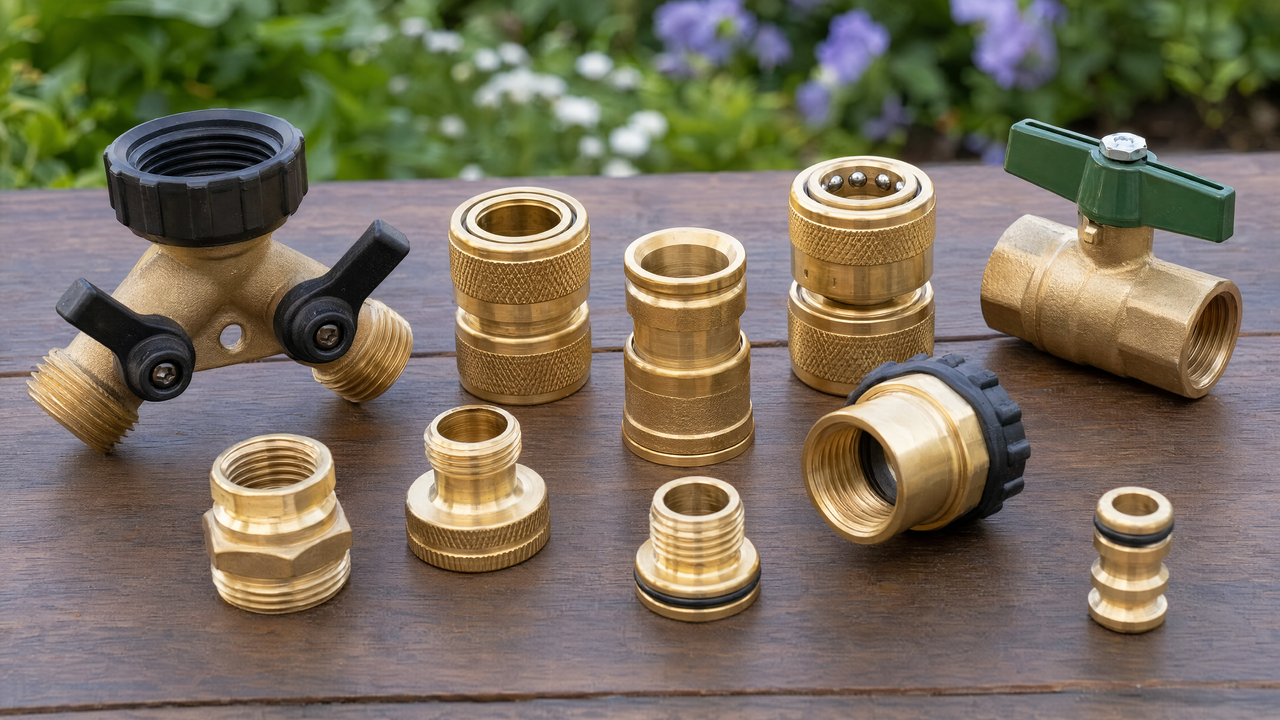
The system is simple. A female coupler goes on the hose end and stays there. Male plugs go on each of your accessories and stay there. From then on you just snap whatever you need into place. A set like these 3/4-inch quick connectors, four male and four female is enough to outfit a nozzle, a sprinkler, a wand and a spare.
Two things to know before you commit. First, quick connects aren't standardized across brands the way GHT threads are — buy your plugs and couplers as one system. Second, each connection point is a potential drip, so keep the included washers in place and replace them when they flatten.
Splitters and shut-off valves
A splitter (or Y-connector) turns one spigot into two or four, each with its own valve. That means the soaker hose in the vegetable bed and the hose you actually drag around can both stay connected. Look for solid brass rather than plastic here — splitters take a lot of hand torque, and plastic ones crack at the worst time.
A shut-off valve lives at the far end of the hose, right before the nozzle, so you can cut the water at the business end instead of walking back to the spigot every time. It also lets you swap accessories without shutting off the main supply and getting soaked. A pair of solid brass shut-off valves is one of those cheap upgrades that feels obvious in hindsight.
The washer does the sealing
This deserves its own line, because it's behind most leaks. On a GHT connection, the threads only pull the two faces together — the rubber washer in the female fitting is what actually seals. If it's missing, cracked, flattened or doubled up, you get a leak no matter how hard you crank.
Washers cost pennies. Keep a bag of them, replace them yearly, and check for one before you assume a fitting is defective.
Brass or plastic?
Plastic is lighter, cheaper, and won't seize onto a spigot. Brass is stronger, handles hand-tightening without cracking, and survives freezing far better. For anything that stays permanently attached or gets cranked on regularly — splitters, shut-off valves, spigot adapters — brass is worth the few extra dollars. For a nozzle you'll toss in a shed, plastic is fine.
Quick reference
- 3/4" GHT — the standard US garden hose thread. Sealed by a washer.
- NPT — tapered pipe thread. Plumbing and pumps. Needs an adapter to meet GHT.
- M22 — metric, common on pressure washer pumps and hoses.
- 5/8" vs 3/4" hose — that's water flow, not thread size. Both use 3/4" GHT ends.
Sorting out a leaky setup or building one from scratch? Our garden watering and hose fittings collection has brass connectors, splitters, quick connects and replacement washers that all speak the same 3/4" GHT language.