
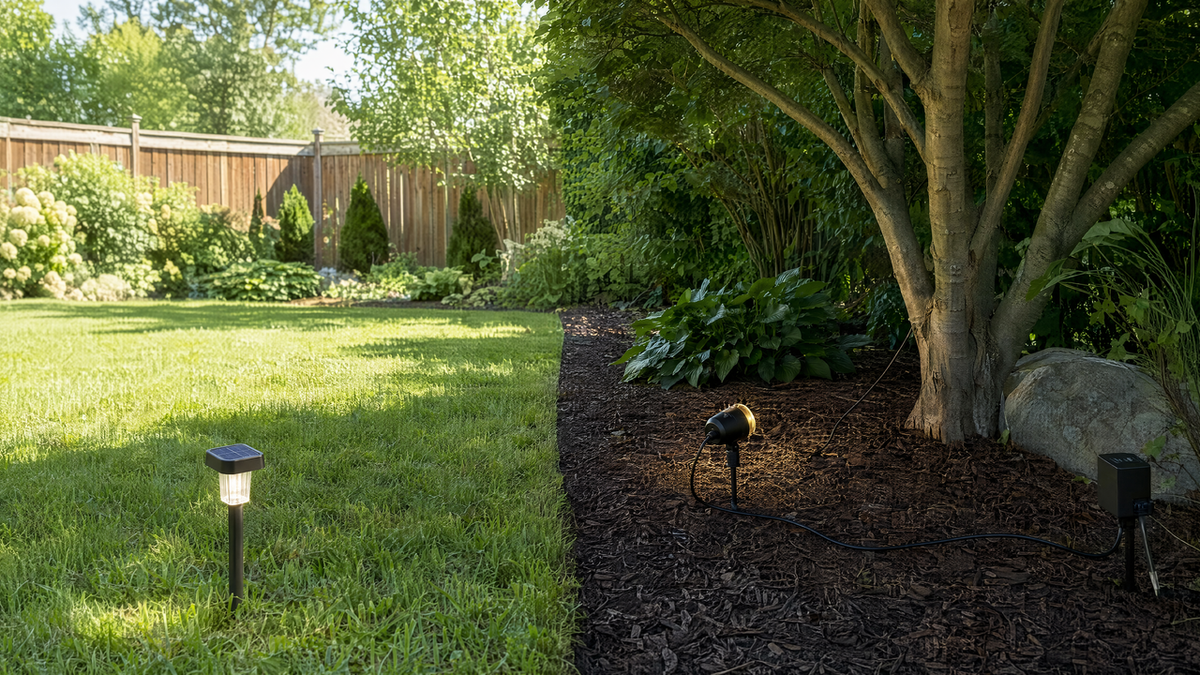
Every outdoor lighting project eventually reaches the same fork: solar or wired. The internet will tell you solar is the lazy choice and low-voltage is the real one, which is not quite right. They are different tools, and picking badly means either an expensive trench you did not need or a row of dim lights that disappoint you all winter.
Here is how the two actually compare, and how to figure out which fits your situation.
The short version
Choose solar if your fixtures will sit in genuinely open sun, you want the project done this afternoon, you rent or expect to rearrange the layout, or the lights are decorative rather than functional.
Choose low-voltage if you need dependable brightness every night, you are lighting for safety or security, your yard is shaded by trees or the house, or you want the lights to look the same in December as they do in June.
Plenty of yards end up with both: low-voltage on the front walkway where reliability matters, solar in the back garden where it does not.
Installation
This is solar's decisive advantage and it is not close.
Solar fixtures push into the ground or hang from a hook. There is no wiring, no transformer, no trenching, no electrician. A dozen path lights takes maybe twenty minutes, most of which is deciding where they look best. Nothing is permanent, so if you dislike the arrangement you move it.
Low-voltage means running cable from a transformer mounted near an exterior outlet out to each fixture, usually buried a few inches deep. It is well within DIY territory, since 12V cable is safe to handle, but a typical front-yard run is a weekend of digging. Add a fixture later and you are opening the trench again.
If you have mature landscaping, established beds, or hardscape between the outlet and where you want light, the trenching problem gets substantially worse.
Brightness and consistency
Low-voltage wins here, decisively.
A wired fixture receives constant power all night at whatever brightness it is rated for. A solar fixture runs off whatever its small panel banked during the day, so output depends on panel size, battery capacity, and how much direct sun the location actually received.
The seasonal gap is the part people underestimate. A solar light that runs a cheerful eight hours in July may manage three or four in December, precisely when nights are longest and you want the light most. Cold also reduces the usable capacity of the battery, compounding the shortfall.
The practical implication: use solar where the light is atmosphere, and wired where the light has a job. Nobody minds if a decorative garden lantern fades at 11pm. Everybody minds if the light over the front steps does.
The sun requirement, which is stricter than it sounds
Solar fixtures need direct sunlight, not ambient daylight. Manufacturers typically specify six to eight hours, and that means unobstructed sun hitting the panel face.
Places that look sunny but are not: the north side of a house, under the drip line of a tree that leafs out in May, along a fence that shades the strip in the afternoon, anywhere a neighbouring building throws shade for part of the day. A panel in dappled shade may collect a third of what it needs.
Before committing, spend a day glancing at the intended spot at 9am, noon, and 4pm. If it is shaded at any two of those, either pick a different location or go wired.
Where you do have sun, hanging fixtures often outperform ground stakes for a simple reason: they sit above grass, mulch, and low planting, so nothing grows up to shade the panel by August. A pair of 34-inch hanging solar lanterns on shepherd hooks can be positioned wherever the sun actually falls rather than wherever the path happens to run, and moved seasonally as shade patterns shift.
Cost over time
Solar has a much lower entry cost. A set of solar path lights runs a fraction of what an equivalent low-voltage setup costs once you include the transformer, cable, and fixtures.
The picture changes over five to ten years. Solar batteries are consumable, typically needing replacement every one to three years, and the panels themselves gradually cloud from UV exposure. Cheap solar fixtures often are not worth repairing when the battery dies.
Low-voltage costs more upfront but the fixtures last a decade or more, LED lamps are replaceable, and the only running cost is a small amount of electricity. If you are lighting a permanent front-of-house scheme you expect to keep, wired is usually cheaper in the long run. For a back garden you will redesign in three years, solar almost certainly is not.
Maintenance
Solar needs the panel wiped clean a few times a year. Dust, pollen, and hard-water residue from sprinklers all cut charging efficiency significantly, and a cloudy panel is the most common reason a solar light "stops working" when the battery is actually fine.
Low-voltage needs almost nothing, though connections can corrode, and buried cable is vulnerable to anyone putting a spade in the wrong place.
A reasonable hybrid approach
Most yards do not need to choose one philosophy. A pattern that works well:
- Front walkway and entry: low-voltage, for reliable brightness where guests and deliveries need to see
- Driveway edges: solar, since these are usually the sunniest strip on the property and the light is guidance rather than task
- Garden beds and back patio: solar hanging lanterns and string lights, for atmosphere
- Steps and level changes: low-voltage, because this is genuinely a safety matter
Start with the safety-critical spots and get those right, then fill in decoratively with solar where the sun cooperates.
What to check before you buy solar
Look for a replaceable battery, since a sealed unit is disposable by design. Check the IP rating: IP44 handles rain, IP65 handles heavy weather and sprinkler spray. Prefer separate-panel designs if your fixture location is shaded but a nearby spot is not, since these let you mount the panel where the sun is. And look at the lumen figure rather than LED count, because twenty dim LEDs are not brighter than six good ones.
Sizing up your yard? Compare hanging lanterns, path lights, and solar string options in our Outdoor & Solar Lights collection, or pair them with plug-in strands from String Lights & Fairy Lights for a layered look.