
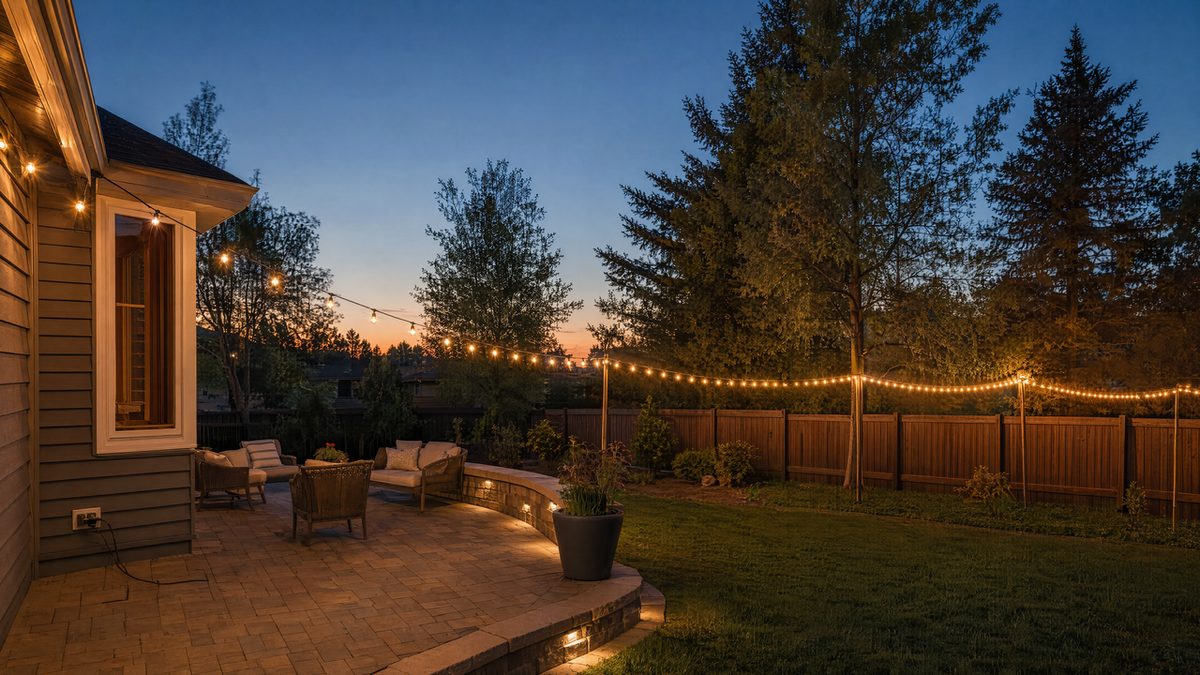
Every set of plug-in string lights ships with a small warning somewhere on the tag: maximum 3 connected sets, or 5, or 43. Most people read it once, shrug, and keep plugging strands together until the run reaches the far end of the patio. Usually nothing happens. Occasionally the breaker trips, a fuse blows in the plug, or the last twenty feet glow noticeably dimmer than the first twenty.
That number isn't arbitrary and it isn't a warranty dodge. It's the point at which the copper in the first strand's wire is carrying as much current as it was designed to carry. This guide explains where the number comes from, how to calculate it for the lights you already own, and how to run lights across a long yard when one chain isn't enough.
Why there's a limit at all
When you connect strands end to end, they wire in parallel. Every strand you add draws its own current, but all of that current flows through the wire of the first strand — the one plugged into the outlet. Strand one carries the load of the entire chain. Strand two carries everything after it. The last strand carries only itself.
So the limit isn't about the lights. It's about how much current the thin conductor in that first strand can move without heating up. Push past it and the wire warms, the insulation ages faster, and in a bad case the inline fuse in the plug does its job and cuts the circuit.
The two numbers that matter
Look at the tag on the plug or the box:
- Watts per set. Modern LED strands are frugal — often 3 to 12 watts for a 33 to 50 foot run. Old incandescent minis were 20 to 40 watts for the same length, which is why the old rule of thumb was "three sets and stop."
- Maximum connected sets. The manufacturer has already done the math for you. If the tag says 43, believe it — LEDs really are that efficient.
Doing the math yourself
If the tag has worn off or you're mixing brands, work it out from first principles. A standard US household circuit is 15 or 20 amps at 120 volts, and the safe continuous load is 80% of that rating: 1,440 watts on a 15-amp circuit.
But the circuit is almost never your bottleneck. The strand's own wire gauge is. A practical approach:
- Find the watts per strand. If it's not printed, multiply amps by 120. A strand rated 0.1A draws about 12 watts.
- Multiply by the number of strands you want to chain. Six 10-watt strands is 60 watts.
- Compare that total to the strand's stated max connected load, usually printed as a wattage on the plug. If the plug says "max 210W connected," 60 watts is comfortably inside it.
- When in doubt, halve it. Nobody has ever regretted running a shorter chain.
One rule that overrides all of the above: never mix LED and incandescent strands in the same chain. The incandescent set will blow past the LED strand's designed load long before you hit the strand count on the tag.
What to do when one chain isn't enough
Say you want lights across a 120-foot property line and your strands top out at three connected sets. You don't need different lights — you need a different layout.
Run parallel chains from a single outdoor outlet
Instead of one 120-foot chain, run three separate 40-foot chains back to an outdoor-rated power strip or splitter. Each chain's first strand now carries only its own third of the load. The outlet handles the total, which is what outlets are built to do.
Extension cords do the heavy lifting here, and they should be outdoor-rated (look for a W in the type designation) and heavy enough for the run — 16 gauge for short hops, 14 gauge past 50 feet.
Choose strands built for long runs
Some designs are simply better suited to distance. Plug-in LED sets like these 33ft star string lights are designed to link end to end and pull very little per strand, so you can chain several before you're anywhere near the limit. Browse the full range in String Lights & Fairy Lights and check the connected-load rating on each product before you commit to a layout.
Go battery-powered where wiring is a nuisance
The connection limit only applies to plug-in strands. Battery and solar sets are electrically independent — each one is its own tiny circuit, so you can place fifty of them and never think about amperage. This is the easy answer for wrapping trees at the back of a lot, decorating a fence line with no nearby outlet, or draping a pergola you'd rather not run cord to. A set like this 99ft copper wire fairy light strand covers serious distance on six AA batteries.
The trade-off is battery changes and lower brightness. For accent lighting and holiday decorating that runs a few hours a night on a timer, most people find it more than acceptable.
Signs you've gone too far
Even if you're technically within spec, the lights will tell you when something's wrong:
- Visible dimming toward the end of the chain. Voltage drop. Not dangerous, but it looks bad and means you're near the practical limit.
- A warm plug or connector. Stop and unplug. Warm is a warning; hot is a problem.
- A breaker that trips after twenty minutes. The circuit is loaded near capacity and heat is doing the rest. Split the run.
- A dead chain from one point onward. Usually the inline fuse in a plug, which is a cheap and easy fix — spare fuses often ship taped inside the plug housing.
A quick planning checklist
- Measure the run before you buy, then add 15% for sag and slack.
- Divide by strand length to get the number of strands.
- Check the max-connected number on the product page. If your count exceeds it, plan parallel chains.
- Locate your outdoor outlets and confirm they're GFCI-protected.
- Put the whole display on a timer so it isn't running unattended overnight.
Ten minutes of planning at the kitchen table beats standing on a ladder in November discovering that the last strand won't light.
Ready to plan your run?
Whether you're lighting a patio for fall evenings or getting ahead of the holiday rush, start with strands rated for the distance you actually need. Browse plug-in and battery options in String Lights & Fairy Lights, or see what's working for other yards in Best Sellers.