
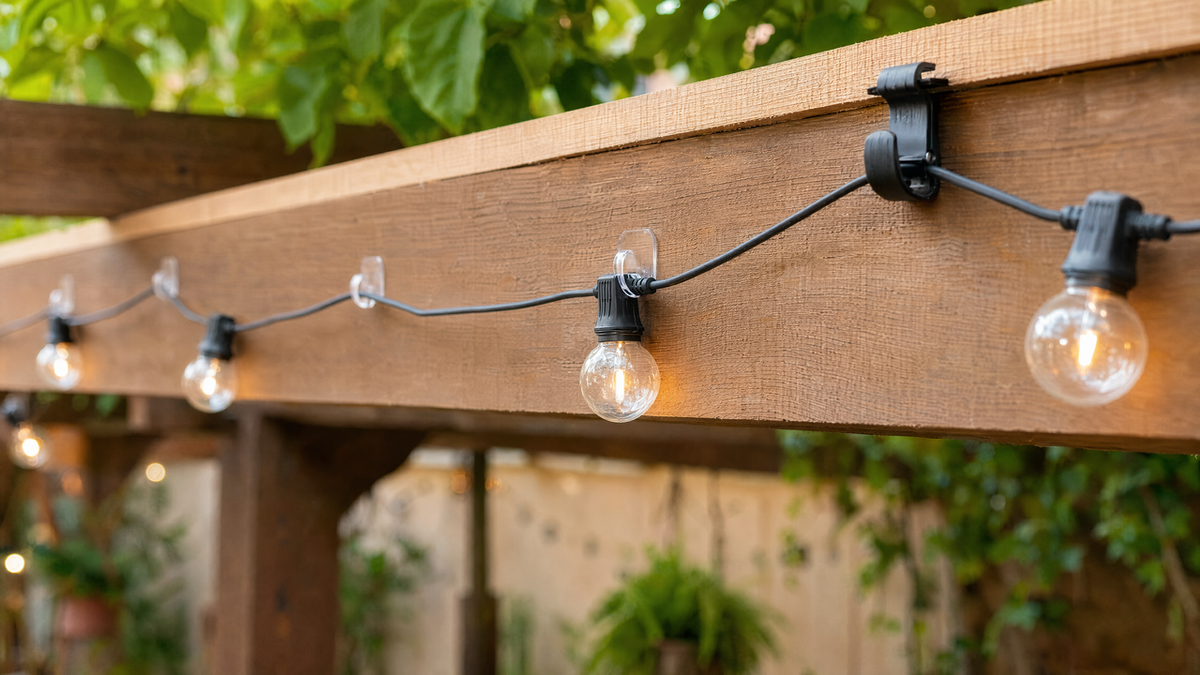
String lights transform a patio faster and cheaper than anything else you can buy. The problem is the mounting. Most guides assume you own the building and are happy to put screw hooks into your fascia board, which is not much help if you rent, if your patio is concrete and brick, or if you simply do not want holes in your siding.
There are good no-drill options. There are also a lot of bad ones that hold for a week and then let a whole strand down onto the grill. Here is what separates them.
First, understand what you are fighting
A strand of lights weighs very little. That is not the load that matters.
What matters is wind. A 25-foot strand strung across an open patio acts like a very long, very low sail, and gusts apply sharp, repeated tugging at the anchor points. Any mount that fails outdoors almost always fails because of cyclic wind loading, not because of the static weight of the lights.
The second factor is temperature swing. Adhesives that hold perfectly at 70°F soften above 90°F and go brittle below 40°F. A hook applied in mild spring weather can release on the first hot afternoon.
Design around both and your lights will stay up.
Method 1: Outdoor adhesive hooks, applied properly
Adhesive hooks work outdoors, but only the ones explicitly rated for exterior use, and only if you prepare the surface. Indoor hooks will not survive a single humid week.
Surface prep is where most people go wrong. Wipe the mounting spot with rubbing alcohol, not household cleaner. Cleaning sprays leave a surfactant film that adhesive will not bond through, which is why so many hooks fall off despite the surface looking clean. Let it dry fully, press the hook firmly for a solid thirty seconds, then leave it alone for an hour before hanging anything.
Adhesive hooks work well on smooth siding, painted trim, glass, and finished wood. They work poorly on brick, stucco, unfinished masonry, and anything textured. If your surface is rough, skip to the next method.
Space hooks every three to four feet rather than only at the two ends. Distributing the load means no single hook takes the full wind force, and a strand supported at intervals also hangs in a much nicer curve.
Method 2: Tension wire between fixed points
This is the most reliable no-drill approach and the one professional installers use for permanent-looking results.
Instead of hanging the light strand itself, run a length of coated steel guy wire between two existing structures: porch posts, fence posts, a pergola frame, a downspout bracket, a mature tree. Wrap and clamp the wire rather than fastening into anything. Then clip the lights to the wire with small S-hooks or zip ties.
The wire carries all the tension. The lights just hang from it, unstressed. This is why the method survives storms that pull adhesive hooks off walls, and why the lights themselves last longer: the strain relief at each bulb socket is no longer being yanked.
Keep the wire taut but not banjo-tight. A slight sag is correct, and it prevents the wire from pulling your anchor points inward over time.
Method 3: Freestanding poles in planters
If you have no useful anchor points at all, which is the usual situation on a balcony or a rented patio slab, make your own.
Set a length of galvanized pipe or a wooden post into a large planter or bucket, fill it with quick-set concrete, and top it with soil and a plant so it looks intentional. Two of these give you a span. Four give you a square canopy overhead.
The rule that matters here is weight. A pole holding a light strand in wind needs a base heavy enough that it cannot tip, which in practice means at least 40 to 50 pounds for a six-foot pole. Undersized bases are the reason DIY light poles end up lying on the patio.
Plug-in strands suit this setup well, since the poles sit near the edge of the space where an outlet usually is. A 33ft plug-in star string light gives a warm, steady glow with no batteries to swap and can be run end to end for longer spans.
Method 4: Gutter hooks and railing clips
Gutter hooks slip over the lip of a gutter and require no fasteners at all. They are genuinely excellent where you have gutters to work with, and they cost almost nothing.
The caveats are real though. Do not use them on gutters already sagging or pulling from the fascia, and clear the gutter before you hang anything, because you will not want to reach past a live strand in November.
For balconies, railing clips and simple zip ties around the balusters work well and leave no trace. Zip ties are unglamorous but they are UV-stable, cost pennies, and hold better than almost anything adhesive. Cut them off at the end of the season and nobody will ever know.
Method 5: Curtain lights on a tension rod
For a covered porch, an alcove, or a window, a curtain-style light panel on a spring tension rod is the fastest install of all. The rod pressure-fits between two walls or a window frame, the light panel hangs from it, and the whole thing goes up in about two minutes with zero hardware.
A 300 LED warm white curtain light creates a solid wall of light rather than a single line, which works especially well as a backdrop for a seating area or behind a bar cart. Just keep the rod span under about four feet, since tension rods lose grip badly as they extend.
Things to avoid
- Staples through the wire. Even careful stapling can pierce insulation and create a shock or fire risk.
- Indoor tape outdoors. Duct tape and painter's tape both fail within days once weather gets to them.
- Suction cups on anything but glass. And even on glass, expect to re-seat them regularly.
- Single-point hanging. One hook at each end concentrates all wind load into two spots. Spread it out.
One safety note
Whatever method you choose, confirm your strands are rated for outdoor use, and plug them into a GFCI-protected outlet. Keep connections off the ground and out of standing water, and if you are running an extension cord, use one rated for exterior use rather than an indoor cord run out through a door.
Pick your mounting method first, then choose the strand length to match the span you have measured. Browse plug-in, battery, and curtain options in our String Lights & Fairy Lights collection.