
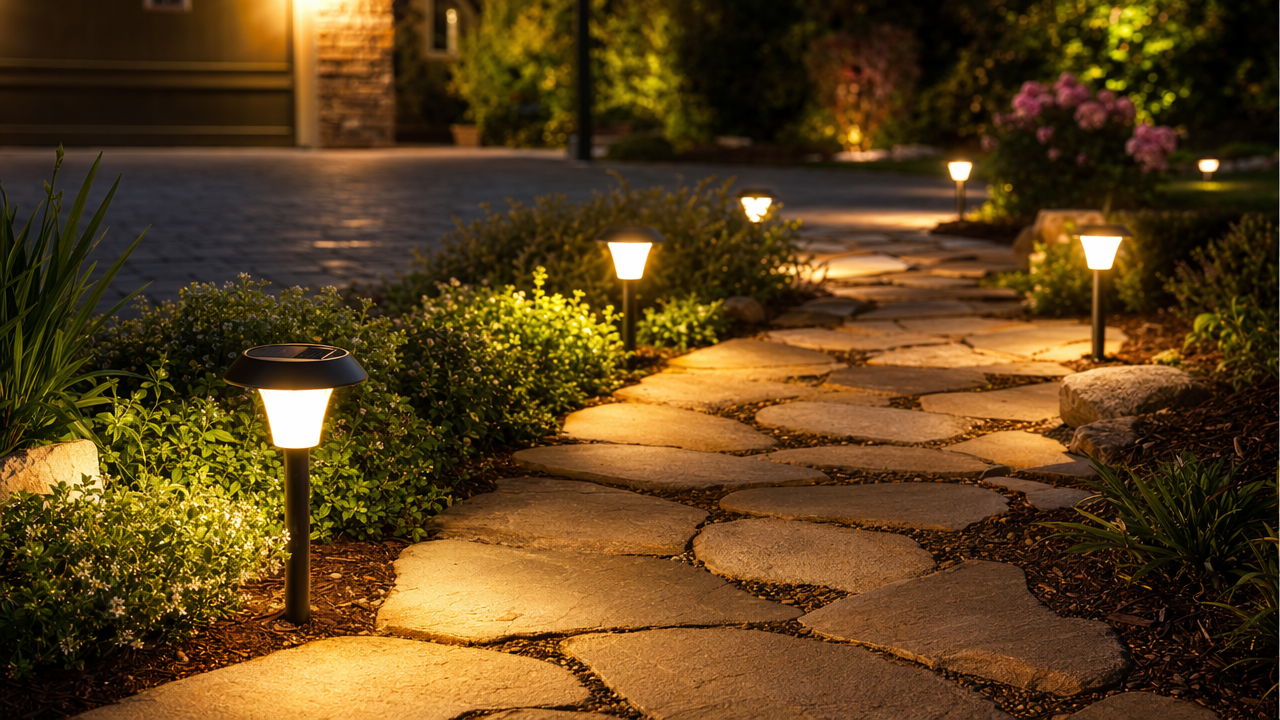
Nothing sharpens the look of a yard after dark quite like a run of solar pathway lights lining the walkway to your front door. They make evening arrivals safer, give landscaping a polished, finished feel, and—because they run on sunlight—they add zero cost to your electric bill. If you have been thinking about lighting up your walkway, driveway, or garden beds this summer, this guide walks through how solar pathway lights work, what to look for before you buy, and how to place them for the best results.
Why choose solar pathway lights?

The biggest draw is simplicity. There is no wiring, no trenching, and no transformer to install. You push each stake into the ground where you want it, let the built-in panel soak up daylight, and the lights switch on automatically at dusk. That makes solar the easiest lighting upgrade a homeowner can tackle in an afternoon.
Solar is also flexible. Because each fixture is self-contained, you can move lights around as your garden changes, add more as your budget allows, or pull them up entirely for winter. And since they draw power from the sun rather than the grid, running them all night costs nothing. If you are just starting to plan an outdoor lighting layout, browse the full range of outdoor and solar lights to see the different styles and brightness levels available.
How solar pathway lights work

Each light has four core parts: a small photovoltaic panel on top, a rechargeable battery, an LED bulb, and a light sensor. During the day the panel converts sunlight into electricity and stores it in the battery. When the sensor detects that it is getting dark, it switches the LED on and runs it off the stored charge. In the morning the cycle starts over.
Because the whole system depends on that daytime charge, placement matters. Our 12-pack pathway lights need roughly 6–8 hours of good sunlight to reach a full charge, which then delivers around 10 hours of run time overnight. A light that sits in shade all day will collect far less and may only glow for an hour or two after sunset.
One practical note that catches people out: there is an ON/OFF switch under the light cap, and it has to be switched ON before the unit will charge at all. Brand-new lights may also need a few charge-and-discharge cycles before the battery reaches full capacity, so do not judge performance on the first night.
What to look for when buying
Brightness and coverage

Set expectations correctly here, because this is where most disappointment comes from. Pathway lights of this type are decorative markers, not floodlights. They outline an edge, cast a soft warm pool on the ground, and throw an attractive shadow pattern — they will not light up a whole yard, and they are not a substitute for a porch fixture or motion floodlight.
Because each light is gentle on its own, the effect comes from repetition. A set that spreads evenly every few feet looks far better than a handful of fixtures with dark gaps between them, which is why buying in a multipack makes sense for a longer path or driveway.
Battery and panel quality

Runtime comes down to the battery and the panel feeding it. Our pathway lights use a standard AAA Ni-MH rechargeable cell in each fixture — an ordinary, replaceable size, which matters more than it sounds. Sealed proprietary batteries turn a dimming light into landfill; a common AAA cell means you can refresh a whole set for a few dollars years down the line.
Weather resistance and materials

These lights live outside year-round, so build quality matters. Look for a stated IP rating rather than a vague "weatherproof" claim. Ours are rated IP44, which under IEC 60529 means protection against solid objects 1 mm and larger plus splashing water from any direction — fine for rain, snow, frost, and sprinkler spray, though not for submersion. Sturdy ABS housing and a firm stake also help fixtures stay upright through wind and mowing.
Height and style
Size the fixture to the job. Ours stand 13.4 inches tall on a 3.3-inch base — tall enough to cast light clear of low planting, short enough to stay unobtrusive along a walkway. Taller fixtures throw light over a wider area and suit driveways and open borders; shorter ones tuck neatly into flower beds. Warm-toned LEDs give a soft, inviting glow, while cooler tones read brighter and more modern. Pick a look that matches your home's exterior.
Where to place solar pathway lights

Along a walkway, space lights evenly—every six to eight feet is a good starting point—and stagger them slightly on either side for a balanced look. Lining a driveway, keep them just off the edge so they mark the boundary for arriving cars without getting in the way. In garden beds, use them to highlight a favorite planting or to light the transition between lawn and border.
Wherever you put them, aim the panels toward open sky and away from the shadow of the house, fences, or dense shrubs. A little planning here is the single biggest factor in how brightly they will shine at night. One more tip: make sure the soil is soft before pushing a stake in — forcing a stake into hard ground is the most common way these get broken on day one. For more placement inspiration, the outdoor and solar lighting collection is a good place to compare pathway lights side by side.
Pairing pathway lights with solar string lights

Pathway lights handle the ground plane, but you can layer in overhead sparkle to finish the scene. A set of outdoor solar string lights draped along a fence, wrapped around a tree, or strung over a patio adds a warm canopy of light above the walkway your pathway fixtures define. Because both run on solar power, the whole display lights up together at dusk with no outlets or timers to fuss with. Explore more overhead options in the string lights and fairy lights collection to build a layered look.
Care and maintenance tips
Solar lights are close to maintenance-free, but a few small habits keep them performing. Wipe the panels clean every few weeks—dust, pollen, and grime block sunlight and shorten runtime. If a light seems dim, check that the panel is not shaded by grass that has grown up around the base. After a long stretch of gray weather, the batteries will simply recharge once the sun returns. And every couple of seasons, swapping in fresh AAA rechargeable cells will restore fixtures that no longer last the night.
Light the way this summer
Solar pathway lights are one of the simplest, most rewarding outdoor upgrades you can make: no wiring, no running costs, and an instant lift to your home's evening curb appeal. Give the panels 6–8 hours of real sun, space the fixtures evenly, and treat them as the decorative accent they are rather than a floodlight replacement—do that and you get a walkway that looks great and feels safe after dark. Ready to get started? Browse the full outdoor and solar lights collection and light up your path tonight.