
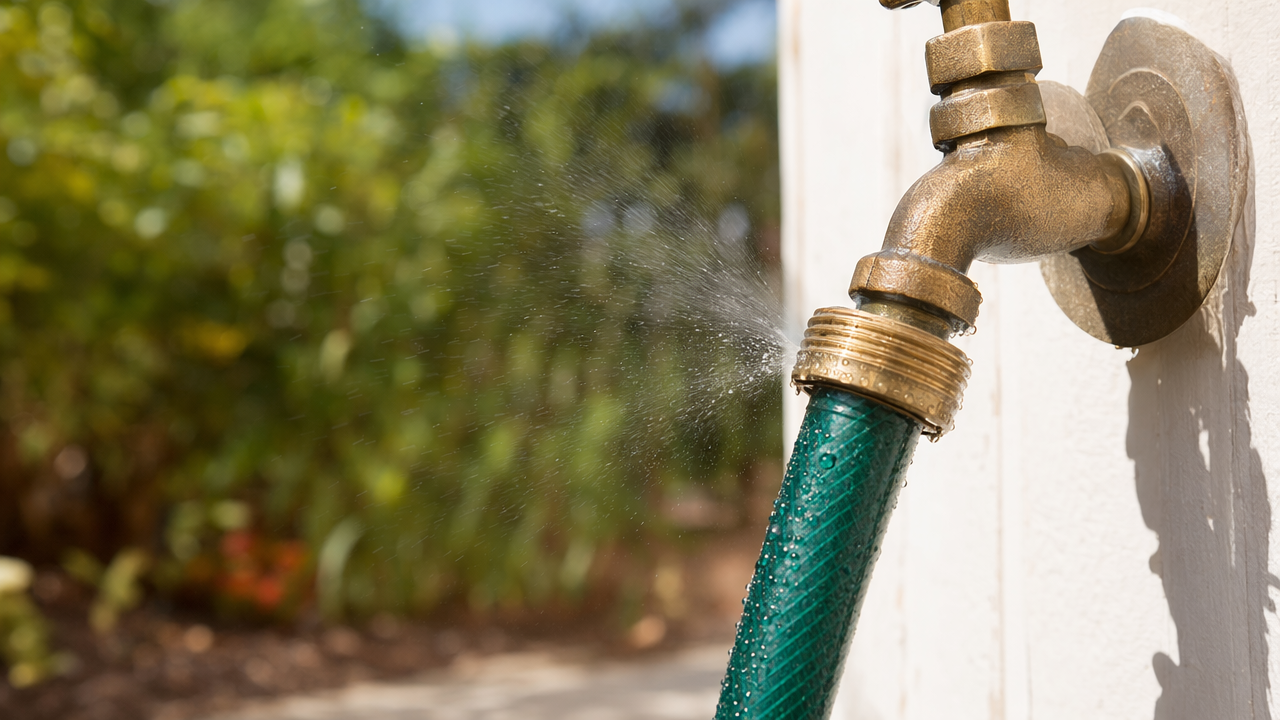
Few backyard annoyances are as persistent as a garden hose that sprays a fine mist from the spigot every time you turn on the water. A leaky hose connection wastes a surprising amount of water — a steady drip can add up to hundreds of gallons over a summer — and it soaks your shoes, erodes the soil by your foundation, and makes every watering session a little more irritating than it needs to be.
The good news: almost every hose leak comes from one of a handful of causes, and most fixes take less than five minutes with parts that cost a few dollars. Here's how to diagnose where your leak is coming from and five fixes that actually work, starting with the cheapest.
First, Find Where the Leak Is Coming From
Turn the water on and look closely. Hose connection leaks almost always show up in one of three spots:
- At the spigot (hose bib): water sprays or drips from the joint where the hose screws onto the faucet.
- At a coupling: the leak is where two hoses join, or where a nozzle, sprinkler, or splitter attaches.
- From the fitting itself: the metal or plastic coupling on the end of the hose is cracked, bent, or corroded and weeps water even when tight.
If water is leaking from the middle of the hose rather than a connection point, you're dealing with a punctured hose — a different repair. For connection leaks, work through the fixes below in order.
Fix 1: Replace the Rubber Washer (Solves Most Leaks)

Inside every female hose fitting sits a small rubber washer that compresses against the male threads to form the seal. These washers flatten, crack, and dry out — usually after a season or two in the sun, or a winter left outside. A worn washer is the single most common cause of a leaky connection.
How to do it
- Unscrew the hose from the spigot or accessory.
- Use a flathead screwdriver or needle-nose pliers to pop out the old washer. If it looks flattened, cracked, or brittle, that's your culprit.
- Press a new washer in flat, then reconnect and hand-tighten.
Hose washers cost pennies, and many quality fittings ship with spares. Keep a few in your garage drawer — it's the duct tape of garden watering.
Fix 2: Re-Seat and Tighten the Connection
If a fresh washer doesn't stop the drip, the connection may be cross-threaded. Unscrew the fitting completely, line it up squarely with the threads, and screw it back on slowly by hand. It should turn easily for several rotations — resistance right away means it's cross-threaded, so back off and start again.
Hand-tight plus a gentle quarter turn with pliers is usually plenty. Over-tightening crushes the washer and warps soft fittings, which causes the very leak you're trying to fix.
Fix 3: Seal Stubborn Threads with Plumber's Tape
For metal-to-metal connections that still weep — especially at the spigot — wrap the male threads with two or three layers of PTFE thread seal tape (plumber's tape), wrapping in the same direction the fitting screws on. The tape fills tiny gaps in worn threads and gives the washer a better surface to seal against. This is a 30-second fix that rescues many older spigots.
Fix 4: Replace Cracked or Corroded Fittings

Plastic couplings crack in the sun, and cheap stamped-metal fittings bend the first time someone drives a lawn mower over them. Once a fitting is deformed, no washer will save it — replacement is the only fix that lasts.
When you replace a fitting, upgrade to solid brass. Brass resists rust and corrosion, holds its shape when tightened, and survives being dropped, stepped on, and left out in the weather. A heavy-duty brass shut-off valve connector is a smart choice at the spigot end: it gives you a leak-free brass joint plus a lever to cut water at the hose itself, so you're not walking back to the faucet every time you switch sprinklers.
You'll find splitters, swivels, shut-off valves, and repair ends in our full range of garden watering and hose fittings — replacing a failed fitting is a five-minute job with the right part on hand.
Fix 5: Upgrade to Quick-Connect Fittings

If your leaks keep coming back, the root cause is often repeated screwing and unscrewing — every swap between nozzle, sprinkler, and pressure washer grinds the threads and chews up washers. Quick connectors fix the pattern, not just the symptom.
A 3/4-inch quick connector male and female set threads onto your spigot, hoses, and accessories once; after that, everything clicks together and apart in one second with no thread wear at all. Install the male halves on your accessories and the female halves on your hose ends, and you'll never wrestle a stuck coupling again. Make sure each threaded joint gets a rubber washer during the one-time installation — that's what keeps the whole system drip-free.
Prevent the Next Leak
- Take fittings inside for winter. Freeze-thaw cycles crack plastic and split cheap metal.
- Replace washers every spring. A once-a-year swap costs almost nothing and prevents most leaks before they start.
- Don't let hoses hang by the connection. The weight bends the coupling oval so it can no longer seal. Use a hose hanger or reel.
- Check O-rings on pressure washer connections too. The same wear happens at higher pressure — worn O-rings and couplers are the usual cause, and pressure washer parts and accessories like replacement O-ring kits and quick-disconnect adapters solve it the same way.
Stop the Drip for Good
Start cheap: new washer, clean re-seat, thread tape. If the fitting itself is damaged, replace it with brass once and stop re-fixing the same leak every season. Ready to end the drip? Browse our garden watering and hose fittings collection for brass connectors, quick-connect sets, splitters, and replacement washers that keep every connection tight all summer.