

⚡ Key Takeaways
- Curtain lights create an instant canopy effect — no pergola or permanent structure required.
- Six distinct placement zones covered: porch, fence, pergola, window, gazebo, and tree.
- ENERGY STAR certified decorative light strings use about 92% less energy than incandescent strands (ENERGY STAR).
- Warm white (2700K–3000K) is the usual choice for evening ambiance; cooler tones read brighter and more task-like.
- Check the IP rating before any outdoor install — IP44 handles splashing water, IP65 adds dust-tightness and water-jet resistance.
Curtain lights have quietly become one of the most versatile tools in outdoor decorating. Unlike standard string lights that run in a single strand, curtain lights hang in vertical rows — creating a shimmering waterfall effect that transforms any plain wall, fence, or overhead beam into something that looks professionally designed. Whether you are preparing for a summer backyard party in July or building a cozy autumn porch setup, the same set of lights can do the job with minimal effort.
This guide covers six tested placement zones, practical installation tips, and answers to the questions most buyers ask before they order. By the end, you will know exactly where and how to hang curtain lights outdoors for maximum effect.

1. What Makes Curtain Lights Different from Regular String Lights?
Curtain lights — also called cascade or waterfall lights — consist of a main horizontal wire from which multiple vertical drop strands hang at even intervals. This "curtain" silhouette is what separates them from single-strand globe or fairy lights.

The key practical differences:
- Coverage area: Our 300-LED panel measures 6.6 ft wide by 9.8 ft long — roughly 65 sq ft of vertical coverage. The 600-LED panel spans 15.7 ft by 9.8 ft, about 154 sq ft. A single string strand covers almost none.
- Visual density: The 300-LED set runs 30 LEDs per drop strand — roughly one bulb every 4 inches down the strand, with strands about 8 inches apart. That grid is what creates the layered, cascading look single strings cannot replicate.
- Installation: You mount one horizontal header wire, not individual hooks every 12 inches.
2. Porch Ceiling & Railing: The Easiest Outdoor Setup

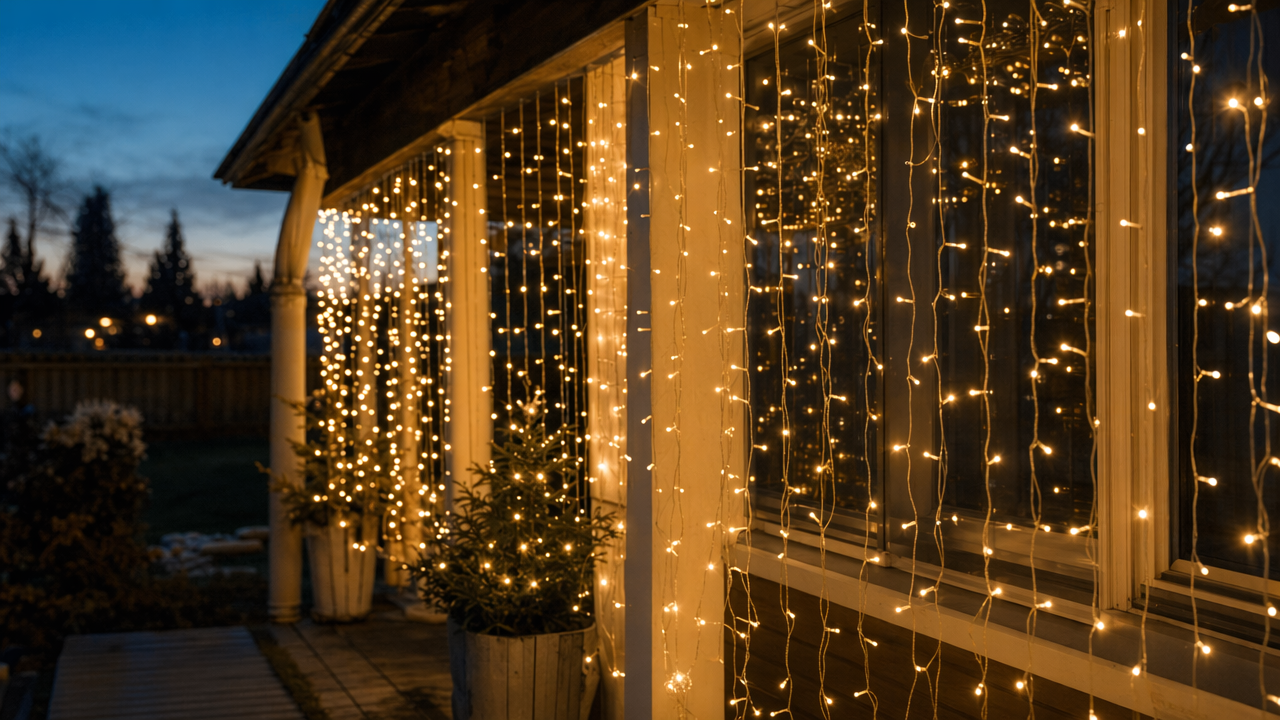
The covered porch is the single best location to start with curtain lights if you have never used them outdoors before. You already have a ceiling edge or fascia board to attach the header wire — no extra hardware beyond a few adhesive hooks or cup hooks is needed.
How to hang curtain lights on a porch ceiling
- Measure the width of the porch opening, then match it to panel width rather than guessing.
- Attach cup hooks or outdoor-rated adhesive clips every 18 inches along the fascia board or ceiling edge.
- Thread the header wire through the hooks, letting the vertical drop strands hang freely downward.
- Plug into an outdoor-rated GFCI outlet. Avoid indoor extension cords — they lack the waterproof sleeve needed for exterior use.
Sizing matters more than most guides admit. A 300-LED panel is 6.6 ft wide, so a 12-foot porch opening needs two panels side by side, or a single 600-LED panel at 15.7 ft wide with a little to spare. Warm white in the 2700K–3000K range is the usual pick for porches — it reads soft and inviting, especially bouncing off a painted ceiling.
3. Fence Backdrop: Turn a Plain Boundary into a Feature Wall

A wood or vinyl privacy fence is the most overlooked canvas in the average backyard. Most homeowners see it as a boundary line. With curtain lights attached horizontally across the top rail, that same fence becomes a dramatic backdrop for outdoor dining, movie nights, or summer gatherings.
Installation method for fences
- Run a length of outdoor-rated extension cord or weatherproof rope along the inside top edge of the fence.
- Use cable clips or zip ties every 12 inches to secure the header wire of the curtain lights to the top rail.
- Let the drop strands hang down the face of the fence. At 9.8 ft, standard drop strands are longer than a 6-foot fence — gather or loop the excess at the base rather than letting it pool in the dirt.
On IP ratings: under IEC 60529, IP44 means protection from solid objects 1 mm and larger plus splashing water from any direction — it is not dust-tight and not rated for hose-down. IP65 is fully dust-tight and withstands low-pressure water jets. Our curtain lights are IP44, which covers normal outdoor exposure; note that the transformer and mode controller are IP44 as well but should never be submerged, so pair them with a waterproof outlet cover outdoors. Browse the full string lights and fairy lights collection to compare panel sizes and drop lengths.
4. Pergola & Gazebo: Building a Canopy of Light

Pergolas and gazebos are architecturally built for lights. Their overhead beams provide natural attachment points, and the open-air structure benefits visually from the downward-cascading curtain effect.
Two approaches for pergola lighting
Option A — Overhead Curtain Drape: Mount the header wire along the top of two parallel beams so the drop strands hang down through the pergola interior. This creates a ceiling-of-light effect for anyone sitting inside.
Option B — Side Panel Enclosure: Hang individual curtain panels from the outside beam edge down to the ground on two or three sides of the pergola. This turns an open structure into a semi-enclosed room — ideal for intimate dinner parties or evening entertaining. A 600-LED curtain panel at 15.7 ft wide covers a full side in one piece, with fewer joins to hide.
String lights running along the top beams can complement curtain panels on the sides — mixing textures (point sources above, linear cascades on sides) produces a layered effect that single-method setups cannot replicate.
5. Window Curtain Lights: Indoor-Outdoor Warmth Through the Glass

Hanging curtain lights inside a large window — facing outward — creates one of the most cost-effective exterior lighting effects available. Passersby see the warm glow through the glass; residents inside enjoy the decorative backdrop without any exterior installation or weatherproofing concerns.
Best practices for window installations
- Indoors, weatherproofing is a non-issue — the glass shields the set, so you can focus purely on size and colour temperature.
- Hang the header wire using removable adhesive hooks on the window frame — no drilling, no damage to the sill.
- Standard 9.8 ft drops are longer than most windows. Gather the excess behind the sill or drape it along the floor rather than cutting — cutting the cord separates the string.
- A plug-in timer is especially useful here — set the lights to run from dusk to bedtime automatically.
6. Tree & Garden Canopy: Natural Overhead Drama

Large deciduous trees offer natural anchor points that no manufactured structure can replicate. Draping curtain light panels from a lower branch — with drop strands hanging freely through the interior of the canopy — creates an organic, forest-party ambiance that photographs beautifully and requires no permanent hardware.
Tree installation tips
- Use tree-safe cable clips rather than tying wire directly to bark — tight binding damages the cambium layer over time.
- Consider solar-powered lights for trees far from electrical outlets. Twinkle Star's solar sets need roughly 6–8 hours of direct sun for a full charge, so pick a tree whose panel can sit in open sky — see the outdoor and solar lights collection.
- Keep drop strands well above mower height to avoid entanglement with lawn equipment.
How to Choose the Right Curtain Lights for Outdoor Use
With hundreds of options available, the table below covers the five criteria that matter most:
| Criterion | What to Look For | Why It Matters |
|---|---|---|
| IP Rating | IP44 for normal outdoor use; IP65 for exposed or wash-down areas | IP44 resists splashing; IP65 adds dust-tightness and jet resistance |
| Bulb Type | LED (not incandescent) | ENERGY STAR certified strings use about 92% less energy; run cool |
| Color Temperature | 2700K–3000K for ambiance; cooler tones for task areas | Warm tones flatter skin tones and landscape features |
| Panel Width | Match header width to your span: 6.6 ft (300 LED) or 15.7 ft (600 LED) | Prevents visible gaps or awkward overlaps between panels |
| Power Source | Plug-in (reliable) or solar (cable-free flexibility) | Choose based on proximity to outdoor GFCI outlet |
One often-overlooked factor is lead wire length — the run from plug to first bulb. Our 300-LED set gives you 9.9 ft and the 600-LED set 8.9 ft, which sets how far from the outlet you can realistically mount before you need an outdoor-rated extension.
Frequently Asked Questions
- Can curtain lights be left outside year-round?
- IP44-rated sets like ours are built to withstand splashing water and normal outdoor exposure, which covers ordinary rain. In regions with heavy snow loads it is still wise to take them down or shelter them during storms, since prolonged snow accumulation stresses wire connections. The transformer and controller are IP44 too but must never be submerged — use a waterproof receptacle cover if the set stays plugged in outdoors. Always check the operating range printed on your own product packaging before overwintering a set outside.
- How many curtain light panels do I need for a 20-foot fence?
- It depends on panel width. Our 300-LED panels are 6.6 ft wide, so three of them span 19.8 ft — essentially seamless across a 20-foot run. Alternatively, one 600-LED panel (15.7 ft) plus one 300-LED panel (6.6 ft) gives you 22.3 ft with a little overlap for density. Curtain lights at this scale are decorative rather than task lighting; if you need brighter illumination over a dining area, add a post-mounted spotlight at the midpoint.
- Are solar curtain lights bright enough for outdoor entertaining?
- For ambient glow rather than task illumination, solar-powered sets are generally adequate. Twinkle Star's solar lights typically need about 6–8 hours of direct sunlight for a full charge and run through the evening from there. For areas requiring brighter function lighting — food preparation, reading — supplement with a plug-in fixture. Solar performs best in summer when daily sun exposure is long; in winter or heavily shaded yards, runtime drops noticeably.
- What is the difference between curtain lights and icicle lights?
- Icicle lights have drop strands of varying lengths — intentionally uneven to mimic the look of ice formations. Curtain lights (also called waterfall lights) use uniform drop strand lengths for a clean, rectangular silhouette. Icicle lights are predominantly used as roofline Christmas decorations. Curtain lights are versatile year-round — they suit weddings, party backdrops, porch enclosures, and garden features as well as holiday displays. If you are decorating for events rather than Christmas specifically, curtain lights with uniform drops give a more polished, intentional result.
- Can I connect multiple curtain light panels end-to-end?
- Often yes — our 300-LED panels are designed to connect up to five sets from a single outlet. Always check the stated maximum for your specific product before chaining, since it varies with LED count and transformer rating. Exceeding it overloads the plug and connector wires, a common cause of outdoor light failure. Note also that the white buckle on the cord is there to secure the power line and must not be cut, or the string separates.

Ready to light up your space?
Curtain lights are the fastest way to turn a plain porch, fence, or window into something that looks deliberately designed. Measure your span first, match it to panel width, pick warm white for ambiance, and start with the easiest zone you have. Browse the full string lights and fairy lights collection to find the right panel size for your space.
References
- Decorative Light Strings — ENERGY STAR, U.S. Environmental Protection Agency. Certified decorative light strings use approximately 92% less energy than conventional incandescent strings.
- IEC 60529 — Degrees of protection provided by enclosures (IP Code), the standard defining IP44 and IP65 ratings.
- Product specifications: Twinkle Star 300-LED and 600-LED Window Curtain String Lights.