
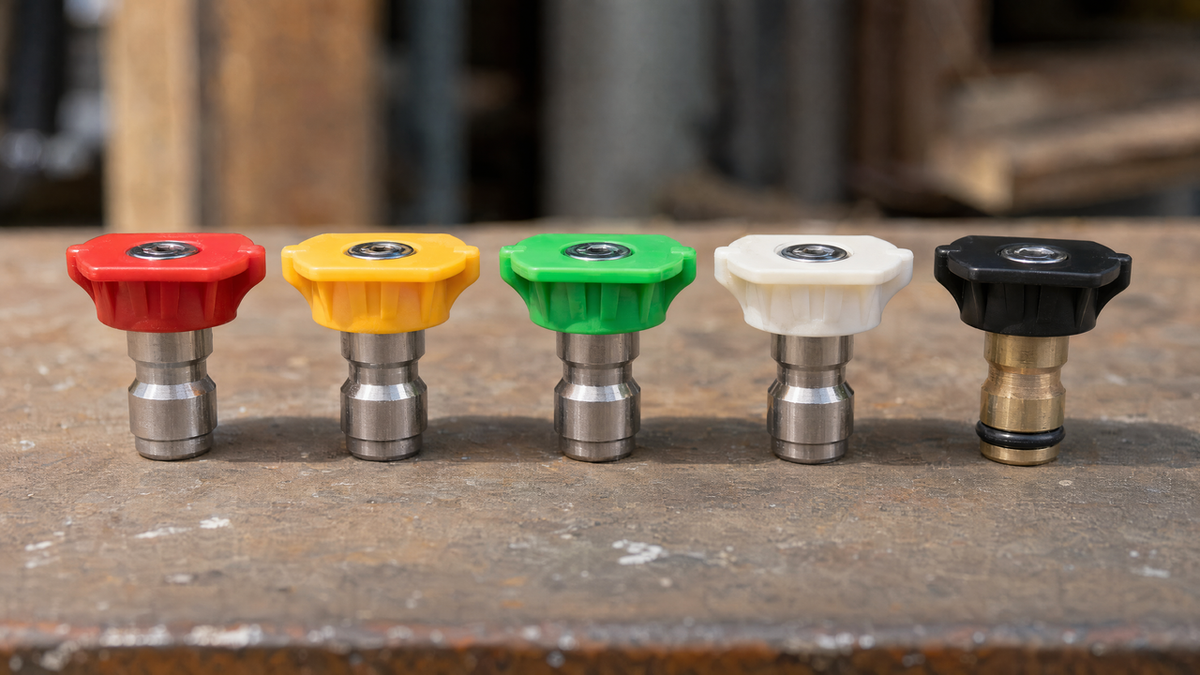
Almost every pressure washer ships with a handful of little color-coded tips, and almost every owner ends up guessing which one to use. That guess matters more than most people realize. The wrong nozzle can carve lines into a wood deck, strip paint off siding, or leave you standing in the driveway for an hour wondering why nothing is coming clean.
The good news is that the color system is standardized across brands. Once you know what the colors mean, you can walk up to any machine and pick the right tip in about two seconds.
What the colors actually mean
The color tells you the spray angle: how wide the fan of water is when it leaves the nozzle. A narrow angle concentrates all of the machine's pressure into a small point, which makes it powerful but aggressive. A wide angle spreads the same pressure across a bigger area, which makes it gentler but better at covering ground.
Here is the standard lineup you will find in a typical five-piece quick-connect nozzle set:
Red (0 degrees)
A single pencil-thin jet of water. This is the most powerful and most destructive tip in the set. It concentrates the full output of the machine into a point roughly the size of a pea.
Use it for: caked-on mud in a wheel well, a stubborn spot of dried concrete on a tool, rust stains on bare metal. Keep it moving and keep it several feet back.
Never use it on: wood, siding, painted surfaces, windows, roofing, or anything you would be sad to replace. The red tip will gouge softwood in under a second.
Yellow (15 degrees)
A narrow fan with real bite. This is your stripping and heavy-prep tip.
Use it for: removing loose paint before a repaint, cleaning unsealed concrete, prepping rough masonry, blasting grease off a garage floor.
Be careful with: soft brick, mortar joints, and any wood surface. Fifteen degrees is still aggressive enough to etch.
Green (25 degrees)
The general-purpose workhorse, and the tip most people should be reaching for most of the time.
Use it for: driveways, sidewalks, patios, fences, outdoor furniture, and general dirt removal on hard surfaces. If you are not sure where to start, start here and only step up to yellow if green is not cutting it.
White (40 degrees)
A wide, soft fan. Low impact per square inch, high coverage.
Use it for: vinyl and painted siding, cars and trucks, boats, windows, deck boards, and anything with a finish you want to keep. This is the tip that gets skipped most often and probably deserves to be used most often.
Black (65 degrees, soap)
The odd one out. The black tip has a much larger orifice, which drops the pressure at the nozzle far enough that the machine's detergent siphon actually engages. Without it, most washers will not draw soap at all.
Use it for: applying detergent. Soap it on with black, let it dwell for a few minutes without drying, then switch to white or green to rinse.
A simple rule for choosing
Start wide and work narrower. Put on the white tip, test an inconspicuous corner from about two feet away, and see what happens. If the surface is not coming clean, step down to green. Only move to yellow if green has clearly failed, and treat red as a specialty tool rather than a cleaning tip.
Distance matters just as much as angle. A green tip held four inches from cedar decking will do more damage than a yellow tip held two feet away. If you want more cleaning power, get closer gradually before you change tips. If you want less, back up.
Match the tip to your machine
Nozzle tips are rated for a specific flow, usually printed as a small number on the side, like 2.5. That number needs to roughly match your washer's gallons-per-minute rating. A tip sized for a big gas unit used on a small electric washer will feel weak and mushy. A tip sized too small will spike pressure and can strain the pump.
Most consumer electric and light gas machines fall in the 2.0 to 2.5 GPM range, which is why 2.5-rated sets are the common default. Check your washer's spec plate before buying a replacement set, and stick with stainless steel tips if you have a choice: brass tips wear out and lose their spray pattern much faster.
Connection problems, and how to solve them
The other reason people struggle with nozzles has nothing to do with color. Pressure washer fittings are inconsistent between brands. Some wands use M22 threads with a 14mm insert, some use M22 with 15mm, and quick-connect sizes vary between 1/4 inch and 3/8 inch.
If your new tips do not seat properly, or your hose will not mate to your gun, an adapter is almost always the fix. A quick-disconnect adapter kit with M22 swivel fittings covers the common mismatches and lets you move tips, hoses, and surface cleaners between machines without buying brand-specific parts.
One more thing worth checking: the small rubber O-rings inside quick-connect couplers are the single most common cause of dripping and pressure loss. They are cheap, they perish, and swapping them takes ten seconds. If a connection has started to weep, replace the O-ring before you replace anything else. You can find both adapters and replacement seals in our pressure washer parts and accessories collection.
Keeping tips working
Nozzles clog. Grit from a garden hose, mineral scale, or a bit of dried detergent will partially block the orifice, and the result is a spray pattern that looks split, angled, or weak.
The fix is a nozzle cleaning wire, or a straightened paperclip in a pinch. Disconnect the tip, push the wire through from the front, then flush it backward with water. If the pattern still looks wrong afterward, the orifice is worn and the tip needs replacing.
It also helps to run an inline filter on your water inlet. Most nozzle clogs and pump wear come from sediment that arrived through the hose, not from the surface being cleaned.
Quick reference
- Red (0°) — spot removal on metal and concrete only
- Yellow (15°) — paint stripping, heavy concrete prep
- Green (25°) — general cleaning, driveways, patios, fences
- White (40°) — siding, vehicles, decks, delicate finishes
- Black (65°) — detergent application only
Print that list, tape it inside the garage door, and the guessing stops.
Ready to restock? Browse stainless nozzle sets, adapters, hoses, and replacement seals in our Pressure Washer Parts & Accessories range, or see what other homeowners are buying in Best Sellers.