
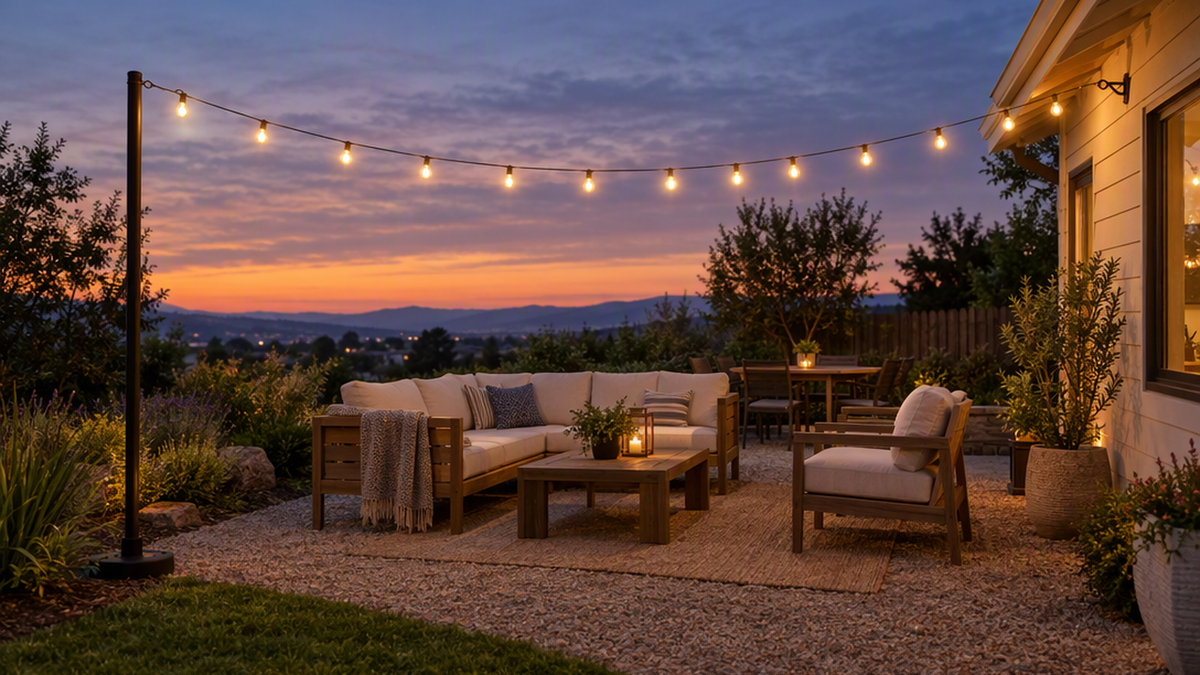
Outdoor string lights look effortless once they're up, but most yards don't come with a pergola or a row of conveniently placed posts to hang them from. The good news is you don't need one. With the right anchor points and a little planning for sag and weight, you can get that same warm, even glow across a patio, deck, or backyard using hooks, poles, trees, or a simple tension wire — no permanent structure required.
What You Need Before You Start
Beyond the lights themselves, plan for three things: anchor points at each end (and along the way for longer runs), a way to take the strain off the light wire itself, and a power source. Outdoor-rated string lights, like an extendable plug-in string light set, make longer runs easier since you can connect multiple strands end to end without doubling up on outlets.
Step-by-Step: Hanging Outdoor String Lights
1. Map your layout and measure first
Walk the space and decide on a shape — straight lines across a patio, a zigzag between two fences, or a loose canopy over a seating area — before buying anything. Measure the total run length and add about 10% for sag, since lights hung perfectly taut look stiff and are actually harder on the wire and anchor points than a gentle drape.
2. Choose your anchor points
Without a pergola, your options are sturdier than you'd think: mature trees, a house eave, a fence post, a garage wall, or freestanding poles set in the ground or in weighted planters. The key rule is strength — an anchor needs to hold the combined weight of the lights plus wind load, not just the lights hanging still on a calm day. A hook screwed into a fascia board or a solid tree branch works; a thin lattice panel or a flimsy umbrella pole usually doesn't.
3. Install tension wire for longer or heavier runs
For anything longer than about 20 feet, or for heavier strands like globe lights, run a length of galvanized steel tension wire between your anchor points first, then attach the string lights to the wire with cable ties or light-duty clips every few feet. The tension wire carries the actual structural load and keeps the lights from stretching, sagging unevenly, or pulling on their own connectors over time.
4. Hang and secure the lights
Attach the light strand to the tension wire (or directly to anchor points for shorter runs), leaving a slight, even curve rather than pulling it drum-tight. Secure the plug and any inline connectors so they're not resting on the ground or hanging at a strain point — a small zip tie looping the cord to the wire near each connector prevents it from working loose in the wind.
5. Plan for power before you're done
Confirm your outlet location and run before you finalize the layout, not after. For patios or yard areas without a nearby outlet, a battery or solar-powered string light set removes the power question entirely, which is often the simplest fix for a spot that looks great but has no plug within reach.
No Pergola? Try These Anchor Options
A single mature tree and a hook on the house can frame one straight run across a patio. Two freestanding poles — driven into the ground or set in filled planters for a deck — give you a defined rectangle to string lights across, and can be moved for next season if your layout changes. For a tighter budget or a rental where you can't drill into siding, over-the-door style hooks on a fence top or temporary adhesive hooks rated for outdoor use can anchor shorter runs without any permanent hardware.
Common Mistakes to Avoid
Pulling the strand too tight is the most common one — it stresses the connectors, and any wind at all puts the whole run under repeated strain. Skipping tension wire on a long run is the second: unsupported light strands stretch under their own weight over a season and sag lower than planned. And running an extension cord across a walking path instead of routing it along a fence line or wall is both a trip hazard and one of the first things guests notice about an otherwise nice setup.
How High Should You Hang Them?
For a seating area, aim for roughly 8 to 10 feet at the lowest point of the sag — high enough that no one bumps a head standing up, low enough that the light still feels close and warm rather than distant. Over a driveway or a wider open yard, you can go higher since the goal is broad ambient light rather than intimate lighting directly overhead. If you're stringing lights near a walkway, double-check clearance at the lowest point of the sag, not just at the anchor points, since that's where a tall guest is most likely to catch a strand.
Bring the Patio to Life Tonight
Once the anchor points and power are sorted, actually hanging the lights takes less time than planning it did. Browse our full range of outdoor string and fairy lights to find the length, brightness, and power option that fits your space.