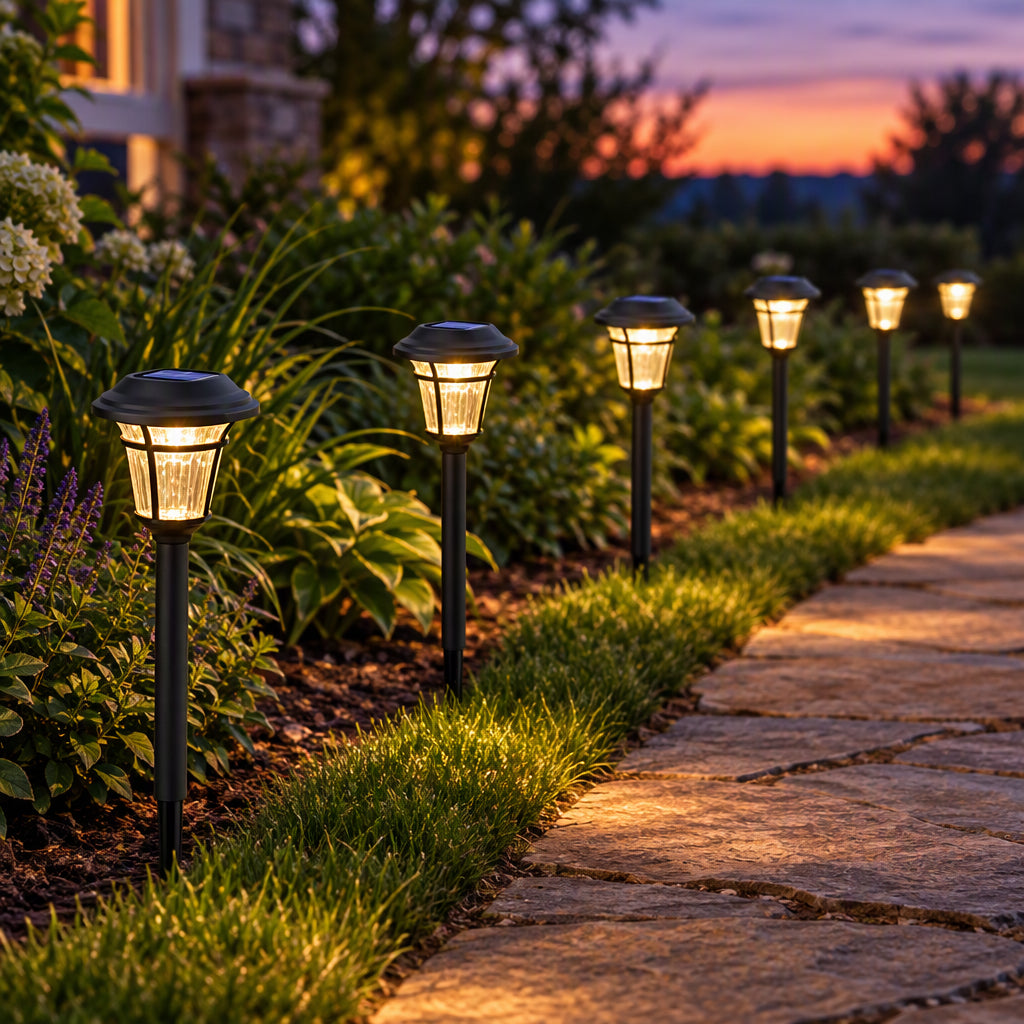
How Many Solar Pathway Lights Do You Need for a 50-Foot Walkway?
For a straight 50-foot walkway, plan on 10 to 13 solar pathway lights spaced about 4 to 5 feet apart on alternating sides. That spacing keeps the pools of light overlapping just enough to read the path edge at night without the stakes looking cluttered in daylight.
Why spacing, not light count, is the real question
Each stake in the 12 Pack Solar Pathway Lights puts out about 1 lumen — enough for a soft decorative glow along the edge of a path, not a floodlit walkway. Because the output is low on purpose, the lights do their job by marking the path edge at regular intervals rather than lighting the ground in between. That's why spacing matters more than raw light count: six lights spread too far apart leave dark gaps, while twelve lights bunched at one end waste coverage everywhere else.
The simple layout rule
- Straight path: stake one light every 4–5 feet, alternating left and right so the glow zig-zags down the path instead of forming two flat lines.
- Curved path: tighten the spacing to 3–4 feet on the inside of each curve so the bend stays visible from a distance.
- Driveway edge: 5–6 feet is usually fine since drivers are looking down the whole length, not at each individual stake.
At 4.5 feet of average spacing, a 50-foot walkway needs roughly 11 lights — which is why the 12-pack is sized for exactly this kind of run, with one spare for a tight curve or an end marker at the door or mailbox.
What changes the number
Three things push the count up or down from that baseline:
- Path width. A wide path (6 feet or more) often looks better lit from both sides, which roughly doubles the stake count for the same length.
- Nearby light sources. A porch light, string lights, or a neighbor's floodlight nearby means you can space the solar stakes a little further apart since they're filling gaps, not providing all the light.
- Sun exposure along the row. Each stake charges on its own; see the next section before you assume every stake needs the same spacing regardless of shade.
Before you stake them in
These lights are rated IP44 and handle rain, snow, and frost fine, but each one needs 6–8 hours of direct, unobstructed sun during the day to reach its 10-hour run time at night. If part of your walkway runs under a tree canopy or along a shaded fence line, a stake placed there will dim out well before the rest of the row does — plan those sections for slightly closer spacing, or skip the solar run there and connect it with the paved or well-lit section it borders.
Related: if a stake you already own is dim or not coming on at all, see Why Are Your Solar Pathway Lights Dim or Not Turning On This Winter? for the charging fix before you assume it's broken.