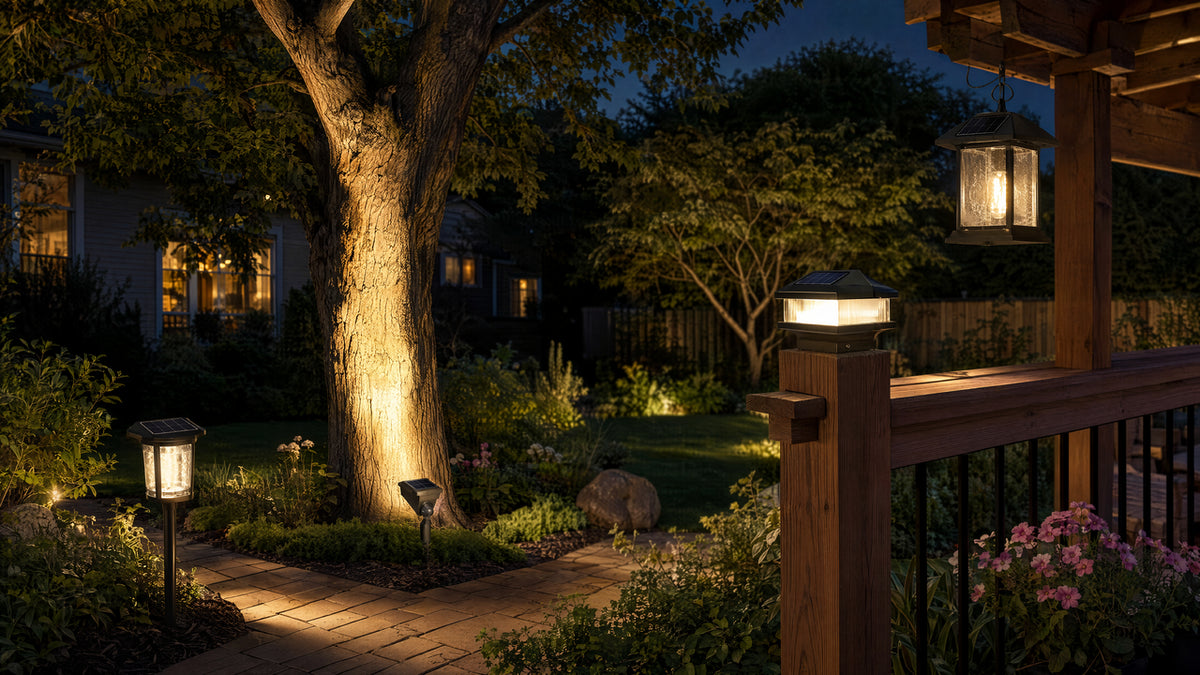
Why Lumens Matter More Than Watts for Solar Lights
Shopping for solar lights used to mean comparing wattage, but that number never told you much about a solar fixture anyway — there's no wall outlet pulling a steady current, just a small panel charging a battery through the day. Lumens are the number that actually matters: they measure how much visible light a fixture puts out, regardless of how it's powered. A pathway light rated at 10 lumens will look like a faint glow at your feet, while a 100-lumen spotlight will throw a real cone of light across a patio. Knowing roughly how many lumens different areas of your yard need makes it much easier to avoid the two most common solar lighting mistakes: buying lights too dim to notice, or buying more fixtures than the space actually calls for — and it makes shopping our outdoor and solar lights collection a lot more straightforward.
How Many Lumens Do You Actually Need?
Pathway and Walkway Lights
For a simple path or driveway edge, 10-30 lumens per fixture is usually plenty. The goal with pathway lighting is to mark the edges of the walkway so people don't step off it in the dark, not to light it up like a runway. Spacing matters as much as brightness here — most homeowners get better results from more lights spaced 6-8 feet apart than from fewer, brighter ones spaced too far to overlap. A set like these 12-pack solar pathway lights is built for exactly this kind of even, low-glare coverage along a walkway or driveway.
Deck, Patio, and Step Lights
Areas where people actually sit, walk, or navigate steps at night need more like 30-60 lumens per fixture, since safety and visibility matter more than ambience. Step and deck-rail lights in particular should be bright enough that the edge of each step is clearly visible, especially if anyone in the household has trouble with depth perception in low light.
Accent and Spotlight Fixtures
If you're lighting up a tree, a flag, or an architectural feature, you'll want a dedicated spotlight fixture in the 50-100 lumen range. These are directional by design, so the lumen output is concentrated on one area rather than spread across a wide space — which is why a 50-lumen spotlight can look brighter on its target than a 100-lumen area light spread over a whole patio.
Hanging Lanterns and Ambient Lighting
Decorative hanging lanterns are meant to create atmosphere, not function as a primary light source, so 15-40 lumens is typically enough. Hanging solar lanterns with shepherd hooks work well along a garden bed border or flanking an entryway, where a soft warm glow matters more than raw brightness.
Other Factors That Affect Brightness
Battery and Solar Panel Size
Two fixtures with identical lumen ratings can perform very differently once the sun goes down, depending on battery capacity. A larger battery and panel combination will run at full brightness for more hours per night and recover faster on cloudy days. If a product listing doesn't mention runtime, it's worth checking reviews for real-world performance, especially for fixtures you're counting on to stay lit until morning.
Number of LEDs Per Fixture
Some fixtures reach their lumen rating with a single bright LED, while others spread the same output across several smaller LEDs. Multi-LED fixtures tend to distribute light more evenly and produce less glare when you look directly at them, which matters for anything installed at eye level, like a lantern or wall-mounted accent light.
Sun Exposure Where You Install Them
Even the best solar light will underperform its rated lumens if it's mounted in a shaded spot. Panels need several hours of direct sun to fully charge, so a pathway light tucked under a tree canopy or a covered porch overhang will run dimmer and shorter than the same light in an open, south-facing spot. If a fixture is underperforming, it's worth checking placement before assuming the light itself is defective.
Matching Lumens to Your Space
A simple way to plan a yard is to work space by space: pathways and driveway edges get low-lumen markers spaced evenly, decks and steps get medium-output fixtures wherever footing matters, and any tree, flag, or feature you want to highlight gets a dedicated spotlight. Mixing brightness levels this way, rather than using one uniform product everywhere, tends to look more intentional and function better than blanket lighting.
Does Color Temperature Change How Bright a Light Looks?
Two fixtures with the same lumen rating can still look different in brightness depending on their color temperature, measured in Kelvin. Warm white light (around 2700-3000K) has a cozy, amber tone that feels softer even at the same lumen output, which is why it's the common choice for lanterns, pathway markers, and anywhere you want ambience rather than pure visibility. Cool white or daylight-toned fixtures (5000K and up) tend to read as brighter and crisper at a glance, which can make them a better fit for security-focused areas like a driveway or a side entrance where visibility matters more than mood. Neither is objectively better — it's worth deciding on the feel you want for each area of the yard before you shop, since mixing warm and cool tones side by side can look inconsistent once it's dark.
Quick Buying Checklist
Before you buy, match the fixture to the job: 10-30 lumens for path markers, 30-60 for decks and steps, 50-100 for spotlights and accents, and 15-40 for decorative lanterns. Then check that the installation spot gets real, direct sun during the day, since even a high-lumen fixture will disappoint in a shaded corner.
Browse our full outdoor and solar lights collection to find the right brightness for every corner of your yard.