
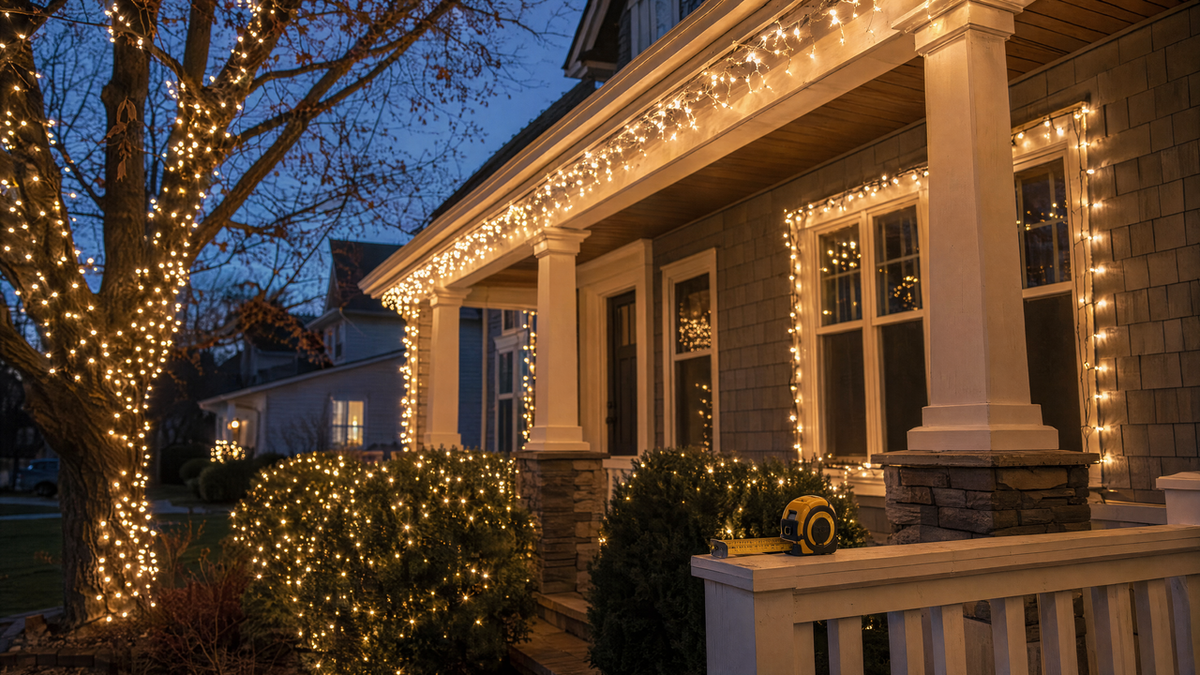
Why Measuring Before You Buy Saves You a Return Trip
Christmas light shopping has a way of turning into three separate trips: one for the lights, one for the extra strand you didn't buy enough of, and one for an extension cord you forgot entirely. The fix is simple — take rough measurements of the spots you're planning to light before you shop, and buy about 10% more than the number suggests, since corners, doubling up strands, and trimming trees always eat into your total. Here's how much you actually need for the most common spots, whether you're shopping our string lights and fairy lights collection or rounding out the rest of your holiday and seasonal decorations.
How Many Feet of Lights Do You Need?
Wrapping a Christmas Tree (Indoor or Outdoor)
A common rule of thumb is 100 feet of lights for every 1.5 to 2 feet of tree height for a full, layered look, which means a 6-foot tree typically takes 300-450 feet total if you're wrapping branches individually rather than just spiraling around the outside. A long run like 99ft of copper wire fairy lights is flexible enough to weave through branches without the wire showing, and one or two strands can cover a 6-7 foot tree on their own.
Outlining a Porch or Roofline
Measure the total linear footage along the edge you want to outline, then add roughly 10% for the droop between clips and the corners where the strand doubles back on itself. A typical single-story porch roofline runs 40-80 feet, while a full house roofline can easily run 150-250 feet depending on the home's size and how many gables and corners it has.
Framing Windows and Doors
To outline a standard window, measure its full perimeter and add a couple of feet for slack — most windows take 12-18 feet of lights to frame completely. A front door with sidelights or a larger picture window will run closer to 20-25 feet. If you're doing multiple windows across the front of a house, it adds up quickly, so tally each one before you check out.
Wrapping Shrubs, Railings, and Trees Outside
Small to medium shrubs generally take 100-200 feet each to wrap densely, while porch railings run about 3-4 feet of lights per linear foot of railing if you're spiraling around the balusters. For outdoor trees, the same "100 feet per 1.5-2 feet of height" guide from indoor trees applies, though outdoor trees are often lit more sparsely with a single spiral rather than a full wrap.
Picking the Right Style for Each Spot
Curtain Lights for Windows
Rather than piecing together strands to frame a window, a curtain-style light does the framing in one piece. A 300 LED window curtain string light hangs flat against a window or wall and instantly fills the space with an even grid of light, which is usually faster and neater than wrapping individual strands around a frame.
Copper Wire and Mini Lights for Trees and Garlands
Thin, flexible copper wire lights are easiest to thread through tree branches, garland, and wreaths without the wire itself being visible in daylight. Traditional mini lights on a green wire work well too, but copper wire strands tend to disappear more completely once they're woven in, which matters if you want the light to look like it's floating in the branches rather than strung on top of them.
LED vs. Incandescent: How It Affects Your Count
If you're switching from old incandescent strands to LEDs, don't assume you need the same number of strands to get the same look. LED strands typically pack more individual bulbs into the same length and throw a brighter, more concentrated point of light per bulb, so a display that used to take six incandescent strands might only need four or five LED strands to look just as full. LEDs also run dramatically cooler and pull far less power, which matters when you're calculating how many strands you can safely connect end-to-end on one circuit — most LED strands can be daisy-chained much further than incandescent ones before you risk overloading a plug.
Planning for Power: Outlets, Extensions, and Battery Options
Before you commit to a layout, walk your planned display and count how many outlets you actually have access to, and where. Most exterior outlets are on one or two circuits, so plan to distribute plug-in strands across those circuits rather than daisy-chaining everything into a single outlet, which can trip a breaker on a cold night when the string draws more current. Battery-operated strands are worth considering for spots without any nearby outlet, like a mailbox, a freestanding shrub, or a second-story window box.
Quick Planning Checklist
Measure every space you plan to light, add roughly 10% to your total for slack and corners, decide which style fits each area (curtain lights for windows, wrapped strands for trees and railings), and confirm you have enough accessible outlets or a battery-powered backup plan before you buy.
Shop our full string lights and fairy lights collection to find the right length and style for every corner of your holiday display.