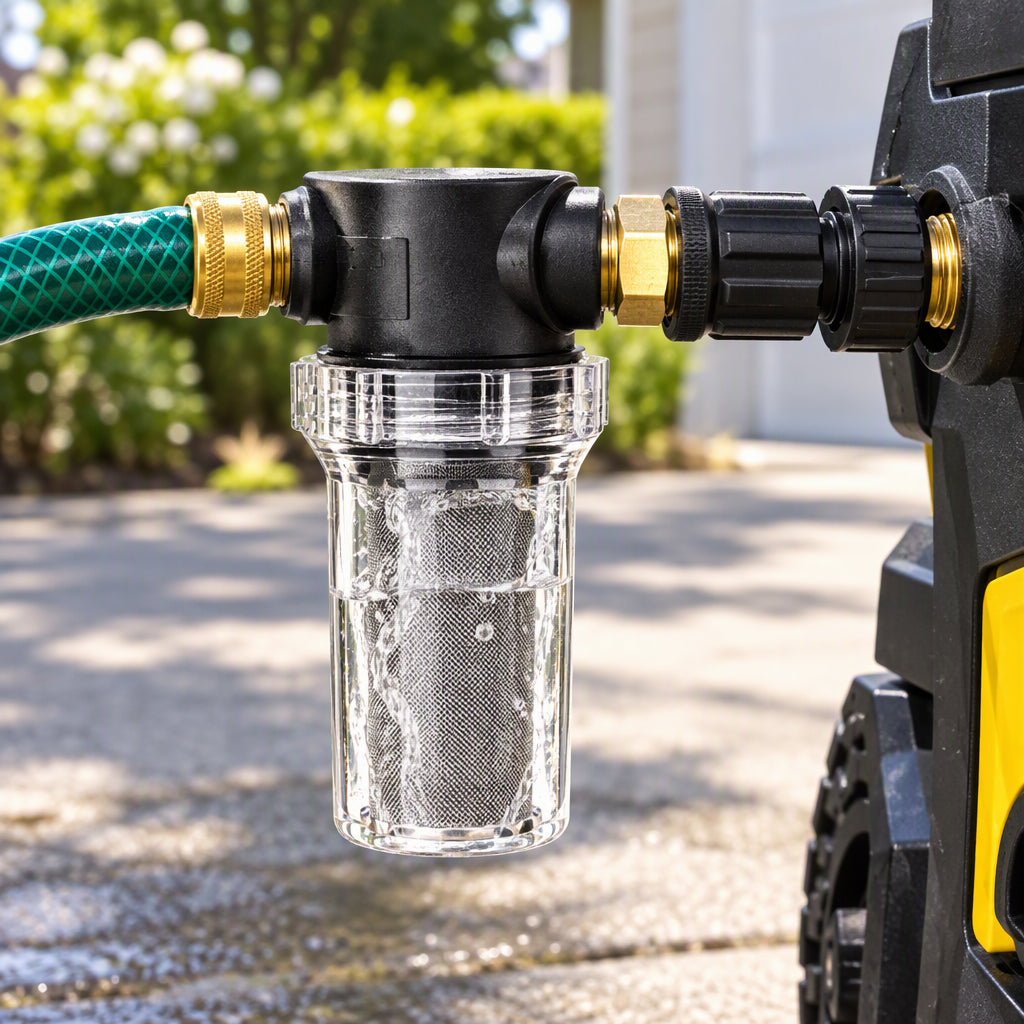
Do You Actually Need a Sediment Filter on Your Garden Hose?
If you've ever noticed grit in the bottom of a bucket after filling it from an outdoor spigot, or had a pressure washer nozzle clog for no obvious reason, the culprit is usually the same thing: fine sand, rust flakes, or mineral sediment riding along inside your water line. An inline hose sediment filter is a small, cheap fix for a problem that otherwise shows up as a damaged pump or a clogged tip.
What an Inline Sediment Filter Actually Does
Twinkle Star's inline hose sediment filter is a 3/4-inch fitting that threads in between your spigot (or garden hose) and whatever you're feeding water into. Inside, it holds a swappable stainless mesh screen — you get both a 100-mesh and a 40-mesh screen, plus two extra rubber washers — rated to catch particles down to roughly 450 microns, at water pressure up to 80 PSI. The 100-mesh screen catches finer sediment; the 40-mesh screen lets more flow through while still stopping larger grit, which matters if you're running a pressure washer that needs volume as well as pressure.
Who Actually Needs One
This isn't a universal must-have — it solves a specific problem. It's worth adding if any of these apply to you:
- You're feeding a pressure washer from an outdoor spigot. Pressure washer pumps have tight internal tolerances, and sand or rust particles are a common cause of premature pump wear or a nozzle that mysteriously won't spray a clean pattern.
- You're on well water or older galvanized plumbing. Both are classic sources of sediment and rust flakes that city water with modern filtration usually doesn't have.
- You're filling an RV or camper from an unfamiliar spigot. Campground water quality varies a lot, and a cheap inline filter is a lot less hassle than a clogged RV water filter or faucet aerator down the line.
- You've already noticed grit, cloudy water, or a nozzle that clogs repeatedly. That's a direct symptom this filter addresses.
If your water is already clean municipal water and you've never seen sediment issues, this is a "nice to have," not a fix for a problem you have.
How to Install It
Installation is just two connections: screw one end onto your spigot or water source, then screw your garden hose (or the pressure washer's inlet hose) onto the other end. There's no orientation to get wrong and no tools required beyond hand-tightening — standard 3/4-inch garden hose threads throughout.
One Thing Worth Knowing Before You Buy
This filter catches sediment — it is not a substitute for a dedicated whole-house water filter and won't remove chlorine, odor, or dissolved minerals, only particulate. And per the manufacturer's own guidance: always disconnect the filter when you're done for the day, and don't leave it under pressure unattended, the same way you wouldn't leave any hose fitting pressurized and unsupervised overnight.
Pairing it with a good set of brass fittings keeps the rest of your line leak-free too — see our garden hose fittings guide if you're also dealing with leaks at the connections, or browse the full Garden Watering & Hose Fittings collection for compatible adapters and nozzles.