
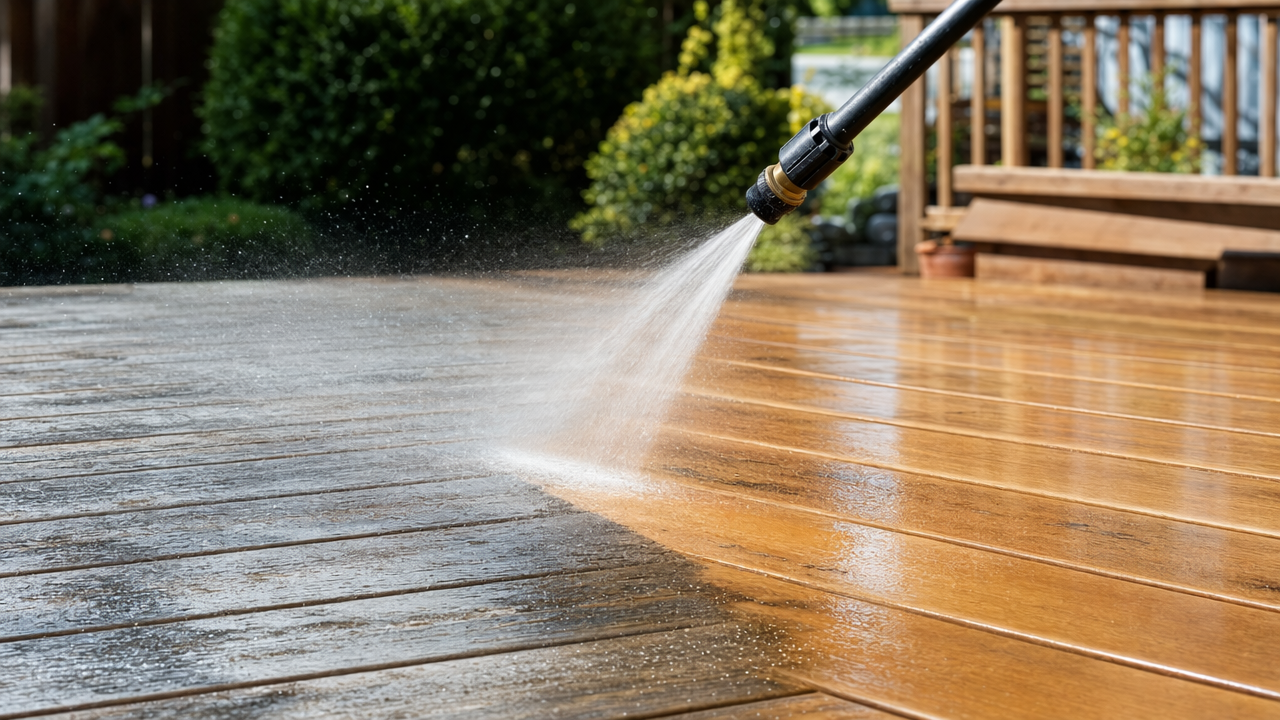
Last updated: July 2026
A deck takes a beating all year — pollen in spring, foot traffic and spilled drinks in summer, and a slow build-up of algae and grime in the shady corners. A pressure washer is the fastest way to bring gray, dingy boards back to life, but it's also the fastest way to gouge soft wood or leave permanent wand marks if you rush it. Done right, the whole job takes an afternoon and can make an old deck look almost new.
Here's how to pressure wash a deck the right way, from choosing the correct nozzle to the spray technique that protects the wood.
Before You Start: Is Your Deck Safe to Pressure Wash?
Most pressure washers push out 1,300 to 3,100 PSI, which is more than enough to etch or splinter softwoods like cedar and pine. Composite decking is more forgiving but can still be damaged by a too-narrow spray held too close. Before you begin:
- Sweep the deck and clear furniture, planters, and grills.
- Look for loose or lifting boards and popped nails or screws — fix these first so the spray doesn't catch an edge.
- Cover nearby plants and close windows and doors.
- Test in an inconspicuous corner before you commit to the whole surface.
Pick the Right Nozzle — This Is the Most Important Step
The single biggest factor in a safe deck-cleaning job is the spray angle. Pressure washer nozzles are color-coded by fan angle, and using the wrong one is what turns a cleaning job into a repair job:
- Red (0°): A pinpoint jet. Never use this on a deck — it will carve lines into the wood.
- Yellow (15°): Aggressive; only for stubborn stains on concrete or hardwood, and only from a distance.
- Green (25°): The workhorse for most wood decks. Good cleaning power with a wider, gentler fan.
- White (40°): The safest choice for composite decking and soft or older wood.
- Black (soap): Low pressure, used to apply detergent.
If your machine came with a single fixed tip, a set of interchangeable tips is a cheap upgrade that gives you the range you need. A quick-connect kit like the Twinkle Star Pressure Washer Nozzle Tips set includes the 25° and 40° tips you'll actually use on a deck, plus a soap nozzle for the detergent step. Start with the widest angle that still cleans, and only move to a narrower fan if you truly need it.

Gather Your Gear
Beyond the washer itself, a smooth job comes down to having your connections sorted before you pull the trigger:
- Your pressure washer and a suitable water supply
- A set of nozzle tips (25° and 40° at minimum)
- Deck-safe cleaner or a wood-brightening detergent
- A stiff-bristle brush for pre-treating stains
- Eye protection and closed-toe shoes
Leaky or mismatched fittings waste water and pressure, and they're the most common reason a session stalls out. If your hose threads don't line up with your machine, an adapter and quick-connect kit such as the Twinkle Star M22 Quick Disconnect Adapter Kit lets you swap between tips and hoses in seconds. You'll find couplers, tips, and replacement parts together in our pressure washer parts and accessories collection.

Step-by-Step: How to Pressure Wash a Deck
1. Apply cleaner first
Switch to the black soap nozzle and apply a deck-safe detergent across the surface. Work in sections and let it dwell for 5 to 10 minutes — but don't let it dry out. The cleaner does the hard work of loosening algae and grime so you can use less pressure.
2. Dial in your distance
Fit the 25° (green) tip and start with the nozzle about 18 inches from the boards. Pull the trigger away from the deck, then bring the spray in until you find the sweet spot that cleans without fuzzing the grain. Keep that same distance for the whole job.
3. Spray with the grain, in smooth passes
Always move along the length of the boards, following the wood grain — never across it. Use long, overlapping, sweeping strokes and keep the wand moving. Stopping in one spot, even for a second, leaves a visible mark. Feather the start and end of each pass so you don't create hard lines.
4. Work in sections toward the exit
Clean two or three boards at a time along their full length before stepping over to the next set. Work your way toward the stairs or exit so you're never walking back across wet, freshly cleaned wood.
5. Rinse and let it dry
Give the whole deck a final rinse to clear away any detergent residue, then let it dry fully — usually 24 to 48 hours — before you replace furniture or apply a stain or sealer.
Common Mistakes to Avoid
- Getting too close. Holding the wand inches from the wood concentrates the force and etches the surface.
- Using too narrow a tip. When in doubt, go wider. A 40° tip cleans slower but is far safer on soft or composite boards.
- Spraying across the grain. This drives water and grit into the wood fibers and roughens the finish.
- Skipping the dry time. Sealing a damp deck traps moisture and leads to peeling later.
Frequently Asked Questions
What PSI is safe for pressure washing a wood deck?
For most residential decks, 1,300 to 2,000 PSI with a 25° or 40° nozzle tip is enough to lift dirt and algae without damaging the wood. Anything above 3,000 PSI held too close can etch softwoods like cedar and pine, so let the nozzle angle and distance do the work rather than cranking up the pressure.
How far should the nozzle be from the deck boards?
Start about 18 inches away and adjust from there. Bring the wand closer only until you find the point where it cleans without fuzzing the wood grain, then hold that exact distance for the rest of the deck so the finish looks even.
Can I pressure wash a composite deck the same way?
Yes, but use the wider 40° white-tip nozzle rather than the 25° green tip recommended for wood. Composite boards resist etching better than natural wood, but a narrow, close-range spray can still scar the surface coating.
How long should a deck dry before staining or sealing?
Plan on 24 to 48 hours of full drying time, longer in humid or shaded conditions. Sealing over damp wood traps moisture underneath the finish and leads to peeling or bubbling within a season.
Keep Your Deck Looking Great Between Washes
A quick sweep every week and a rinse with a garden hose after pollen season or a big storm will stretch the time between deep cleans. Reliable hose fittings and connectors make that routine maintenance painless — browse our garden watering and hose fittings for the couplers and nozzles that keep your water supply leak-free.
Ready to tackle the job? Stock up on the tips, adapters, and replacement parts you need in the Twinkle Star Pressure Washer Parts & Accessories collection and give your deck the refresh it deserves this summer.