
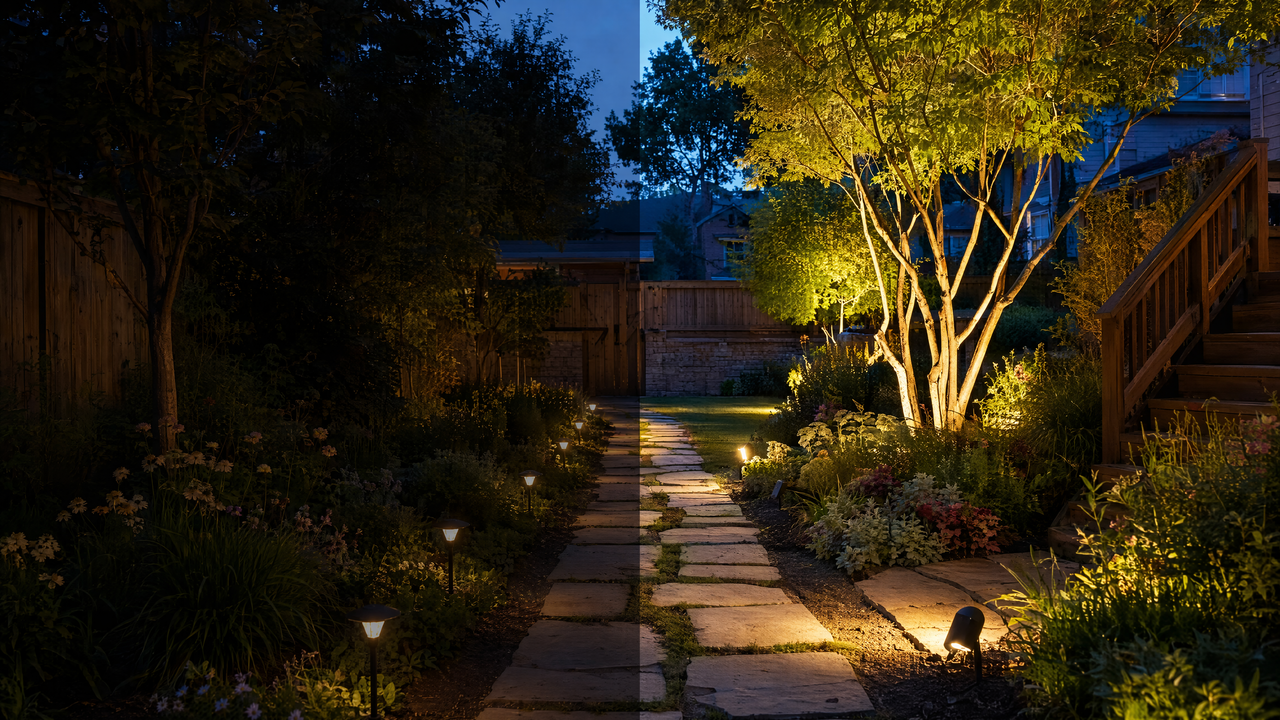
Sooner or later, every yard-lighting project hits the same fork in the road: solar or low-voltage wired? Online forums treat it like a religious war — solar fans preach zero wiring and zero electric bills, wired devotees counter with brightness and reliability. The truth is more useful: each type wins in specific spots, and the best-looking yards almost always mix the two. Here's an honest breakdown so you can put your budget where it counts.
The 30-Second Version
- Solar wins on: installation ease, zero operating cost, safety, flexibility, and spots with no power access
- Low-voltage wins on: brightness, consistency, control, and shaded locations
- Most yards want: wired fixtures for the few high-impact focal points, solar for everything else
Installation: No Contest — Solar
A solar path light installs in the time it takes to push a stake into soil. A dozen lights, ten minutes, no tools. Low-voltage systems are far friendlier than old 120V setups — the 12V current is safe to handle — but you're still buying a transformer, trenching or hiding cable runs, and making waterproof wire connections at every fixture. Call it a weekend for a typical front yard. If the idea of burying cable is what's kept your yard dark, solar removes the excuse entirely.
Brightness and Consistency: Advantage Wired
Physics is physics: a fixture drawing from a transformer delivers the same lumens at 7 p.m. and 3 a.m., December included. A solar light delivers whatever its battery banked that day — brilliant after a sunny July day, dimmer after a gray November one. Modern solar has closed the gap dramatically for ambient and accent duty, but for reliably illuminating a dark staircase, a driveway entrance, or the tree you want spotlit at full drama every night, wired power is still the tool.
Cost: Solar Up Front, Solar Long-Term Too
Per fixture, solar and budget low-voltage lights cost similar amounts — but the wired system adds a transformer, cable, and connectors before the first light glows, and professional installation if trenching isn't your hobby. Operating cost for solar is zero forever; low-voltage LED systems sip electricity but do add up across a large yard, and transformers eventually need replacement. Solar's hidden cost is batteries: expect to swap rechargeable cells every 1–2 years (a few dollars per light — our solar light troubleshooting guide walks through the five-minute swap).
Placement Rules: Where Each Type Belongs
Give solar the sunny, low-stakes zones
- Pathways and borders: the classic solar assignment — lots of fixtures, ambient duty, full sun. A multi-pack like the 12-pack solar pathway lights edges an entire walkway for the price of two wired fixtures.
- Decorative accents: hanging lanterns add charm where running wire would be absurd — the 34-inch hanging solar lanterns on shepherd hooks drop a warm coach-light glow into flower beds, along fences, or beside a garden bench, no electrician involved.
- Seasonal and movable lighting: anything you rearrange — party zones, planters, holiday displays — favors stakes over cables.
Save wired power for the money shots
- Security and task zones: entries, garage aprons, and steps where consistent output matters every single night.
- Deep shade: under mature trees or on the north side of the house, solar panels simply starve. Wire it or skip it.
- Uplighting and spotlights: dramatic tree and facade lighting demands lumens that small panels can't bank.
This split is exactly the layering approach from our Landscape Lighting 101 guide — wired fixtures carry the few high-impact layers, solar fills in the wide, ambient ones.
Maintenance Reality Check
Neither is zero-effort. Solar wants panels wiped monthly and batteries refreshed every couple of seasons. Wired systems want connections checked yearly and transformer timers adjusted as daylight shifts. The difference: solar problems are per-light and cost pennies; wired problems (a nicked cable, a failed transformer) take down whole runs and take real troubleshooting. Renters and anyone who moves frequently should note that solar goes with you — buried cable doesn't.
The Verdict
Ask each zone of your yard three questions: Does it get 6+ hours of direct sun? Is consistent brightness critical here? Is there power nearby? Sunny + ambient + no power nearby = solar, every time. Shaded or mission-critical = wired. For most homes that shakes out to two or three wired fixtures doing the dramatic work and a dozen solar lights doing everything else — the best-looking result per dollar you can get.
Start with the easy wins: browse the Outdoor & Solar Lights collection for pathway sets, hanging lanterns, and solar string lights that install before dinner and glow the same night.