
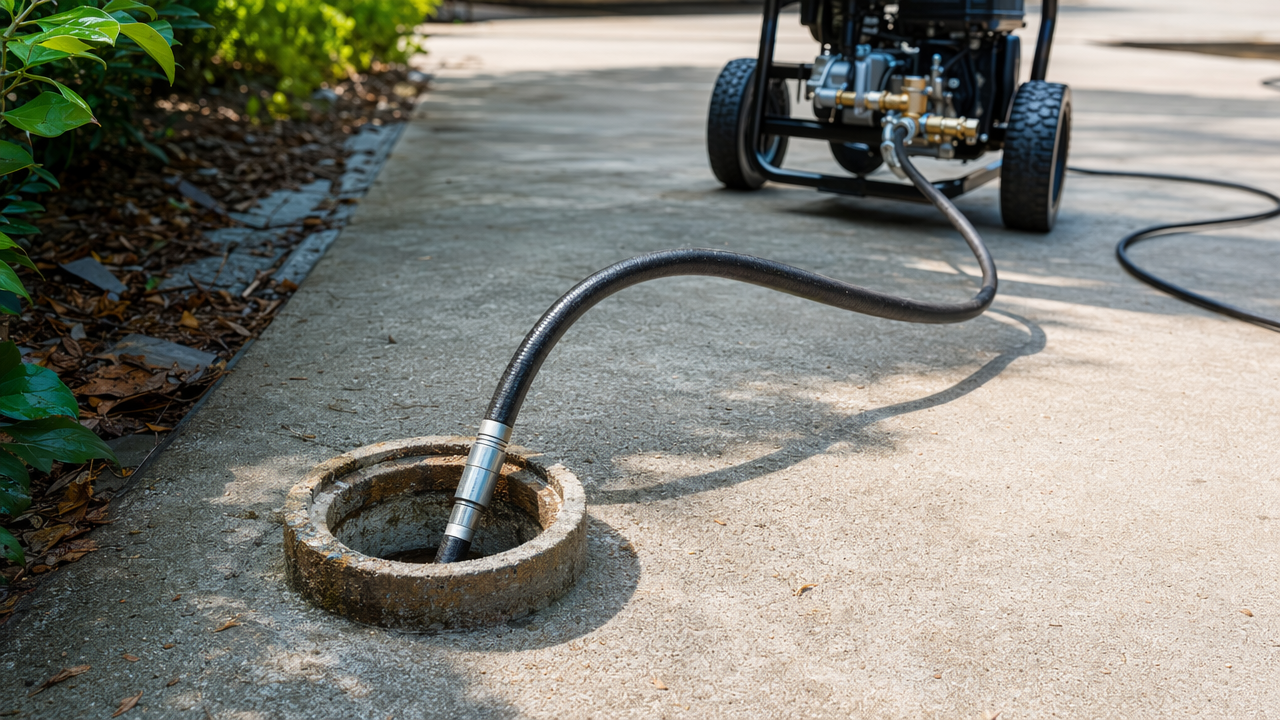
How to Unclog Drains with a Pressure Washer Sewer Jetter: A Summer Home Maintenance Guide
Last updated: July 2026
A pressure washer sewer jetter is a flexible hose-and-nozzle attachment that connects to your existing pressure washer, turning it into a high-powered drain-cleaning machine. Unlike chemical drain cleaners that can corrode pipes, or manual plumbing snakes that only punch through a clog, a sewer jetter uses water pressure (up to 5,800 PSI) to blast debris out of the pipe entirely — leaving the interior walls clean. This guide walks you through everything you need to know to do it safely and effectively this summer.
Quick Answer: Attach the sewer jetter hose to your pressure washer's gun or wand, insert the nozzle end into the drain, turn on the washer, and slowly feed the hose forward. The rear-facing jets propel the hose deeper while flushing debris out behind it. A 50 ft hose handles most residential drain runs.
Why Summer Is the Best Time to Jet Your Drains
Summer brings heavy rain, lawn clippings, barbecue grease, and increased outdoor water usage — all of which accelerate drain buildup. Studies from the Plumbing-Heating-Cooling Contractors Association show that 67% of residential drain blockages occur between May and September, making proactive summer jetting one of the highest-ROI maintenance tasks a homeowner can do.
Beyond clogs, warm weather means the ground is soft and pipes are more accessible. Cold-weather jetting risks residual water freezing inside the hose. Summer jetting has none of these risks.

What You Need: Gear Checklist
- ✓ Pressure washer — electric or gas, minimum 1,500 PSI; up to 5,800 PSI supported
- ✓ Sewer jetter kit — 50 ft hose, button-nose nozzles (orifice 4.0, 4.5, 5.5), rotating nozzle, M22-14 brass adapter, 1/4-inch quick connector
- ✓ Inline hose filter — protects the pump from sediment (80 PSI max / 450μ particle size)
- ✓ Safety glasses and waterproof gloves
- ✓ Drain access point — cleanout cap, floor drain, or gutter downspout
Step-by-Step: How to Use a Sewer Jetter
- Install the inline water filter between your outdoor faucet and the pressure washer inlet. This traps sediment before it reaches the pump.
- Select the right nozzle. For a standard clog, start with the button-nose nozzle (orifice 4.5). For compacted grease or root intrusion, switch to the rotating nozzle.
- Attach the jetter hose to your pressure washer gun via the 1/4-inch quick connector, or directly to the wand via the M22-14 brass adapter.
- Insert the nozzle 12 inches into the drain opening before starting the washer. This prevents blowback.
- Turn on the pressure washer and begin feeding the hose slowly — approximately 1 foot every 3–5 seconds. The rear jets will push the hose forward automatically.
- At maximum depth, pull the hose back slowly to flush loosened debris toward the drain opening.
- Repeat 2–3 passes for heavily blocked pipes.
- Flush with clean water for 60 seconds after jetting to clear remaining debris.

Nozzle Selection Guide
| Nozzle Type | Orifice | Best For |
|---|---|---|
| Button Nose (standard) | 4.0 | Soft debris, leaves, light grease |
| Button Nose (medium) | 4.5 | All-purpose — start here for unknown clogs |
| Button Nose (heavy) | 5.5 | Heavy grease, compacted sediment, large pipes |
| Rotating Nozzle | 4.5 | Root intrusion, scale buildup, 360° pipe wall scrubbing |
Button-nose nozzles fire 1 jet forward (0°) to clear the blockage plus 3 jets rearward (33°) that propel the hose and flush debris back out. The rotating nozzle spins those rear jets for a shot-blasting effect.
Protect Your Pump: Why a Hose Water Filter Matters
Most pressure washer failures are caused by sediment entering the pump. Municipal tap water typically carries 100–300 ppm of dissolved solids, and well water can exceed 1,000 ppm. A simple inline sediment filter installed at the faucet end intercepts particles down to 450μ before they reach the pump.
The Twinkle Star filter includes two interchangeable mesh screens — 100 mesh (fine) for city water and 40 mesh (coarse) for well water or heavier debris. Maximum operating pressure: 80 PSI / 551.58 kPa.

Safety Tips
- Never aim a jetter nozzle at people or animals. Water at 3,600+ PSI can penetrate skin.
- Always insert the nozzle before starting the washer to prevent blowback.
- Disconnect all fittings when finished. Do not leave the system pressurized and unattended.
- In cold climates, drain residual water from the hose after use to prevent freezing.
- Inspect the hose before each use for kinks, cuts, or worn fittings.
- Do not use on PVC pipes rated below 80 PSI without verifying pipe material and rating.
Frequently Asked Questions
What PSI do I need for a sewer jetter to work?
A minimum of 1,500 PSI is recommended for light residential drain cleaning. For stubborn grease clogs or root intrusion, 2,000–3,600 PSI provides better results. The Twinkle Star Sewer Jetter Kit is rated up to 5,800 PSI, compatible with most consumer and semi-professional pressure washers.
Can I use a sewer jetter on indoor drains?
Yes, on cast iron and ABS plastic pipe rated above 80 PSI. Avoid older galvanized steel pipes with existing corrosion or PVC rated below operating pressure. For kitchen sink and shower drain lines, a 25 ft hose is usually sufficient — the standard 50 ft kit handles longer runs.
How often should I jet my outdoor drains?
For most homes, once per year — ideally at the start of summer before peak debris season — is sufficient preventive maintenance. Homes with large trees (root intrusion risk) or heavy clay soil may benefit from semi-annual jetting.
Do I need a special fitting to connect the jetter to my pressure washer?
The Twinkle Star kit includes both an M22-14 Solid Brass adapter (fits most gas-powered pressure washers) and a 1/4-inch quick connector (fits most electric pressure washers). Thread seal tape is also included.
Will jetting damage my pipes?
Not if you stay within the pipe's pressure rating. Cast iron, ABS, and Schedule 40 PVC in good condition handle the pressures involved. The key risk is pre-existing cracks or joint failures — high-pressure water can widen these. If your drain line has known structural issues, inspect it with a camera first.
Ready to Clean Your Drains This Summer?
Get the full kit and protect your pressure washer pump at the same time:
- 🔧 Twinkle Star 50 FT Sewer Jetter Kit — $49.99, rated to 5,800 PSI
- 🔩 Twinkle Star Inline Sediment Filter — $17.99, dual-mesh pump protection
Browse the Twinkle Star Blog for more home maintenance guides.