
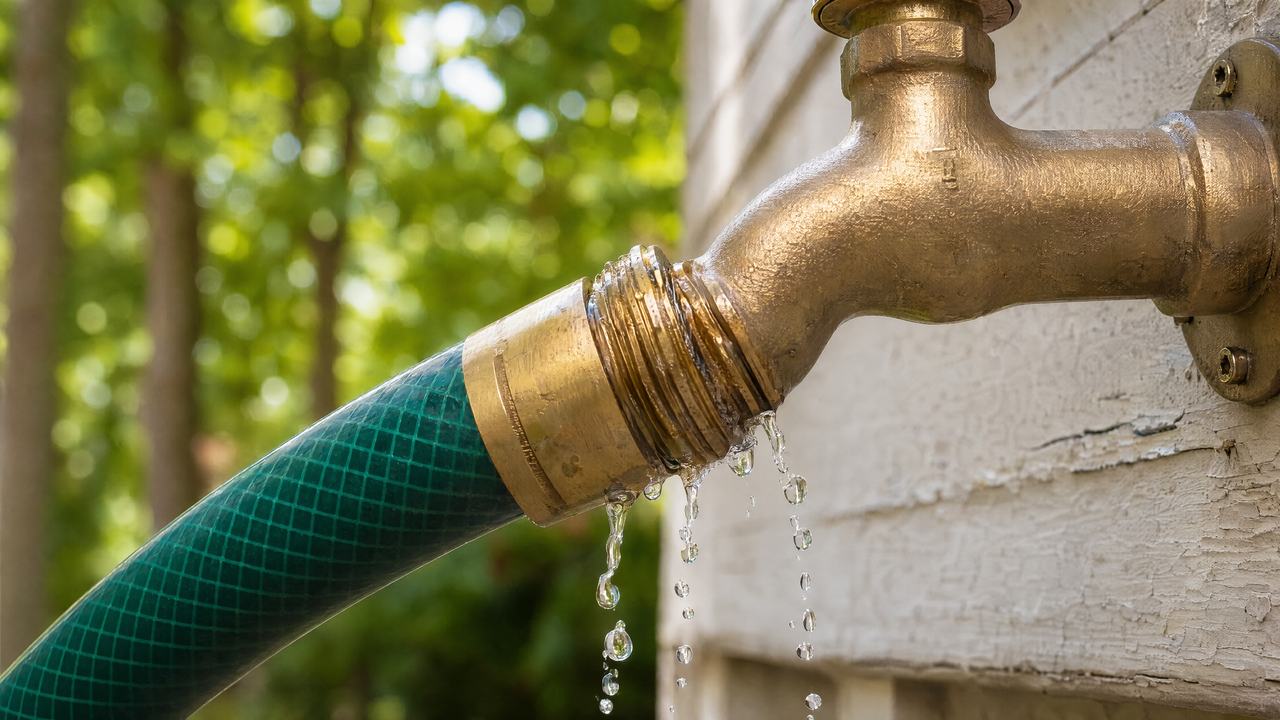
Few backyard annoyances are as persistent as a garden hose that drips at the spigot every time you turn on the water. By late summer, your hose has been screwed on and off dozens of times, dragged across the driveway, and left baking in the sun — so if it's leaking now, you're not alone. The good news: most hose connection leaks cost under $5 and five minutes to fix. Here's how to diagnose the problem and stop the drip for good.
Why Hose Connections Leak in the First Place
Almost every leak at a hose connection comes down to one of four causes:
- A worn or missing rubber washer. This is the culprit 80% of the time. The small rubber gasket inside the female fitting flattens, cracks, or falls out entirely.
- Cross-threading. If the coupling was forced on crooked, the threads no longer seat evenly and water escapes.
- A bent or damaged coupling. Plastic fittings crack; thin stamped-metal ones get stepped on and go oval.
- A failing spigot. Sometimes it's not the hose at all — the packing nut or valve seat on the faucet itself is worn.
Work through the fixes below in order, since they run from cheapest to most involved.
Fix 1: Replace the Rubber Washer
Unscrew the hose and look inside the female end. If the washer is flattened, brittle, or missing, pry it out with a flathead screwdriver and press in a new one. Standard 3/4-inch hose washers are sold in multipacks for a few dollars, and many garden hose fittings and connectors ship with spares included.
Two tips that make washers last longer: don't over-tighten the coupling (hand-tight plus a quarter turn is plenty — crushing the washer shortens its life), and swap washers at the start of every season as cheap insurance.
Fix 2: Check the Threads and Re-Seat the Connection
If a fresh washer doesn't stop the drip, unscrew the hose and inspect the threads on both sides. Wipe away grit — a single piece of sand can hold the washer off its seat. Then start the coupling by hand, turning it backward first until you feel it click into the thread, and tighten forward. This prevents cross-threading, which permanently damages soft brass or aluminum fittings.
Threads visibly flattened or stripped? Move on to Fix 3.
Fix 3: Upgrade to Solid Brass Fittings
Thin stamped fittings and plastic couplings are where leaks are born. Solid brass hardware costs a little more but seals better, resists corrosion, and survives being run over by the wheelbarrow.
Two upgrades solve most recurring leaks:
Add a shut-off valve at the spigot
A heavy-duty brass shut-off valve threads between the faucet and hose, giving you a fresh, true set of threads on both sides — and letting you cut the water at the source without walking back to a stiff, weeping spigot handle. It's one of the simplest fixes for a faucet that never quite closes all the way.
Switch to quick connectors
If your leaks come from constantly screwing attachments on and off, a 3/4-inch quick connector set ends the thread-wear cycle entirely. Install the male fitting on each sprayer, sprinkler, or wand once, and swap tools with a push-and-click instead of twisting threads dozens of times a week. Each connection seals on an internal washer, so there's no torque and no cross-threading — the two things that kill hose ends.
Fix 4: When the Spigot Itself Is Leaking
Water seeping from behind the faucet handle (not the hose coupling) usually means a loose packing nut — snug it an eighth of a turn with a wrench. If the spigot drips from the spout even when closed, the internal valve washer is worn; that's a 15-minute faucet repair or a job for a plumber if the valve is seized.
The same diagnostic logic applies to pressure washer connections, by the way — leaks at the pump inlet or gun are almost always an O-ring or a worn coupling, and replacement pressure washer fittings and adapters are far cheaper than living with the pressure loss.
Make the Fix Last: Three Habits Worth Keeping
- Take the hose off before winter. A hose left attached traps water in the spigot and can crack both the faucet and the coupling when it freezes.
- Store hose ends off the ground. Dirt in the threads is the #1 source of "mystery" leaks that a new washer doesn't fix.
- Keep spare washers in the garage. They're the cheapest part in your entire watering setup and the most common failure point.
When to Replace Instead of Repair
If the hose leaks along its length (not at the ends), bulges when pressurized, or the coupling is cracked through, repair kits rarely hold at full pressure — replacement is the better bet. But if the drip is at a connection, one of the four fixes above will almost always solve it for a fraction of the cost of a new hose.
Ready to stop the drip? Browse our full range of garden watering and hose fittings — brass valves, quick connectors, splitters, and washers that keep every connection tight all season.