
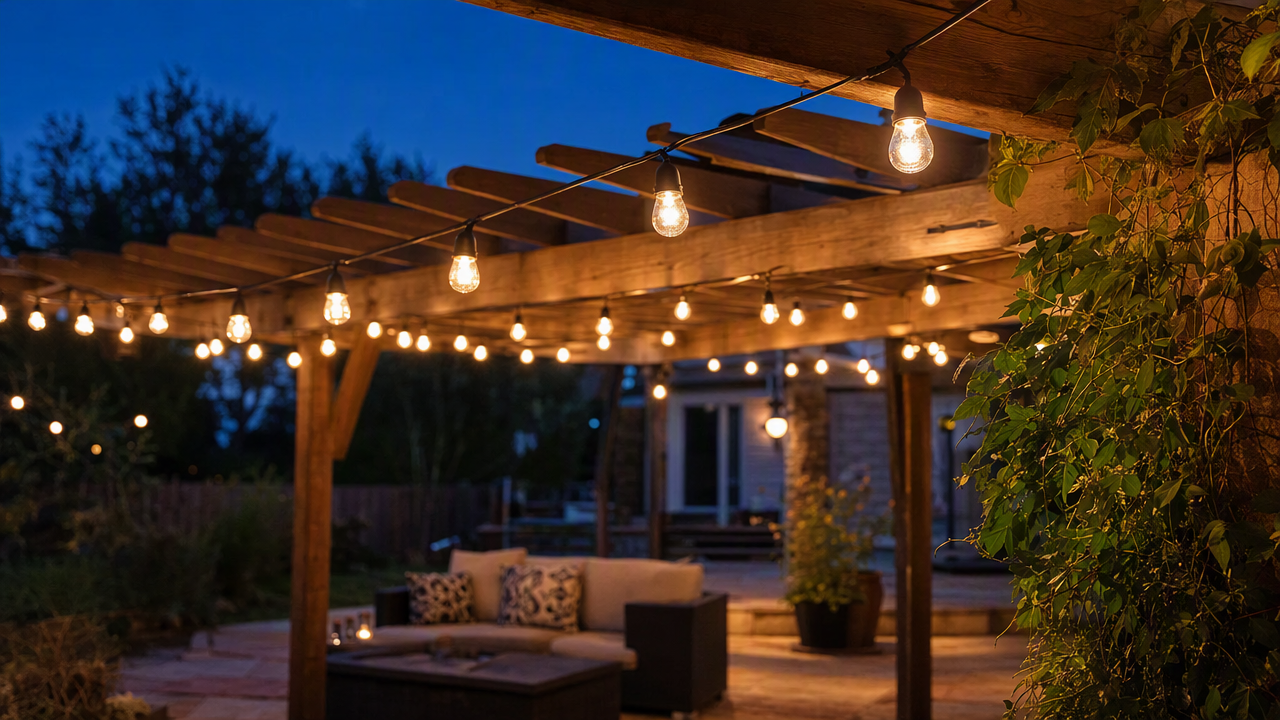
Every string light looks about the same in the product photo: a warm glow, a leafy backdrop, someone holding a drink. What the photo never tells you is how the lights are powered — and that detail decides whether they're a five-minute win or a recurring annoyance.
There are three ways to power string lights: batteries, a wall outlet, or the sun. Each solves a different problem. Here's how to tell which is right for the spot you have in mind.
The short version
If you need lights somewhere with no outlet nearby and you only turn them on for evenings, go battery. If you want reliable, consistent brightness in a spot you use every night, go plug-in. If you want lights outdoors that run themselves and you don't want to think about them again, go solar.
Most homes end up with a mix. That's fine — the goal isn't to pick one type forever, it's to pick the right one per location.
Battery-operated string lights
Battery lights are the most flexible option, and flexibility is the whole reason to buy them. The battery pack is small enough to tuck behind a planter, under a mantel, or inside a centerpiece. There's no cord dictating where the lights can go, which means you can wrap a tree in the middle of the lawn, line a fence at the back of the property, or decorate a table that's nowhere near a wall.
What to look for
- A timer. This is the single feature that makes battery lights practical. A built-in timer that runs 6 hours on and 18 hours off means you're not walking outside every night to switch them on, and you're not accidentally draining a set of AAs by leaving them lit until morning.
- A remote. Useful when the battery box ends up somewhere awkward — behind furniture, high in a tree, buried in greenery.
- A waterproof battery box. If the lights are going outside, the wire being weatherproof isn't enough. The box holding the batteries has to be sealed too.
Thin copper or silver wire is the usual construction here, which is a genuine advantage: it bends and holds its shape, so you can shape it around a railing or through a wreath and it stays put. The 99ft copper wire fairy lights with remote and timer are a good example of the format — long enough to cover a real space, with the controls that make battery power livable.
The trade-off
Batteries run out. On a 100-LED set used a few hours a night, expect somewhere in the range of two to three weeks from a fresh set of AAs, less in cold weather. For a table setting or a two-week holiday display, that's a non-issue. For a patio you sit on every night from May to September, you'll get tired of it.
Plug-in string lights
Plug-in lights are the workhorses. Constant brightness, no runtime limit, no seasonal dimming, no batteries to replace. If you're lighting a space you actually use — a covered patio, a bedroom wall, a pergola over a dining table — this is usually the right call.
They're also the brightest of the three by a wide margin. Battery and solar sets are limited by their power source, so manufacturers keep the LEDs conservative. A plug-in set doesn't have that ceiling, which matters if the lights are doing real work rather than just adding atmosphere.
What to look for
- End-to-end connectors. Sets that link together let you run one continuous line off a single outlet instead of hunting for a second one. If you're covering a long fence or a large tree, this is the feature that decides whether the project is easy or miserable.
- An outdoor-rated cord and an appropriate IP rating if any part of the run will be exposed to rain.
- Low-voltage adapters. Most decorative LED sets step down to around 30V, which is safer around kids, pets, and damp ground than line voltage.
Decorative shapes work especially well in plug-in form, since consistent power keeps every bulb evenly lit. The 33ft star string lights are an easy pick for a window, a headboard wall, or a covered porch — extendable, waterproof, and bright enough to read by if you want them to be.
The trade-off
You are permanently tethered to an outlet. Outdoors, that often means running an extension cord across a walkway or along a fence line, which is both a tripping hazard and something you'll be re-taping every few weeks. Measure the actual distance from your outlet to where the lights start before you buy — the "33ft" on the box is the lit section, not the lead wire.
Solar string lights
Solar sets have a small panel on a stake or clip that charges during the day and switches the lights on automatically at dusk. No wiring, no outlet, no battery swaps. Install once, forget about it.
For fences, garden beds, trees away from the house, and anywhere along a driveway, solar is genuinely the low-effort answer. It's also the only option that costs nothing to run.
What to look for
- Panel placement freedom. Make sure the panel can go somewhere with 6+ hours of direct sun even if the lights themselves are in shade. A panel on a short lead limits you badly.
- Weatherproofing on the panel and the connection point, not just the light strand.
- Realistic runtime expectations. A full summer charge gets you most of the night. A cloudy November day gets you a couple of hours.
Our full range of solar sets, pathway markers, and hanging lanterns lives in the Outdoor & Solar Lights collection if you want to compare formats.
The trade-off
Solar is the dimmest and the least predictable of the three. Output drops noticeably in winter and after overcast days, and the internal rechargeable batteries degrade after a couple of seasons. It's a poor choice for anywhere you need guaranteed light on a specific evening — which is exactly why it's not the right pick for a party or a holiday display you've planned around.
Matching the power source to the spot
- Covered patio or pergola you use nightly — plug-in. Brightness and reliability matter most.
- Bedroom, dorm, or gallery wall — plug-in, or battery if the outlet situation is bad.
- Tables, mantels, wreaths, centerpieces — battery. The pack hides easily and the runs are short.
- Fence lines, garden beds, distant trees — solar. Nothing to run power to.
- Party or event on a set date — battery or plug-in, never solar.
- Seasonal outdoor display — plug-in for anything near the house, solar for the far reaches of the yard.
One thing people get wrong
Buying one type for the entire yard. A backyard rarely has uniform needs: the patio wants bright and constant, the fence 40 feet away wants zero maintenance, and the table wants something you can put away in a drawer. Three jobs, three answers.
Ready to pick a set? Browse the full String Lights & Fairy Lights collection — battery, plug-in, and solar options in one place, sorted by length and style so you can match the run to the space you're lighting.