
Last updated: July 12, 2026
Few things kill the momentum of a Saturday cleaning project like discovering your new pressure washer hose doesn't fit your gun — or that the replacement wand uses a totally different connection than your machine. Pressure washer fittings look intimidating, but there are really only a handful of standards. Once you can identify them, choosing adapters is easy.
The Three Connections on Every Pressure Washer
Every residential pressure washer has three connection points, and each one can have a different fitting type:
- Water inlet — where your garden hose attaches. This is almost always standard 3/4" garden hose thread (GHT).
- Pump outlet — where the high-pressure hose connects to the machine. Usually M22 threaded or 3/8" quick connect.
- Gun/wand end — where the hose meets the spray gun. Same story: M22 or quick connect.
M22: The Threaded Standard
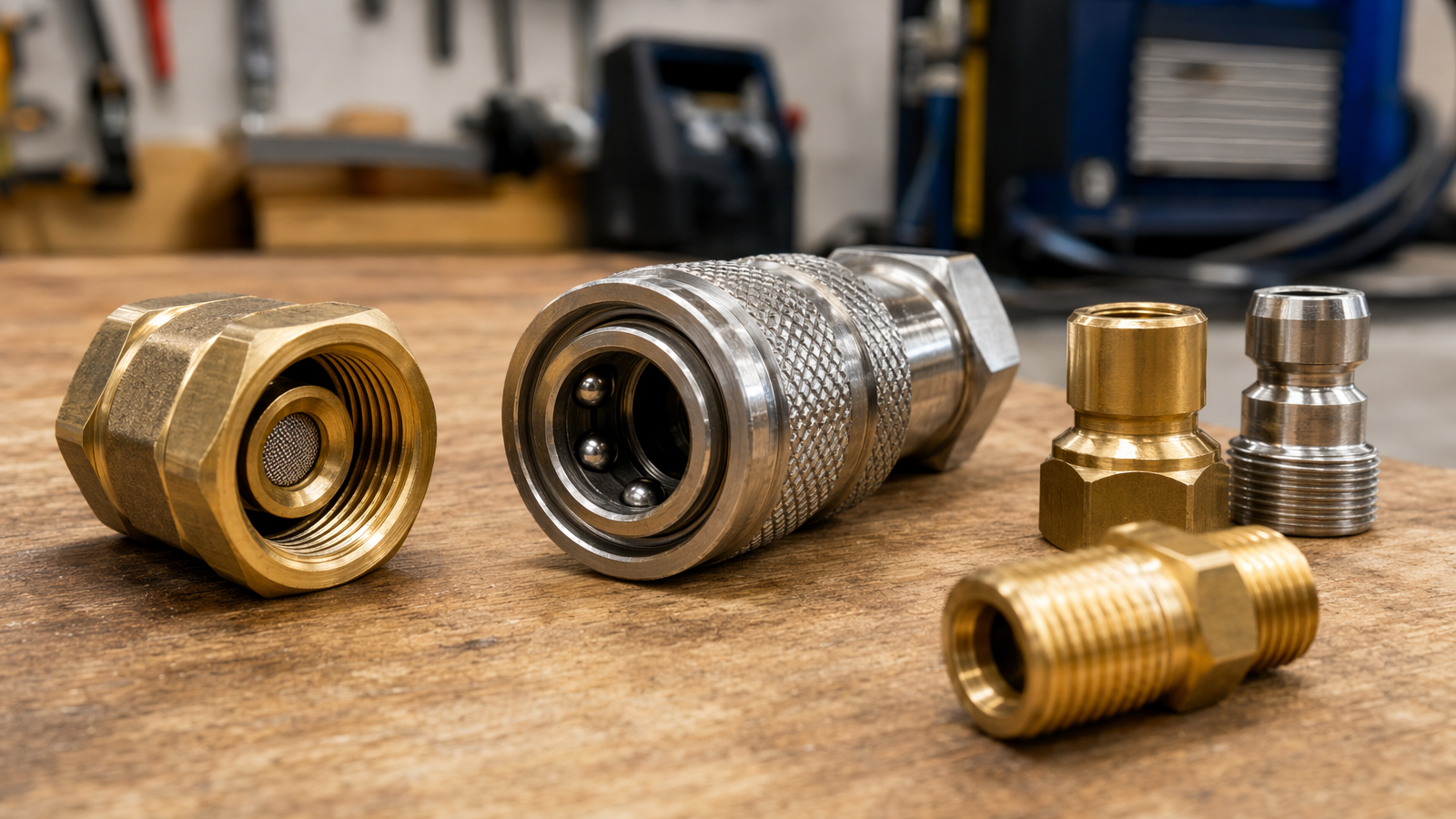
M22 is a 22mm metric threaded fitting used by most electric pressure washers (Sun Joe, Ryobi, Greenworks) and many gas models. You screw it on by hand — no tools. There's one catch: M22 comes in two internal diameters:
- M22-14mm — the common size on consumer machines and aftermarket hoses.
- M22-15mm — found on some gas machines (often Karcher).
They look nearly identical, and a 14mm hose will thread onto a 15mm port — then leak. If your connection drips no matter how tight you crank it, measure the inner post before blaming the O-ring.
Quick Connect: The Convenience Standard
Quick connect (QC) fittings snap together with a spring-loaded collar — pull back, push on, release. The common sizes are 1/4" QC (nozzle tips and lances) and 3/8" QC (hoses and pump connections on higher-end machines). If you swap nozzles often or disconnect the hose after every use, converting a threaded M22 setup to quick connect is the single best upgrade you can make. An M22-to-3/8" quick connect adapter set converts both ends of a standard hose in about two minutes, and the swivel version stops the hose from kinking as you move around the driveway.
Matching Adapter to Problem
- "My new hose doesn't fit my gun" — you likely have an M22 hose and a QC gun (or vice versa). One M22-to-QC adapter fixes it.
- "I want to swap attachments faster" — convert everything to quick connect with an adapter kit.
- "My garden hose connection leaks" — the inlet washer is worn, or the hose end is deformed. A fresh rubber washer, or upgrading to brass garden hose fittings and quick connectors on the supply side, usually solves it.
- "Everything fits but still drips" — see below. It's almost always O-rings.
O-Rings: The 50-Cent Fix for 90% of Leaks
Inside every M22 and QC fitting is a small rubber O-ring that does the actual sealing. They compress, dry out, and crack — especially if the washer lives in a garage through freezing winters. If a connection leaks under pressure, replace the O-ring before buying any new parts. A 40-pack of pressure washer O-rings costs less than a single replacement hose and covers both 1/4" and 3/8" fittings for years of maintenance.
Three Habits That Prevent Fitting Problems
- Hand-tight is right. M22 fittings seal on the O-ring, not the threads. Wrenching them down just destroys the O-ring faster.
- Relieve pressure before disconnecting. Squeeze the gun trigger after shutting off the machine. Disconnecting under pressure damages QC collars and O-rings.
- Drain before storage. Water left in fittings freezes, expands, and splits brass and plastic alike. Blow out or drain lines before winter.
A Quick Buying Checklist
Before ordering any hose, gun, or adapter, note these three things about your setup: the fitting type at the pump outlet (M22 or QC), the fitting type on your gun, and — if M22 — whether it's 14mm or 15mm. With those three facts, every listing's compatibility chart suddenly makes sense.
Get Connected
Whether you're converting to quick connect, replacing a worn coupler, or just stocking up on O-rings, you'll find adapters, hoses, and repair parts in our Pressure Washer Parts & Accessories collection.